Alphabet announced in July 2024 that it would invest another $5 billion in Waymo over several years. The commitment was intended to finance continued autonomous-driving development and expansion of Waymo’s ride service—not to launch a consumer product.
What Alphabet announced
Alphabet CFO Ruth Porat described the commitment as consistent with Waymo’s recent annual investment levels. Her stated objective was to let Waymo continue building an autonomous-driving technology company. The announcement did not provide a project-by-project budget, a profitability forecast, or a date by which Waymo would reach a particular market or financial milestone.

“Another $5 billion” means a multi-year funding commitment, not necessarily a single transfer made in July 2024. The announcement also does not establish Alphabet’s cumulative lifetime investment in Waymo.
How the commitment fits Waymo’s later financing
| Date | Financing | What was disclosed |
|---|---|---|
| July 2024 | Alphabet commitment | Another $5 billion over the next few years, intended to support autonomous-driving technology (TechCrunch, July 23, 2024). |
| October 25, 2024 | $5.6 billion round | Oversubscribed round led by Alphabet, with Andreessen Horowitz, Fidelity, Perry Creek Capital, Silver Lake, Tiger Global and T. Rowe Price participating. Waymo said the money would help add riders to Waymo One and advance the Waymo Driver (Waymo, 2024). |
| February 2, 2026 | $16 billion investment round | Valued Waymo at $126 billion post-money. Dragoneer Investment Group, DST Global and Sequoia Capital led the financing; Alphabet remained Waymo’s majority investor (Waymo, 2026). |
These figures should not be added together as Alphabet’s total contribution. The later rounds included outside investors, and the public announcements do not state how much Alphabet supplied in each round or whether amounts overlap with the earlier commitment.
#1 Best Overall
What the money is meant to support
Waymo Driver development
The stated core use is continued development of the Waymo Driver, Waymo’s autonomous-driving system. Alphabet presented the spending as ongoing technology investment rather than a one-time demonstration project.
Waymo One expansion
Waymo’s October 2024 financing announcement connected the funding to adding riders to Waymo One, its autonomous ride service. That makes the investment both a technology program and an effort to expand a commercial mobility operation.
Rank #2
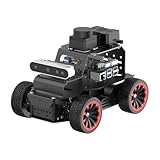
- For Raspberry Pi 5 & ROS2 Robot Car. MentorPi A1 smart AI robot car is powered by Raspberry Pi 5, compatible with ROS2, and programmed in Python, making it an ideal platform for AI robot development.
- High-Performance Hardware. Equipped with Ackerman chassis, closed-loop encoder motors, TOF lidar, depth camera, AI voice interaction box, and other advanced components to ensure optimal performance and efficiency.
- Advanced AI Capabilities. Supports SLAM mapping, path planning, multi-robot coordination, vision recognition, target tracking, and more, covering a wide range of AI applications.
- Autonomous Driving with Deep Learning. Utilizes YOLO model training to enable road sign and traffic light recognition, along with other autonomous driving features, helping users explore and develop autonomous driving technologies.
- Empowered by Large AI Model, Human-Robot Interaction Redefined. MentorPi AI robot car deploys multimodal models with ChatGPT at its core, integrating 3D vision and Al voice interaction box. This synergy enhances its perception, reasoning, and actuation capabilities, enabling advanced embodied AI applications and delivering natural, context-aware human-robot interaction.
Scaling a capital-intensive business
Porat’s reference to recurring annual investment levels signals that autonomous mobility requires sustained financing. The announcements do not break out spending for vehicles, sensors, mapping, maintenance, insurance, safety operations or market launches, so no reliable percentage can be assigned to any of those categories.
Waymo’s operating scale by June 2026
Alphabet’s June 2026 investor presentation said Waymo had launched six new markets during 2026, operated in 11 major U.S. cities and surpassed 500,000 fully autonomous rides per week. Those figures describe operating scale, not revenue, profit or a return on Alphabet’s investment.
Quick wins for a faster PC:
Scan for outdated or missing drivers - takes under a minuteDriver Scan →Repair Windows errors before they cause bigger problemsFix Now →Fix the driver behind crashes, sound loss and screen glitchesFind Drivers →Rank #3

- AUTHENTIC DESIGN: Meticulously detailed 1:38 scale die-cast metal model of the 2016 Pagani Huayra BC supercar with stunning metallic finish and precise exterior details
- INTERACTIVE FEATURES: Working doors that open and close plus pull-back motor mechanism allows the car to zoom across smooth surfaces
- PREMIUM CONSTRUCTION: Built with durable die-cast metal body, rubber tires, and detailed plastic components for lasting quality and play value
- PERFECT DISPLAY SIZE: Compact 5-inch length makes it ideal for collectors while maintaining impressive detail and proportion
- QUALITY MATERIALS: Manufactured using safe, high-grade materials suitable for ages 3 and up, combining durability with authentic styling
Safety figures and their limits
Waymo’s official blog said its analysis covered more than 270 million fully autonomous miles through the end of June 2026 and estimated that at least 841 people avoided injuries they otherwise would have sustained in traffic crashes. These are Waymo’s own reported estimates. They should not be treated as an independently audited industry ranking; comparisons depend on the underlying methodology, exposure and crash definitions.
What the investment means for Alphabet investors
- It increases financial commitment. Alphabet is continuing to fund a long-horizon business whose technology and service expansion require large, recurring investment.
- It is not a guaranteed payoff. The announcements establish funding and operating targets, not profitability, cash-flow or a timetable for recovering the investment.
- It is not a direct shareholder payout. The money is intended for Waymo’s operations and development, rather than dividends or buybacks.
- The $126 billion figure is specific to 2026. It is the post-money valuation reported for the February 2026 round, not a valuation assigned to the July 2024 commitment.
- A cumulative Alphabet total is not established. The disclosed rounds involve different investors and do not reveal Alphabet’s contribution to every financing.
International expansion adds another funding use
Waymo said in September 2026 that it was preparing European operations beginning with London and Munich. It also described an Allianz Partners collaboration covering insurance, claims and safety research. These plans broaden the potential use of future capital, but they do not change the terms of the July 2024 commitment.
Quick Recap
Best Value

- 【RaspberryPi 5 & ROS2 Platform】TurboPi robot car runs on the ROS2 operating system and leverages Python and OpenCV to deliver efficient AI processing and a wide range of robotic applications.
- 【Multimodal Large AI Model ChatGPT & OpenClaw】With an integrated multimodal large AI model and OpenClaw, TurboPi robot car kit supports smart conversations, environment awareness, and flexible task execution for richer human-machine interactions.
- 【AI Vision & Autonomous Driving】Equipped with a 2DOF HD camera, TurboPi robot car offers FPV video feedback, object and color recognition, line following, and autonomous driving features—perfect for creative AI projects.
- 【360° Omnidirectional Movement & 2-DOF Robotic Arm】Featuring a robust metal chassis and Mecanum wheels, TurboPi robot car pairs with a 2DOF robotic arm to smoothly execute complex, dynamic transporting tasks across all scenarios.
- 【Comprehensive Code & Learning Resources】 We provide full Python source code, diverse experiment examples, and detailed course materials to support your journey in mastering AI and programming while inspiring endless innovation.
Rank #4

- Designed for autonomous driving, suitable for visual model training and smart car autonomous driving scenarios.
- Supports two line patrol modes, using K210 visual module to achieve visual line patrol, and can also be used with infrared sensors to achieve infrared line patrol function. Yahboom's Tinybit Pro and Raspbot are both applicable.
- High-quality material, using PVC (polyvinyl chloride) material, UV printing process, with durability, waterproof and easy to clean characteristics. The surface is covered with a layer of frosted matte film, which can play a protective role and extend the service life of the map sandbox. 2M*1.5M, light material, easy to carry
- Gameplay display, supports small robot cars with a body width of no more than 20cm, and the list comes with traffic lights and various traffic signs. The car can realize steering, honking, traffic light recognition, and line patrol functions.
- Application of a variety of scenarios, the map can be used in school training competition projects, robot laboratories, etc., and is suitable for a variety of models, whether you are Microbit, raspberry pi, jetson master robot, or virtual machine version, can be used with this autonomous driving sandbox.
What the headline does—and does not—say
- It says Alphabet committed another $5 billion over several years.
- It does not say Alphabet wrote one $5 billion check in July 2024.
- It does not announce a new consumer vehicle or a retail product.
- It does not establish that Waymo is profitable or that autonomous driving has reached nationwide availability.
- It does not provide enough information to calculate Alphabet’s total historical investment in Waymo.
Product prices and availability are accurate as of the date/time indicated and are subject to change. Any price and availability information displayed on Amazon at the time of purchase will apply.




