The Tool Desk
Outbyte Driver Updater FREEScan for outdated or missing drivers - takes under a minuteDriver Scan →Outbyte PC Repair FREEClear out junk files and repair common Windows errorsFree Scan →For most US PC gamers, the Radeon RX 9070 is the best AMD graphics card to buy in 2026. It combines 16GB of VRAM, strong 1440p rasterized performance and a more sensible street price than the faster RX 9070 XT. Prices checked against coverage available August 16, 2026; retailer pricing, stock, taxes and board-partner models vary.
Quick answer
| GPU | Best for | VRAM | Target resolution | Price signal | Verdict |
|---|---|---|---|---|---|
| Radeon RX 9070 | Most buyers | 16GB | 1440p | About $620 tracked July 31, 2026 | Best balance |
| Radeon RX 9060 XT 16GB | Value systems | 16GB | 1080p/1440p | About $440–$459.99 in mid-2026 coverage | Best value |
| Radeon RX 9070 XT | High-refresh 1440p and stronger 4K | 16GB | 1440p/4K | $599 launch SEP; about $719.99 for one tracked model in August | Buy only at a reasonable premium |
| Radeon RX 9060 XT 8GB | Lowest-cost new Radeon | 8GB | 1080p | $299 MSRP; $369.99 tracked model | Only with a large discount |
| Radeon RX 9070 GRE | Sale purchase | Not stated in cited coverage | 1440p | About $549 | Conditional only |
Performance and recommendations reflect PC Gamer testing and price tracking (PC Gamer; price watch) plus Tom’s Hardware’s analysis (GPU guide).
Best AMD graphics card overall: Radeon RX 9070
The RX 9070 is the default recommendation when you want a new AMD card for 1440p gaming. It has 3,584 shaders, 16GB of GDDR6 at 20 GT/s, 640GB/s of bandwidth and a 220W total graphics power rating. PC Gamer’s test suite placed it ahead of Nvidia’s RTX 5070 in several rasterized 1440p results; those are suite-specific outcomes, not guaranteed frame rates in every game.
Its main advantage is pricing discipline. AMD’s launch SEP was $549, while late-July tracking put a card around $620. That is materially easier to justify than an RX 9070 XT near $720. Choose a specific board partner only after checking its dimensions, slot thickness, connectors, cooler and warranty.
What’s actually slowing this PC down?
Pick the symptom - the matching free tool is one click away.
#1 Best Overall

- System Compatibility Note: 2.5-slot card, 290x123x51mm, two 8-pin power, recommended 700W PSU. Verify chassis clearance before purchase.
- Dedicated Support: Please contact us directly through Amazon for any product questions or assistance you may require.
- AMD RDNA 4 Architecture: RX 9070 GPU with 56 CUs, 3584 stream processors, 3rd gen RT and 2nd gen AI accelerators – built for 1440p/4K gaming.
- Factory Overclocked Performance: Boost clock up to 2520 MHz, game clock 2070 MHz – delivers smooth, high-framerate gaming out of the box.
- 16GB GDDR6 on 256-Bit Bus: High-speed 20 Gbps memory provides exceptional bandwidth for 4K textures, ray tracing, and demanding workloads.
Skip the RX 9070 when
- You mainly use heavy ray tracing, CUDA applications, Blender or AI tools where Nvidia software support is stronger.
- The RX 9070 XT is only modestly more expensive and you will use its extra performance.
- Your case, power supply or legacy BIOS cannot meet RX 9000 requirements.
Best value: Radeon RX 9060 XT 16GB
The RX 9060 XT 16GB is the sensible midrange choice for high-settings 1080p and standard 1440p. Its 2,048 shaders, 16GB memory and 160W TGP allow a lower-power system than the RX 9070. PC Gamer tracked roughly $440, while Tom’s Hardware reported a mid-2026 midpoint of $459.99. If its price approaches an RX 9070, move up to the faster card.
Sixteen gigabytes provides useful texture and frame-time headroom, but this remains a midrange GPU; memory capacity does not make it a dependable 4K card.
8GB versus 16GB
The 8GB model can serve a tightly budgeted 1080p build, but it is not equivalent for demanding 1440p use. PC Gamer recorded materially different 1% lows between capacities in at least some titles, including Total War: Warhammer 3; the size of the gap depends on resolution, texture settings and whether the game exceeds available VRAM. The 8GB version was tracked at $369.99 against a $299 MSRP, so it deserves a substantial discount before purchase.
Fastest AMD option worth buying: Radeon RX 9070 XT
With 4,096 shaders and 16GB of GDDR6, the RX 9070 XT is the better AMD choice for very high-refresh 1440p and more comfortable 4K. Demanding 4K games can still require upscaling, reduced settings or frame generation.
Rank #2
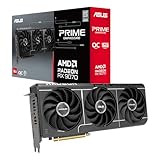
- OC mode(GPU Tweak III): up to 2610 MHz (Boost Clock)/up to 2140 MHz (Game Clock)/ Default mode: up to 2590 MHz (Boost Clock)/up to 2120MHz (Game Clock)
- Axial-tech fans now feature a smaller fan hub that facilitates longer blades and a barrier ring that increases downward air pressure
- Phase-change GPU thermal pad helps ensure optimal heat transfer, lowering GPU temperatures for enhanced performance and reliability
- 2.5-slot design allows for greater build compatibility while maintaining cooling performance
- Dual-ball fan bearings last up to twice as long as standard conventional sleeve bearings designs
AMD launched it at a $599 SEP, but PC Gamer’s August price watch listed an ASRock model at $719.99. Buy it when the premium over the RX 9070 is small enough to justify roughly 10–15% more performance in your games, or when it is close to launch-level pricing. A $100–$150 premium usually makes the non-XT the better value.
Should you buy the RX 9070 GRE?
Tom’s Hardware reported global availability after Computex 2026 and assessed the roughly $549 positioning as difficult to justify because of its performance and compromises. Treat it as a sale-only option: it should clearly outperform the RX 9060 XT 16GB and sit far enough below RX 9070 pricing to compensate for its trade-offs. Current evidence does not establish it as a default recommendation.
Choose by resolution and refresh rate
1080p
Choose the RX 9060 XT 16GB for high settings and high frame rates. A faster card is useful mainly for unusually high-refresh esports monitors or heavy ray tracing.
1440p
The RX 9070 is the safest baseline. Select the RX 9070 XT for higher refresh rates, ultrawide 1440p or more demanding ray-traced settings.
Quick wins for a faster PC:
Scan for outdated or missing drivers - takes under a minuteDriver Scan →Clear out junk files and repair common Windows errorsFree Scan →Fix the driver behind crashes, sound loss and screen glitchesFind Drivers →Rank #3

- Axial-tech fans now feature a smaller fan hub that facilitates longer blades and a barrier ring that increases downward air pressure
- Phase-change GPU thermal pad helps ensure optimal heat transfer, lowering GPU temperatures for enhanced performance and reliability
- 2.5-slot design allows for greater build compatibility while maintaining cooling performance
- Dual-ball fan bearings last up to twice as long as standard conventional sleeve bearings designs
- 0dB technology lets you enjoy light gaming in relative silence
4K
The RX 9070 XT is AMD’s more credible option, but settings compromises and upscaling remain realistic in demanding releases. The RX 9060 XT 16GB is not a 4K-first purchase.
Ray-traced gaming
RDNA 4 improves Radeon ray tracing, yet Tom’s Hardware still identifies Nvidia advantages in ray tracing, upscaling maturity, AI performance and creator software. Compare Nvidia alternatives if games such as Cyberpunk 2077, Alan Wake 2 or Black Myth: Wukong dominate your library.
Independent reader supportYour contribution helps us test, update, and keep practical guides available for everyone.AMD versus Nvidia: when the answer changes
| Priority | Better starting point | Reason |
|---|---|---|
| Rasterized gaming per dollar | AMD | RX 9070-class cards are competitive in conventional rendering. |
| Ray tracing and mature upscaling | Usually Nvidia | Broader RT and software advantages remain. |
| CUDA, AI and Blender | Usually Nvidia | Application support can outweigh Radeon memory value. |
| VRAM at this price tier | AMD | RX 9060 XT 16GB and RX 9070 models provide 16GB. |
AMD’s current software stack includes FSR upscaling, frame generation, HYPR-RX, Radeon Anti-Lag 2, Radeon Super Resolution and FreeSync. FSR 4 and newer features depend on compatible RDNA 4 hardware, supported games and the relevant AMD software; they are not universal across every Radeon generation. See AMD’s product information at amd.com.
Power, cooling and case planning
- Do not confuse GPU TGP with complete-system consumption. PC Gamer measured about 220W TGP for the RX 9070 and substantially higher system draw for its RX 9070 XT test platform.
- Check the exact board’s recommended PSU, connector count, length, height and slot thickness; factory-overclocked triple-fan cards may not fit compact cases.
- Provide front-to-back airflow and leave clearance beneath the card’s fans. Cooler design affects noise and temperatures more than the GPU name alone.
Compatibility checklist before buying
- Case: Compare the manufacturer’s exact card dimensions and occupied slots with your case clearance.
- Power: Confirm PSU wattage, PCIe connectors and cable routing for the chosen board.
- Platform: Use an available PCIe x16 slot and check CPU limits, especially at 1080p.
- Firmware: Verify UEFI boot configuration. AMD’s RX 9000 guidance is available at AMD support; legacy BIOS/CSM systems may need firmware changes.
- Display: Match outputs, resolution and refresh rate to the monitor.
- Drivers: Install current drivers from AMD’s RX 9000 download page. When replacing Nvidia or Intel hardware, a clean installation is sensible; DDU is a third-party troubleshooting utility, not an AMD product.
- Purchase protection: Check return terms, warranty length and the exact board-partner model.
Used and previous-generation Radeons
An RX 6000- or RX 7000-series card can make sense only when substantially cheaper than current RX 9000 models, has adequate VRAM, acceptable power use and a trustworthy return policy. More shaders or memory alone do not overcome an unfavorable street price, older architecture or missing warranty.
Crashes, No Sound, or Screen Glitches?
Random freezes, missing sound and display glitches usually trace back to one bad driver. Find and replace yours safely.Free scan · under a minutePC Slower Than It Used to Be?
A free scan shows the junk files, broken settings and background clutter dragging Windows down - then fixes them in one click.Free scan · Windows 10 & 11The Bottom Line
Buy the Radeon RX 9070 for the best overall AMD balance. Choose the RX 9060 XT 16GB when your budget centers on 1080p or sensible 1440p, and choose the RX 9070 XT only when its premium is modest or you genuinely need extra 1440p/4K performance. If ray tracing, CUDA, AI or creator software is your priority, compare Nvidia before committing.
Quick Recap
Product prices and availability are accurate as of the date/time indicated and are subject to change. Any price and availability information displayed on Amazon at the time of purchase will apply.




