A liability is a present obligation to pay, transfer an asset, or provide goods or services to someone else. Liabilities include more than loans: supplier bills, unpaid wages, taxes payable, and customer payments received before delivery can all qualify. On a balance sheet, liabilities are shown alongside assets and equity, helping readers understand what is owed and how resources are financed.
What Is a Liability?
In plain English, a liability is something an individual or organization owes or is obligated to do for another party. It generally arises from a past event that has already created an obligation, such as borrowing money, receiving goods on credit, or accepting a customer’s advance payment for work not yet performed. An expectation or intention to pay for something in the future does not, by itself, create a liability.


An obligation may require cash payment, delivery of another asset, provision of services, or readiness to perform. The other party might be a lender, supplier, employee, tax authority, customer, or landlord. The applicable accounting rules determine whether and how an obligation is recognized, measured, or disclosed.
Liabilities, Assets, and Equity
An asset is a resource or right controlled by an entity that can provide future economic benefits. A liability is an obligation that requires transferring or providing economic benefits to another party. For example, a supplier’s receivable may correspond to the buyer’s payable: one party has a right to receive cash, and the other has an obligation to pay it.
#1 Best Overall
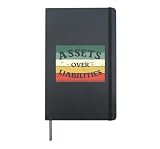
- Assets Over Liabilities For An Accountant is perfect for certified public accountants who love accounting.
- Hardcover journal with 240 line-ruled pages (120 sheets)
- Built-in elastic closure and ribbon bookmark
- Includes an expandable inner storage pocket and a pen holder
The balance-sheet equation is Assets = Liabilities + Equity. It means resources are financed by creditors’ claims, represented by liabilities, and owners’ residual claims, represented by equity. Equity is calculated as assets minus liabilities. For an individual, this relationship is commonly described as net worth: what the person owns minus what the person owes.
Types of Liabilities
| Type | What it means | Examples |
|---|---|---|
| Current | Generally expected to be settled within one year or the normal operating cycle, whichever is longer. | Accounts payable, accrued wages, taxes payable, short-term borrowing, current portions of long-term debt |
| Noncurrent or long-term | Generally not expected to be settled within the current-liability period. | Long-term loans, bonds payable, mortgages, long-term lease obligations |
| Operating | Arises from ordinary business activity rather than primarily from borrowing. | Supplier bills, utilities payable, accrued payroll, deferred customer revenue |
| Financing | Arises from obtaining funds or credit. | Bank loans, notes payable, bonds, mortgages |
| Accrued | For goods or services already received, although an invoice may not have been paid or finalized. | Wages, interest, taxes, utilities, professional fees payable |
| Deferred or unearned revenue | Cash received before the entity has delivered the promised goods or services. | Customer deposits or advance payments for future service |
Current and noncurrent presentation depends on the applicable reporting framework, contractual terms, and circumstances. A long-term liability may have a current portion: the amount due within the current period is separated from the remainder when relevant. For personal finances, common liabilities include mortgages, student loans, auto loans, credit-card balances, and unpaid bills; company reporting rules do not necessarily apply to an individual’s finances.
How Liabilities Appear on a Balance Sheet
A balance sheet is a snapshot of an entity’s financial position at a point in time, not a record of all cash flows during a period. It presents assets, liabilities, and equity. Liabilities are commonly ordered by when they are due, while assets are often ordered by liquidity. The exact presentation varies by reporting framework and entity type.
Under accrual accounting, an obligation may be recorded before cash is paid. For example, when employees have worked but have not yet been paid, the entity may record wages payable and the related wage expense. However, a liability is not recognized merely because a payment might occur: a present obligation and the applicable recognition requirements matter.
Do these 3 things before closing this tab:
1Clear out junk files and repair common Windows errors2Fix the driver behind crashes, sound loss and screen glitches3Repair Windows errors before they cause bigger problemsSome obligations have uncertainty about timing or amount, including warranties, guarantees, environmental remediation, and litigation-related matters. The conceptual definition helps identify an obligation, but the relevant accounting standard determines whether it is recognized, how it is measured, or whether it is disclosed. FASB notes that its conceptual framework guides standard-setting and does not itself replace existing GAAP requirements.
Liabilities Are Not the Same as Expenses or Debt
An expense is a cost recognized in measuring performance over a reporting period; a liability is an obligation reported in the statement of financial position. They can arise together, as when work performed by employees creates both wage expense and wages payable. Paying an existing payable reduces cash and the liability, but does not necessarily create a new expense at the payment date. Depreciation expense, by contrast, reduces income and an asset’s carrying amount without creating a new payable to an outside party.
Rank #3
Debt usually refers to borrowed money or formal financing arrangements. Liabilities are broader: accounts payable, accrued wages, taxes payable, deferred revenue, and obligations to provide services can all be liabilities even when no money was borrowed. So a liability is not always a loan.
Why Liabilities Matter
Liabilities help readers assess liquidity, solvency, financial risk, and the claims that rank ahead of owners’ residual interest. Comparing current assets with current liabilities provides a basic indication of short-term liquidity; working capital is current assets minus current liabilities. Measures such as the current ratio, quick ratio, debt-to-assets ratio, debt-to-equity ratio, and interest-coverage measures can offer additional perspective.
The Tool Desk
Outbyte Driver Updater FREEFix the driver behind crashes, sound loss and screen glitchesFind Drivers →Outbyte PC Repair FREEClear out junk files and repair common Windows errorsFree Scan →Ratios should be interpreted together and in context, including industry, accounting policies, maturity dates, disclosures, and asset quality. High liabilities are not automatically bad: borrowing may finance productive assets, expansion, or working capital. Conversely, even modest liabilities may be difficult to manage if resources are illiquid or cash flows are weak.
Rank #4
A Simple Balance-Sheet Example
Suppose a business has $100,000 in assets, owes suppliers and lenders $40,000, and has $60,000 in equity. The equation balances: $100,000 = $40,000 + $60,000. If it buys $10,000 of inventory on credit, assets and liabilities each rise by $10,000 at the purchase date, while equity does not change. The purchase creates an obligation and an asset; it is not automatically a loss.
Independent reader supportYour contribution helps us test, update, and keep practical guides available for everyone.FAQ
Is a liability always a loan?
No. Loans are liabilities, but so are supplier payables, unpaid wages, taxes payable, customer deposits for undelivered goods or services, and other obligations.
Is an expense the same as a liability?
No. An expense measures a cost during a period, while a liability is an obligation at a point in time. An unpaid expense can create a liability, but the terms are not interchangeable.
Best Value

- Ideal Accountant Gifts : Crafted with a high - quality leather cover, our notebook exudes an air of sophistication and durability. Each set comes complete with an accountant - themed notebook, a sleek metal ballpoint pen, a heartfelt greeting card, all neatly packaged in an elegant gift box. This all - inclusive set makes it the perfect and ready - to - go present for any occasion, whether it's a casual get - together or a special event
- Thoughtful Accounting Gifts : The cover of our notebook is embossed with accountant - themed text, adding a unique and meaningful touch that resonates with accounting professionals. It's not just a notebook but a symbol of recognition for their expertise and dedication
- Portable A6 Size for Versatile Use : Designed in a compact A6 size, approximately 7.9x4.7 inches, our notebook is highly portable. With 70 sheets (140 pages), it offers ample space for all your note - taking needs, whether you're at the office, in a meeting, or on the go. Its small size fits easily into bags, purses, or briefcases, making it convenient to carry around
- Dual - Purpose Interior with Extra Features : Inside, this notebook boasts a versatile design. Half of the pages are blank, providing a free space for creative ideas, sketches, or quick notes. The other half are lined pages, ideal for structured note - taking, jotting down important information, or keeping track of tasks. Additionally, it includes card slots and a zippered pocket, offering practical storage space for cash, credit cards, business cards, or even a smartphone. This all - in - one organizer ensures you're always prepared and organized in any situation
- Perfect for Various Gifting Occasions : This leather notebook set is a special gift for accountant friends, family members, and colleagues. It serves as a meaningful and practical present for graduations, retirements, birthdays, Valentine's Day, Christmas, and many other occasions. It's a gift that combines functionality with a personal touch, sure to be appreciated by any accounting professional
Is advance payment from a customer revenue?
Not necessarily. If the entity still owes the customer goods or services, the payment is generally recorded as a liability until the promised performance is provided, subject to applicable accounting rules.
Does every expected future payment count as a liability?
No. An expectation or intention to transact does not itself create a liability. A present obligation must exist, and recognition depends on the applicable accounting requirements.
Do more liabilities always mean worse financial health?
No. Their effect depends on purpose, cost, maturity, liquidity, and the cash flows or assets supporting them. Consider these factors together rather than judging by the total alone.
Quick Recap
Product prices and availability are accurate as of the date/time indicated and are subject to change. Any price and availability information displayed on Amazon at the time of purchase will apply.
Free tools Windows power users keep installed
One-click scans. No signup required.




