
You can increase your refund only by claiming tax benefits you qualify for or by having more tax withheld during the year. The first can reduce your tax bill; the second usually means you get less take-home pay and receive some of that money back later. For a 2025 federal return filed in 2026, these six steps can help you find eligible benefits without treating a larger refund as free money.
1. Check refundable credits—even if you may not have to file
A refund can include federal tax withheld from your pay or estimated payments you made, as well as refundable credits you qualify for. The Earned Income Tax Credit (EITC) and Child Tax Credit (CTC) may make filing worthwhile even when your income is below the usual filing threshold. Whether you qualify, and for how much, depends on details such as income, filing status, and qualifying children.
As an Amazon Associate I earn from qualifying purchases.
For the 2025 return, the IRS says the CTC may be up to $2,200 per qualifying child; that is a maximum credit, not a promised refund. Use the IRS EITC Assistant and the current Form 1040 instructions to check the rules. The IRS also identifies withheld federal tax, estimated payments, and refundable-credit eligibility as reasons to file even if filing is not otherwise required (IRS Tax Tip 2026-24).
What’s actually slowing this PC down?
Pick the symptom - the matching free tool is one click away.
2. Review deductions that apply to the return’s tax year
For 2025 federal returns filed in 2026, IRS guidance describes new or changed provisions under the 2025 law, including potential deductions for some seniors, qualified tips, and qualified overtime. The IRS describes maximums of up to $6,000 for a potentially eligible senior, up to $25,000 for qualified tips, and up to $12,500 for qualified overtime—or $25,000 for joint filers. These are maximum deduction amounts, not refund increases or dollar-for-dollar tax savings. Eligibility, limits, and other requirements apply; check the IRS’s 2025 tax-law guidance and current return instructions before claiming a deduction.
#1 Best Overall

- Yearly Tax Organizer: includes 2 spiral bound tax organizer designed to help you collect, sort, and store important tax records throughout the year, keeping receipts, income records, bills, and other paperwork in one easy to manage place
- Large Size for Everyday Documents: cover measures about 13 x 9.65 inches, with inside pages about 9.65 x 6.5 inches; The spacious pocket design provides room for receipts, statements, records, and tax-related papers without taking up too much desk or shelf space
- 12 Monthly Pockets for Easy Sorting: the tax record organizer features 12 pockets, making it simple to separate documents by month or category; Useful for organizing medical expenses, charitable donations, prescriptions, invoices, income folders, and monthly bill receipts
- Spiral Bound for Convenient Access: the secure spiral binding lets pages turn smoothly, so you can quickly add, remove, or review documents whenever needed; A practical design that helps simplify filing and reduce last-minute stress during tax season
- Widely Applied: this annual tax organizer is suitable for managing annual taxes, tracking receipts and preparing for audits all year round, making your tax preparation more systematic and manageable, and it is very suitable for annual tax returns, document storage and filing, professional tax services and tax agencies
3. Confirm your filing status and household details
Filing status affects tax calculations, deductions, credits, and filing requirements. Marriage, divorce, a birth, or a death may affect which status is legally correct or whether you qualify for a benefit. Choose the status supported by your circumstances, not the one that appears to produce the largest refund. The IRS explains the available statuses and their rules in its filing-status guidance.
4. Gather records and report all income
Complete records make it easier to prepare an accurate return and spot benefits you may qualify for. Collect identity details, income forms, prior-year information, and bank details if you plan to use direct deposit. Keep documents organized in an electronic system or clearly labeled paper folders, as the IRS recommends in its recordkeeping guidance. Report income accurately; omitting income or claiming unsupported expenses can lead to errors, delays, or other problems. The IRS’s filing preparation tips provide a checklist of information to assemble.
Rank #2
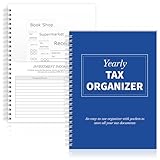
- Yearly Tax Organizer: includes 1 spiral bound tax organizer designed to help you collect, sort, and store important tax records throughout the year, keeping receipts, income records, bills, and other paperwork in one easy to manage place
- Spiral Binding: with spiral security binding, you can sort and access your monthly tax documents all year round; Help simplify tax time
- Durable: our tax document organizer is made of paper, which is very durable and convenient for you to use frequently in your daily work
- Large Capacity: this tax document organizer has 12 pockets, which makes it convenient for you to sort and file receipts and records and store them in a centralized manner; With this document organizer, you can organize various documents such as medical expenses, prescription drugs, charitable donations, etc. throughout the year, and face tax season confidently and efficiently
- Widely Applied: this annual tax organizer is suitable for managing annual taxes, tracking receipts and preparing for audits all year round, making your tax preparation more systematic and manageable, and it is very suitable for annual tax returns, document storage and filing, professional tax services and tax agencies
5. Adjust withholding for the next tax year—not just for a bigger refund
Withholding is money sent to the IRS from your pay during the year. If you withhold more than your final tax liability, the excess generally comes back as part of your refund; it does not itself lower the tax you owe. The IRS puts the goal plainly: “You should try to have your withholding match your actual tax liability.” Use the Tax Withholding Estimator to review your situation and, if appropriate, submit an updated Form W-4 to your employer.
Recheck withholding after a large refund, a substantial balance due, a major life or financial change, or a change in tax law. IRS Publication 505 covers withholding and estimated-tax adjustments. A larger refund created solely by extra withholding trades lower take-home pay during the year for a larger payment back later.
Rank #3

- Great way to organize and store vital tax records
- Instruction sheet/checklist and preprinted labels included
- 12 pockets plus one large pocket in back provides ample storage
- Protective flap and elastic cord closure
- Contains 10% recycled content, 10% post-consumer material
6. File accurately and choose a safe way to get help or your refund
Choose DIY or paid preparation based on the return’s complexity
If your income, credits, or household situation is complex, compare the work you can document yourself with the total cost and service offered by a paid preparer. Ask about fees, e-file availability, and whether the preparer will be available after filing. Avoid fees calculated as a percentage of your refund and be wary of unusually large refund promises. The IRS warns: “Not signing a return, promising an unusually large refund or charging fees based on the size of the refund are red flags that the preparer may be looking to make a quick profit.” See the IRS’s tips for choosing a tax professional. You remain responsible for the information on your return.
Use direct deposit for delivery, not as a refund booster
The IRS says most refunds for complete, accurate e-filed returns with direct deposit are issued in fewer than 21 days, but that is a typical timeframe, not a guarantee. E-filing and direct deposit can affect how quickly you receive an eligible refund, not how large it is. The IRS is also phasing out paper refund checks; review its refund-payment guidance for current options.
Quick Recap
Rank #4

- All-In-One Monthly Organizer: Keep all your important documents in one place with Sooez Accordion File Organizer. 13 pockets design works great for Monthly organizing and protecting all your important paperwork, bills, taxes, receipts, invoices and more. Perfect for letter size.
- Expandable Capacity: The accordion file folder can be stretched up to 12 inches. 13 pockets allow you to store more than 2000 sheets. No matter how many documents you need to store, this folder can accommodate your needs as it can be easily expanded according to your requirements.
- Efficient Organization & Easy Lookup: To enhance your file organization, we provide blank labels along with this folder. You can personalize them to suit your requirements, such as labeling sections by month for effortless file retrieval.
- Stable & Portable: Stand on its own on the desk and not easy to tip over. Designed with portability in mind, allowing you to effortlessly move it between your desk, cabinet, and any other preferred locations.
- Maximum Protection and Durability: Well made, made from durable wipe-clean polypropylene. Waterproof & sturdy. Tear-resistant plastic provides durable structure. Acid-free, PVC-free, and archival quality for safe storage. Adjustable snap closure helps keep contents secure. Use 2 additional front pockets for business cards, project title cards or notes.
Product prices and availability are accurate as of the date/time indicated and are subject to change. Any price and availability information displayed on Amazon at the time of purchase will apply.




