
Free tools Windows power users keep installed
One-click scans. No signup required.
For one room, a window air conditioner is usually the cheaper and simpler choice. For several rooms, a ductless mini-split is generally the better long-term option when you own the home, can pay for professional installation, and want quieter, steadier cooling—or heating from the same system.
The right answer depends on how many rooms you need to condition, how long the equipment will run, local electricity prices, climate, noise tolerance, window access, and whether you can make a permanent installation. A mini-split is not automatically more economical in every home, and a window unit is not automatically inefficient.
As an Amazon Associate I earn from qualifying purchases.
What “split AC” and “window AC” mean
A conventional window air conditioner is a room air conditioner fitted into a window or a purpose-built through-wall opening. Its cooling components are in one cabinet, with the condenser side rejecting heat outdoors and the evaporator side cooling indoor air. It normally serves one room or a small adjoining zone.
In this comparison, “split AC” means a ductless mini-split, not necessarily a ducted central-air replacement. A mini-split separates the indoor air handler from the outdoor condenser. Refrigerant lines, wiring, and a condensate drain pass through a small wall penetration. One indoor unit can serve one zone, while a multi-zone system connects several indoor units to one outdoor unit.
#1 Best Overall
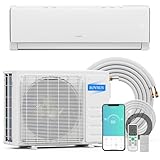
- 【All-Season Integrated Mini Split】: Our mini split air conditioner and heating system is an all-season solution, featuring air conditioning, robust heat pump, dehumidifie and fan function. It includes automatic defrosting, self-diagnosis, 24-hour timer, wind swing, sleep mode, ECO mode, and more
- 【Energy-Saving Cooling & Heating】: This split air conditioner is equipped with high-power compressor, heat pump & innovative inverter technology. Its 17 SEER2 grade ensures optimal performance in every season with 25% energy-savings rather than others' 14 SEER2 ac unit. It is also ETL and AHRI certified, guaranteeing the reliability of electricity bill savings (functioning in temperatures 5°F-122°F)
- 【WIFI-Enabled & Voice Control】: Apart from the remote control, it can seamlessly integrate with a mobile APP or voice control (compatible with Alexa/Google Assistant). Set routines for optimal temperature changes, allowing you to adjust your mini split air conditioner from anywhere so you can enjoy endless comfort as soon as you arrive home
- 【Ultra-Quiet Operation】: This air conditioner operates ultra-silently at only 29 dBa at low speed. The smart 24-hour timer and low-noise operation ensure a sweet night of sleep. More importantly, the display screen on the indoor unit can be turned off when not needed, so it won't disturb your sleep
- 【100% Satisfaction】: We are confident to stand behind our product and would like to guarantee you a best shopping experience upright position for 24 hours. Extra professional installation is required. Perfect for Home, Storage, Office, Business or Light Commercial Use. We are confident to stand behind our product and would like to guarantee you a best shopping experience
The U.S. Department of Energy treats ducted split systems as a central-air category and rates them with SEER2 and EER2. Room air conditioners have a separate category and use room-unit metrics such as CEER and EER. Those ratings come from different test methods; comparing a mini-split’s SEER2 directly with a window unit’s CEER does not produce an apples-to-apples result.
Quick comparison
| Factor | Window AC | Ductless mini-split |
|---|---|---|
| Typical coverage | One room or zone | One zone or multiple zones, depending on configuration |
| Indicative equipment cost | $200–$700 for basic units; modern units commonly $350–$700, according to EnergySage’s 2026 marketplace ranges | $2,000–$10,000 per room or zone in EnergySage’s 2026 indicative range; a local installed quote can differ substantially |
| Installation | Seasonal window or through-wall installation; comparatively simple but awkward and safety-sensitive | Permanent installation requiring refrigerant, electrical, mounting, drainage, and commissioning work by a qualified professional |
| Windows | Occupies a window during operation; some designs preserve more access | Leaves windows usable but requires an exterior wall penetration and permanent equipment |
| Noise | Usually louder because the compressor is in or beside the room; variable-speed, U-shaped, and saddle-style designs can reduce noise | Indoor units are described by EnergySage as almost always very quiet because the compressor is outdoors |
| Heating | Cooling-only models do not heat; a heat-pump room unit is a separate product choice | Many ductless systems are heat pumps that provide both cooling and heating |
| Efficiency label | CEER/EER and ENERGY STAR room-AC criteria | SEER2/EER2-style ratings used for split systems; evaluate the model’s own certification and performance data |
| Best fit | Renters, one-room needs, low initial spending, seasonal or reversible use | Owners seeking multiple zones, quiet comfort, no ductwork, and possible year-round heating |
When a window AC is the better financial decision
You need only one room cooled
A window unit avoids paying for capacity and installation in rooms that do not need conditioning. If the bedroom, home office, or living room is the only problem area, a correctly sized room unit can meet that need without a whole-home project.
You rent or cannot alter the building
Most mini-splits require an outdoor condenser, an indoor wall-mounted unit, a refrigerant line set, electrical work, and a wall penetration. A landlord, condominium association, or historic-building authority may not permit those changes. A window unit is usually easier to remove when you move, although you still need permission where leases or building rules require it.
Quick wins for a faster PC:
Scan for outdated or missing drivers - takes under a minuteDriver Scan →Clear out junk files and repair common Windows errorsFree Scan →Your priority is the smallest upfront bill
EnergySage’s 2026 indicative figures place basic window units around $200–$700 per room or zone, with modern units commonly around $350–$700. Those are marketplace ranges, not guaranteed installed prices. Brackets, a through-wall sleeve, electrical upgrades, delivery, or professional installation can raise the actual total.
You use cooling seasonally
A removable unit can make sense when you cool only a short season, occupy the home intermittently, or expect to move soon. Store it clean and dry when it is not in use, and follow the manufacturer’s instructions for removal and storage.
When a ductless mini-split is worth the higher cost
You need several rooms or zones
One mini-split indoor unit serves one zone; a multi-zone design can serve several rooms. This lets you condition occupied rooms instead of cooling an entire home uniformly. The number and placement of indoor units, outdoor-unit capacity, line-set length, and control strategy must be designed together.
Your home has no usable ductwork
A ductless system avoids installing supply and return ducts in an older home, addition, garage conversion, or outbuilding. If you already have sound, accessible ductwork, compare a ducted central system separately; ductless is not automatically the best retrofit.
The Tool Desk
Outbyte Driver Updater FREEFix the driver behind crashes, sound loss and screen glitchesFind Drivers →Outbyte PC Repair FREEClear out junk files and repair common Windows errorsFree Scan →Rank #2

- All-in-One Comfort Control: This mini split AC/heating system provides cooling, heating, dehumidifying, and fan modes with 61°F–90°F settings, plus a 24-hour timer and sleep mode for everyday comfort
- Energy-Efficient Performance: Featuring an advanced invert heat pump with a SEER2 18 rating, this system delivers strong airflow while cutting energy usage and electricity costs without reducing comfort
- Stable & Reliable Year-Round Use: This 12,000 BTU ductless mini split AC/heating operates in extreme conditions (5°F to 122°F) and efficiently covers spaces up to 750 sq. ft. for all-season comfort
- Quiet Operation & Easy Control: This split AC unit runs quietly below 29dB to create a peaceful environment at home or work, with simple, intuitive controls for effortless daily operation
- Self-Cleaning & Warranty Protection: This Air Conditioner offers self-cleaning function, easily removable filters and air blades for convenient cleaning, plus a 5-year compressor and 7-year parts warranty
You value quiet, steady comfort
With the compressor outdoors, a mini-split generally produces less indoor mechanical noise than a conventional window unit. Variable-capacity operation can maintain a steadier indoor temperature rather than repeatedly switching between full output and off. The exact sound level and control behavior depend on the selected model and installation.
You want heating as well as cooling
Many ductless mini-splits are heat pumps. ENERGY STAR describes ductless heat pumps as alternatives to window cooling units and to radiator or baseboard heating, allowing one system to provide year-round conditioning. Confirm that the model is a heat pump and that its low-temperature performance suits your climate; a cooling-only mini-split will not provide this benefit.
You own the property and expect to stay
A permanent installation has more opportunity to pay back over years of use, particularly when it replaces several window units or another form of electric heating. The financial case is weaker if you may sell or move before using the system long enough to offset its installation cost.
Upfront cost: what the published ranges do—and do not—tell you
EnergySage reports indicative 2026 ranges of $200–$700 for basic window units, $350–$700 for modern window units, and $2,000–$10,000 per room or zone for ductless mini-splits. Whole-home examples can be much higher and vary with design and incentives. Treat these as broad marketplace figures, not quotes.
A window-unit budget may include the appliance and basic mounting materials, but the total can change if the window needs reinforcement, an unusual opening requires a sleeve, the electrical circuit is inadequate, or a professional installer is hired. A mini-split quote may include equipment, line sets, wall brackets, electrical work, condensate management, labor, evacuation and refrigerant charging, controls, permits, and commissioning. Ask for those items in writing so two quotes cover the same work.
Do not compare the price of a bare mini-split kit with the price of a window unit that is ready to plug in. Refrigerant-system installation should be performed by a qualified professional, and a low bid that omits electrical or drainage work can become an expensive correction later.
Which one costs less to run?
There is no universal percentage by which every mini-split is cheaper. Annual cost depends on the equipment’s tested efficiency, capacity and sizing, climate, indoor temperature, hours of operation, electricity rate, maintenance, and whether the system is conditioning one room or several.
Rank #3

- 【12,000 BTU High-Efficiency Cooling & Heating】-The mini split ac/heating system delivers 12,000 BTU cooling and 12,000 BTU heating, covering up to 750 sq. ft. Advanced inverter technology maintains stable temperature (62°F–89°F) while cutting energy use by up to 30%. AHRI & ETL certified for proven performance and safety.
- 【6 in-1 All-Season Comfort】-The split ac unit offers 6 modes — Cool, Heat, Dry, Fan, Sleep, ECO — with intelligent ECO function that optimizes energy use year-round. IFEEL mode senses temperature at the remote for precise, room-specific comfort.
- 【Customizable Airflow & Wide Coverage】-The split system air conditioners with 5 fan speeds (Turbo, High, Med, Low, Mute) let you tailor airflow intensity. Keeps consistent comfort whether you’re working, sleeping, or entertaining, with reliable coverage throughout the room.
- 【Energy-Efficient & Fresh Air Quality】-The mini split air conditioner achieves 19 SEER2 and HSPF2 9.1 efficiency ratings. Self-cleaning evaporator (57 °C high-temp clean) and washable filter keep air fresh, while auto-defrost ensures steady performance with minimal maintenance.
- 【Sleep-Friendly & Thoughtful Design】-The wall-mounted split ac units operates as quietly as 30 dB, ideal for bedrooms, living rooms, offices, and other personal and commercial spaces. Sleep Mode gradually adjusts temperature for all-night comfort, while Silent Mode mutes remote control beeps. Includes 24-hour timer and is equipped with up to 10 ft connect pipe. Professional HVAC installation required for optimal performance and safety.
Calculate electricity cost as:
annual energy use in kWh × your electricity price per kWh = annual electricity cost
Use the rating and estimated annual consumption for the product category you are buying. A room AC’s CEER or EER is not interchangeable with a split system’s SEER2 or EER2. Your utility bill may also include fixed charges, taxes, and time-of-use rates, so the equipment portion is an estimate rather than a promise of total bill savings.
The DOE room-AC example
In 2024 guidance, the U.S. Department of Energy gave an example using a nine-year life: an ENERGY STAR room air conditioner used 612 kWh per year, compared with 826 kWh per year for a less-efficient model. Under those specific assumptions, the difference is 214 kWh annually. Multiply that difference by your electricity rate to estimate the corresponding energy-cost gap; actual use can be higher or lower.
The example compares two room air conditioners under DOE assumptions. It does not establish that every mini-split uses less electricity than every window unit. A small, properly sized mini-split serving one room may operate efficiently, while an oversized system, poor installation, or a multi-room system running for long hours can change the result.
Why sizing and installation matter
The Department of Energy warns that oversizing, improper refrigerant charging, and leaky ducts cause efficiency losses, discomfort, and shortened equipment life. Although a ductless mini-split has no distribution ducts inside the home, it still requires correct capacity selection, line-set installation, drainage, electrical work, and commissioning. A window unit also loses performance when it is installed with gaps around the cabinet, blocked airflow, or an unsuitable circuit.
What’s actually slowing this PC down?
Pick the symptom - the matching free tool is one click away.
Efficiency labels and ENERGY STAR considerations
Read the label for the equipment category
- For room air conditioners, look for CEER or EER and the estimated annual kWh shown for that model.
- For split systems, use the system’s SEER2 and EER2 information and verify that the indoor and outdoor components are matched as required.
- Compare models within the same category and capacity rather than ranking a CEER number against a SEER2 number.
ENERGY STAR’s room-AC criteria include CEER thresholds that vary by capacity. Product listings may also identify variable-speed compressors and connected controls. A variable-speed room AC can reduce energy use and noise compared with basic cycling designs, but the product’s own rating and installation still matter.
Federal credit information requires a date check
The ENERGY STAR federal tax-credit page cited for this comparison said qualifying split central air conditioners installed from January 1, 2025 through December 31, 2025 needed SEER2 of at least 17.0 and EER2 of at least 12.0, with a 30% credit capped at $600. A reader making a purchase in 2026 should verify whether Congress or the responsible agencies extended or changed those rules before counting an incentive in the budget. Eligibility can also depend on the equipment type, installation date, location, and required documentation.
Rank #4

- Alexa Enabled Mini Split AC/Heating System: Integrate with voice control or app, allowing you to adjust your mini split air conditioner from anywhere. Set routines for temperature changes.
- Versatile 4-in-1 Mini Split: All-season solution with air conditioning, heat pump (functional up to 5F/-15C), dehumidifier, fan, and turbo function. Includes a DC Inverter that's UL Listed, AHRI Certified, and works with Alexa.
- Stylish & Functional Mini Split AC: Suitable for both home and business. Provides performance without compromising aesthetics. Ideal for bedrooms, living areas, stores, eateries, and warehouses.
- Installation Package Included: Includes indoor air handler, outdoor condenser, remote control, and installation kit with a 16ft. line set and communication wire. Pre-loaded with refrigerant for up to 25 ft. Note: Professional installation required.
- 5 Year Manufacturer's Warranty: Includes 5 years on parts replacement and 5 years on the compressor. Senville offers complimentary technical assistance. Labor not included.
Comfort, noise, and window access
Noise
Basic window units place the compressor close to the room, so vibration and compressor cycling can be noticeable. ENERGY STAR notes that variable-speed room-AC compressors can reduce both energy use and noise. U-shaped and saddle-style window designs position more of the compressor outside and can preserve more window access while reducing indoor sound.
Mini-split indoor units are generally quieter because the compressor is outdoors. Indoor fan speed, mounting, wall resonance, and outdoor-unit placement still affect what you hear. Ask the installer for the model’s indoor and outdoor sound ratings and for a mounting plan that avoids transmitting vibration into a bedroom wall.
Do these 3 things before closing this tab:
1Scan for outdated or missing drivers - takes under a minute2Clear out junk files and repair common Windows errors3Fix the driver behind crashes, sound loss and screen glitchesTemperature control
A window unit typically measures temperature near its cabinet. A mini-split’s sensor is in the indoor head or remote control, depending on the model and settings. Neither arrangement guarantees uniform temperatures in every corner of a room; sun exposure, insulation, open doors, and airflow paths matter.
Window use and security
A conventional window unit occupies part of the opening during the cooling season and must be sealed and supported. A mini-split leaves the window available for daylight, ventilation, and emergency egress, but the outdoor condenser and wall penetration are permanent. Verify that any window installation preserves required egress and can be secured against weather and intrusion.
Installation: seasonal appliance versus permanent HVAC work
Installing a window unit safely
- Confirm that the window opening, sash, sill, and frame can support the unit and that the manufacturer permits the installation orientation.
- Check the electrical requirements. Do not use an undersized circuit, damaged cord, or inappropriate extension cord.
- Install the supplied brackets, panels, seals, and weather barriers exactly as directed. ENERGY STAR says an improperly installed room AC can leak as much air as a 6-square-inch hole, increasing energy costs and reducing comfort.
- Keep the outdoor coil clear and ensure condensate can drain as the instructions specify.
- Test cooling, drainage, and stability before leaving the unit unattended. Remove or secure it when the season ends according to the manufacturer’s guidance.
Planning a mini-split installation
- Have a qualified contractor assess the rooms, insulation, solar exposure, electrical service, outdoor-unit location, line-set route, and condensate path.
- Request a load-based capacity recommendation rather than choosing the largest available unit. Oversizing can reduce comfort and efficiency.
- Confirm whether the design is single-zone or multi-zone, which rooms each indoor unit serves, and how each zone is controlled.
- Review the written scope: equipment match, mounting, refrigerant lines, electrical disconnect, condensate drainage or pump, wall sealing, permits, startup, and commissioning.
- Ask the contractor to document refrigerant charging, operating checks, warranty registration, filter access, and maintenance requirements.
A mini-split should not be treated as a simple do-it-yourself appliance. Refrigerant handling, electrical connections, evacuation, leak testing, and commissioning require appropriate qualifications and equipment.
Maintenance and expected upkeep
Window AC maintenance
- Clean or replace the filter at the interval specified for the model, more often in dusty or high-use conditions.
- Keep the indoor intake and outdoor coil free of lint, leaves, and other obstructions.
- Inspect the cabinet seals and support hardware for gaps, corrosion, or movement.
- Before seasonal storage, clean and dry the unit as directed rather than sealing a damp appliance.
Mini-split maintenance
- Clean indoor filters regularly and keep the indoor coil and discharge area unobstructed.
- Inspect the outdoor coil, fan clearance, line-set insulation, and condensate drain.
- Arrange professional service at the interval recommended for the specific system, especially when performance, drainage, or refrigerant symptoms appear.
- Follow the manufacturer’s service instructions and keep records of maintenance and repairs.
ENERGY STAR recommends regular mini-split maintenance and use of a qualified installer. Neither system should be allowed to run with blocked airflow, persistent water leakage, unusual vibration, or a damaged electrical connection.
Decision guide by household situation
| Your situation | Usually the better starting point | Why |
|---|---|---|
| One bedroom or office; limited budget | Window AC | Lowest initial cost and direct room-by-room cooling |
| Several rooms; no ducts | Multi-zone mini-split | One designed system can serve multiple zones without installing ducts |
| Renter or short expected stay | Window AC | Seasonal and removable, subject to lease and building rules |
| Homeowner seeking quiet operation | Mini-split | Compressor is outdoors and indoor units are generally quieter |
| Homeowner needing cooling and heating | Heat-pump mini-split | One system may provide both functions; confirm climate suitability |
| Existing usable central ducts | Compare ducted central options separately | Ductless installation is not automatically the best retrofit |
| Window cannot be occupied | Mini-split, if permitted | Preserves the window but requires permanent wall and outdoor equipment |
A practical way to make the choice
- Count the zones. If the need is genuinely one room, price a properly sized window unit first. If several rooms need independent control, obtain a mini-split design.
- Separate equipment cost from installed cost. Include brackets, electrical work, drainage, permits, labor, and removal or storage in the comparison.
- Estimate annual use. Record likely cooling hours, the product’s category-appropriate kWh estimate or efficiency rating, and your utility rate.
- Check ownership and permissions. Confirm landlord, condominium, historic-district, electrical, and egress requirements before buying.
- Value heating separately. If a mini-split replaces electric resistance, radiator, or baseboard heat, evaluate that year-round use rather than comparing cooling bills alone.
- Get a load-based design. Oversizing and poor installation can erase expected savings in either a central-style or ductless system.
- Choose the least complex system that meets the need. Paying for multiple indoor units when one room is the only priority is unnecessary; relying on one window unit to cool a whole home is usually unrealistic.
Bottom line
Choose a window AC when you need inexpensive, focused cooling, especially in one room, a rental, or a home where permanent work is not practical. Choose a professionally installed ductless mini-split when you own the property, need multiple zones, lack ducts, prioritize quiet and steady comfort, or want heat from the same equipment. Compare category-specific efficiency ratings, realistic installed prices, and your actual hours of use instead of assuming that one technology is always cheaper to run.
Quick Recap
Product prices and availability are accurate as of the date/time indicated and are subject to change. Any price and availability information displayed on Amazon at the time of purchase will apply.




