
Do these 3 things before closing this tab:
1Scan for outdated or missing drivers - takes under a minute2Clear out junk files and repair common Windows errors3Fix the driver behind crashes, sound loss and screen glitchesThe most reliable way to find where your paycheck goes is to reconcile every source of spending—checking accounts, credit cards, cash, recurring bills, irregular costs, and savings contributions—against monthly take-home pay. Track first without trying to “fix” the numbers. Once the record is complete, patterns become visible and you can choose one realistic adjustment.
What a complete spending picture includes
A bank statement is only part of your spending record. A useful monthly picture includes:

As an Amazon Associate I earn from qualifying purchases.
- Deposits that make up your take-home income.
- Checking-account payments, transfers used for purchases, and automatic bill payments.
- Credit-card transactions, including charges that have not yet been paid from checking.
- Cash purchases and tips that never appear in an account history.
- Recurring subscriptions, insurance, debt payments, and other scheduled charges.
- Less-frequent costs such as medical care, school expenses, gifts, travel, seasonal needs, and annual premiums.
- Contributions to an emergency fund or another savings goal.
Include savings contributions because they are money assigned to a purpose rather than money available for everyday spending. Also distinguish transfers between your own accounts from actual expenses so you do not count the same dollars twice.
What’s actually slowing this PC down?
Pick the symptom - the matching free tool is one click away.
Choose a tracking period that you can finish
For active tracking, one calendar month is a useful minimum because it captures income and expenses together. The Consumer Financial Protection Bureau (CFPB) also notes that two weeks or another shorter period can be a manageable starting point. If you want to identify less-frequent charges, review several months of statements; a single month can miss an annual insurance payment or a seasonal bill.
#1 Best Overall

- Effective Budget Planning - Take control of your finances with the budget account book. This comprehensive planner allows you to plan and track your income, expenses, savings, and financial goals in one convenient place. With its intuitive layout and easy-to-use sections, you can stay organized and make informed decisions to achieve financial success.
- User-Friendly Layout - The budget planner features a user-friendly layout designed for easy navigation and organization. Each month, you'll find dedicated budget pages where you can set financial goals, track your income, and plan your expenses. Additional sections include debt trackers, savings goals, bill payment trackers, and more, making it simple to stay on top of your finances.
- Undated Monthly Calendar & Bonus Stickers - Featuring undated calendar each month, you'll have ample space to mark paydays, bills due, appointments, and important dates. Say goodbye to difficult writing spaces. Plus, we've included 3 cute sticker sheets that allow you to personalize your financial organizer and make budgeting more fun. Dates are not pre-printed and are completed by the user.
- Reliable and Convenient Design - Our monthly budget planner is designed for your convenience and built to last. The elastic band keeps everything securely in place, and the dual-sided pocket provides extra storage. Experience a budget planner that combines practicality and durability.
- Master Budgeting with Ease - Our financial planner includes a complete guidebook that provides valuable insights and instructions for optimal usage. From setting financial goals to tracking expenses, this guidebook offers step-by-step guidance and practical tips. Whether you're new to budgeting or an experienced user, this resource will help you make the most of your budget planner, empowering you to achieve financial success.
Use a short start when you need momentum
Pick a definite start and end date, such as the first through the last day of a month. A two-week log is enough to practice recording purchases and learn which transactions are easy to overlook. Do not treat a short period as a complete annual budget; use it as a sample and then extend the process.
Use several months to expose irregular costs
Download or collect three to six months of checking and card history when possible. Scan for charges that appear quarterly, twice a year, or once a year. Divide an annual cost by 12 when you want a monthly planning amount, while keeping the original due date in your calendar so the cash is available when the bill arrives.
Gather records before entering numbers
Collect the information first, then record it in one place. Useful sources include:
Free tools Windows power users keep installed
One-click scans. No signup required.
- Checking-account transaction histories and statements.
- Credit-card histories and statements for every card used during the period.
- Pay stubs or deposit records showing take-home pay.
- Utility, insurance, medical, tuition, and other bills.
- Receipts, order confirmations, and delivery records.
- A calendar of known annual or seasonal payments.
Mark the date range on each statement. If a card statement closes in the middle of the month, use transaction dates consistently rather than mixing statement totals with calendar-month totals.
Capture cash and small purchases
Cash is the main gap in account-based tracking. Save receipts, write down each purchase immediately, or carry a small notebook and enter the amount, date, and purpose. A notes app, spreadsheet, free worksheet, or personal-finance tool can serve the same function. Buying a product is optional; the method matters more than the format.
A minimum cash entry
Record four details:
- Date of purchase.
- Amount paid, including tip when applicable.
- What it was for.
- Category you expect to use when totaling the month.
If you withdraw cash for several purposes, record the withdrawal separately and then log each later purchase. Otherwise the withdrawal may be mistaken for one category and the individual spending will disappear.
Rank #2
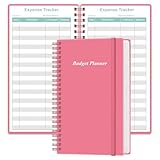
- MANAGE YOUR MONEY & ACHIEVE YOUR FINANCIAL GOALS - This budget tracker will help you keep your money organized, spend well, start saving, set and achieve financial goals. It can help you to manage all your personal finance, savings, debts, daily expense etc.
- UNIQUE DESIGN - This budget sheets expense tracker total 80 sheets/160 pages contains an annual overview (calendar from 2025-2026), yearly goals page, contact pages, important pages, and 10 pages (lined) for notes, lists, goals, etc, that help you manage your money efficiently and reach your finance goals perfectly.
- POCKET SIZE - This budget planner size of 3.75 x 6.75 inch, perfect size to fit in your bag, A6 envelopes pockets & wallet.
- SUPERIOR QUALITY - This expense budget sheets planner with 100gsm thick paper to reduce ink leakage, erase fraying and shade issues. Sturdy and flexible PP cover to protect the inner pages well. Strong metal and lay-flat twin-wire binding, Planner with inner pocket to store loose items, like tickets, cards etc and elastic closure to protect your finance planner.
- EASY TO USE - You can use this card to record your daily expenses. They can help you know where your every cent is going; Our expense tracker sheets can really help you keep track and stay on budget.
Set categories that explain decisions
Categories should be detailed enough to show what you might change, but not so numerous that you stop using them. A practical starting set is:
Quick wins for a faster PC:
Fix the driver behind crashes, sound loss and screen glitchesFind Drivers →Repair Windows errors before they cause bigger problemsFix Now →- Housing
- Utilities and communications
- Food: groceries and eating out
- Transportation
- Health and personal care
- Debt payments
- Subscriptions and memberships
- Savings and emergency-fund contributions
- Discretionary purchases
- Miscellaneous
Split a transaction when it contains materially different items. For example, separate groceries from household supplies if that distinction will affect a decision. Keep a miscellaneous category for items that genuinely do not fit; review its contents at the end of the period instead of forcing every charge into an inaccurate label.
Handle common transaction types consistently
- Refunds: enter the refund as a negative amount in the category of the original purchase, or record it in a separate refunds column that reduces that category total.
- Credit-card payments: record the purchase when it occurs; treat the later payment from checking as a transfer, not a second expense.
- Transfers between your own accounts: exclude them from spending unless the transfer is a contribution to savings or debt repayment that your plan tracks separately.
- Cash withdrawals: record the eventual cash purchases, not just the withdrawal, when you can identify them.
- Shared expenses: record your full outlay, then record reimbursement as income or a reduction to the relevant category according to the system you use. Apply the same rule every month.
Build the tracker
A simple table is sufficient. Use one row per transaction and columns for date, description, account, amount, category, and notes. Add a column for income or expense if you want one sheet for both. A separate summary area can total each category and compare the result with take-home pay.
| Column | What to enter | Why it matters |
|---|---|---|
| Date | Transaction or purchase date | Prevents omissions and supports monthly comparisons |
| Description | Merchant, bill, or purpose | Makes recurring charges recognizable |
| Account | Checking, card, cash, or other source | Shows which records still need review |
| Amount | Actual amount paid or received | Allows totals to reconcile to statements |
| Category | One agreed category | Groups spending for decisions |
| Notes | Split, refund, annual bill, or other context | Explains unusual entries later |
Whether you use paper, a spreadsheet, a worksheet, or a digital service, choose the format you will review consistently. The available guidance does not establish that one format is best for everyone.
Enter income and calculate take-home pay
Use the amount that actually reaches your spending accounts, not gross salary. Include regular wages and other dependable income that belongs in the period. If pay arrives weekly or biweekly, total the deposits received during the tracking month and note whether an occasional extra-paycheck month affects the result.
Keep one-time or uncertain income separate from regular take-home pay. That prevents an irregular bonus or reimbursement from making a normal month appear more affordable than it is.
Rank #3

- Effective Budget Planning - Take control of your finances with the budget account book. This comprehensive planner allows you to plan and track your income, expenses, savings, and financial goals in one convenient place. With its intuitive layout and easy-to-use sections, you can stay organized and make informed decisions to achieve financial success.
- User-Friendly Layout - The budget planner features a user-friendly layout designed for easy navigation and organization. Each month, you'll find dedicated budget pages where you can set financial goals, track your income, and plan your expenses. Additional sections include debt trackers, savings goals, bill payment trackers, and more, making it simple to stay on top of your finances.
- Undated Monthly Calendar & Bonus Stickers - Featuring undated calendar each month, you'll have ample space to mark paydays, bills due, appointments, and important dates. Say goodbye to difficult writing spaces. Plus, we've included 3 cute sticker sheets that allow you to personalize your financial organizer and make budgeting more fun. Dates are not pre-printed and are completed by the user.
- Reliable and Convenient Design - Our monthly budget planner is designed for your convenience and built to last. The elastic band keeps everything securely in place, and the dual-sided pocket provides extra storage. Experience a budget planner that combines practicality and durability.
- Master Budgeting with Ease - Our financial planner includes a complete guidebook that provides valuable insights and instructions for optimal usage. From setting financial goals to tracking expenses, this guidebook offers step-by-step guidance and practical tips. Whether you're new to budgeting or an experienced user, this resource will help you make the most of your budget planner, empowering you to achieve financial success.
Total spending and compare it with what remains
After categorizing every entry, total each category and all expenses. Compare total spending plus tracked savings contributions with monthly take-home income. Then compare the budget’s predicted leftover amount with what typically remains in the relevant account.
A useful reconciliation is:
Take-home income − spending − savings contributions = expected leftover
Compare that expected leftover with the change in your account balances after accounting for transfers, card timing, and any income or expense outside the period. The figures may not match exactly if transactions are pending or dates cross the period boundary, but a persistent gap calls for investigation.
The Tool Desk
Outbyte PC Repair FREEClear out junk files and repair common Windows errorsFree Scan →Outbyte Driver Updater FREEFix the driver behind crashes, sound loss and screen glitchesFind Drivers →When the numbers do not match
- Check that every checking account and credit card used during the period is included.
- Search for cash purchases, tips, ATM withdrawals, and small convenience-store charges.
- Look for annual, quarterly, medical, school, gift, travel, or seasonal payments.
- Remove duplicate entries caused by counting both a card purchase and its payment.
- Verify refunds, reimbursements, and transfers between your own accounts.
- Compare category estimates with the actual transaction amounts.
- Check whether the income total uses the same date range as the expenses.
Do not edit transactions merely to make the result fit a target. The purpose of the first pass is to understand current use of money. The CFPB’s Your Money, Your Goals: A Financial Empowerment Toolkit puts the principle plainly: “Before deciding on changes to your spending, it’s a good idea to understand how you use your money now.”
Review for patterns before changing anything
Look for evidence that can guide a specific decision:
- Recurring charges you no longer recognize or use.
- Categories whose actual total is consistently higher than expected.
- Several small purchases that add up to a meaningful monthly amount.
- Irregular bills that need a monthly sinking-fund amount.
- Card spending that is paid from the next month’s income.
- Months in which the predicted leftover never remains in the account.
Choose one adjustment first, such as canceling an unused subscription, setting aside a monthly amount for an annual bill, or creating a weekly limit for a category. Recheck the tracker after the next period and change the plan when income, household arrangements, or recurring costs change.
Compare tracking methods by fit, not marketing claims
| Method | Capture effort | Coverage strengths | Risks or trade-offs |
|---|---|---|---|
| Receipts and notebook | Manual entry at the time of purchase | Good for cash, tips, and small purchases | Can be lost or forgotten; requires a later total |
| Spreadsheet or free worksheet | Manual entry and categorization | Flexible categories, formulas, and clear totals | Missed entries remain unless you reconcile accounts |
| Statement review | Periodic review of bank and card histories | Efficient for electronic and recurring transactions | Does not automatically capture cash; timing can obscure card spending |
| Bank or credit-union tool | Often less manual after setup | May combine account activity and show transactions in one place | Check current data handling, connection requirements, category accuracy, and fees |
| Personal-finance tool | Varies by setup and maintenance | Can offer dashboards, rules, and reminders | Features, privacy practices, costs, and effectiveness vary; no specific service is established as best here |
The best choice is the one that captures your payment methods and leads to a review habit. A digital tool that omits cash is incomplete; a notebook that is never totaled is no more useful than an unreviewed statement.
Use feedback without confusing interest with proof
In a CFPB study published in 2017, more than 90 percent of the consumers the agency interviewed expressed interest in real-time spending-feedback tools that show a remaining budget at the point of purchase. That figure describes interest within that study group and year. It is not evidence that such tools improve behavior, nor is it a current estimate for all consumers.
If you use alerts or real-time feedback, treat them as prompts to review the underlying transaction record. Confirm categories, cash spending, irregular bills, and savings contributions rather than assuming an automated balance is complete.
Independent reader supportYour contribution helps us test, update, and keep practical guides available for everyone.Protect privacy and keep the system maintainable
Before connecting accounts to any digital service, review what data it requests, how connections are maintained, whether fees apply, and how you can disconnect or delete access. Use strong, unique credentials and multi-factor authentication where available. If you prefer not to connect accounts, manual statements and a spreadsheet can provide full coverage with more entry work.
Set a recurring review time—weekly for capture and monthly for reconciliation. Store statements and receipts securely for the period you need, then dispose of unnecessary copies. If another household member spends from a shared account, agree on who records cash, how reimbursements are labeled, and when the tracker is reviewed.
A repeatable monthly routine
- Start: choose the date range and gather statements, bills, receipts, and income records.
- Capture: enter electronic transactions and add cash purchases from receipts or your written log.
- Categorize: apply the same category rules, splitting transactions when useful.
- Scan history: identify annual, seasonal, medical, school, gift, travel, and other infrequent costs.
- Include goals: record emergency-fund and other savings contributions.
- Total: calculate category spending, total spending, take-home income, and expected leftover.
- Reconcile: compare expected leftover with account changes and investigate gaps.
- Decide: select one adjustment based on the record, then schedule the next review.
Questions that arise after the first month
Should I track every purchase if I already review my statements?
Yes, if you use cash, split purchases, or need to understand timing. Statements provide strong electronic coverage but cannot show a cash purchase that never reached an account.
Best Value

- Neatly Track & Organize Your Finances: The accounting ledger book is here for you to stay on top of your spendings & income! Clearly & neatly structured, it offers ample space for all crucial information about checks, savings, bills & other expenses or income
- Perfect For Small Business Owners: Keep it simple, yet super effective - the undated income and expense log book is an absolute must-have among small business supplies! Register your financial data and use your debit & credit records to compile a trial balance
- Premium Style With A Sturdy Cover: With the 120-page finance tracker, you can manage your finances conveniently in one place. A solid cover, thick paper and a reliable ring binding ensure maximum durability
- Beautiful Modern Minimalistic Design: A visual highlight just like you can expect from ZICOTO! The sage green cover of the ledger book, look stunning with a modern golden floral on the front - makes bookkeeping simply beautiful!
- Super Handy - Always At Hand: Thanks to its practical size, the 8.6x6.1” ledger book fits into any bag easily and is therefore always by your side. Whether used as a checkbook register or to track other financial flow, with the log book you’ve got it all sorted!
How long should I keep tracking?
Continue until the process reliably captures your accounts, cash, recurring bills, and irregular costs. Many people then keep a lighter monthly routine and perform a deeper several-month scan when circumstances or income change.
What if my income changes each month?
Record actual take-home deposits for each period and keep uncertain income separate from dependable income. Compare spending with the income that actually arrived rather than an annual average alone.
Do I need to buy a spending-tracker notebook?
No. The CFPB suggests carrying a notebook as one practical way to record expenses, but receipts, a free worksheet, a spreadsheet, or another method can work. The requirement is a complete, reviewable record—not a particular product.
Frequently Asked Questions
How should I handle a purchase returned in a later month?
Record the return or refund in the month it occurs and link it in your notes to the original category. If your monthly reports track purchase and refund dates separately, leave the original month unchanged and show the later reduction in the refund month.
How can couples track spending from separate accounts?
Agree on a shared category list and tracking period, then record each person’s contributions and expenses by account. Reconcile shared bills and reimbursements with the same rule every month so one person’s payment is not counted twice.
What should I do when a pending card transaction changes after posting?
Use the final posted amount for the period you reconcile. Replace the pending estimate rather than keeping both entries, and note unusual adjustments such as tips or foreign-exchange changes.
Quick Recap
Product prices and availability are accurate as of the date/time indicated and are subject to change. Any price and availability information displayed on Amazon at the time of purchase will apply.




