
Do these 3 things before closing this tab:
1Repair Windows errors before they cause bigger problems2Scan for outdated or missing drivers - takes under a minute3Clear out junk files and repair common Windows errorsThe safest approach combines discreet physical security, meticulous records and written confirmation from your insurer. Keep home-held silver in a secured safe or other controlled location, maintain an inventory with receipts and photographs, and never assume a standard homeowners or renters policy will reimburse the full bullion value. For silver stored elsewhere, investigate the facility’s access controls, surveillance, emergency procedures and financial protection before depositing anything.
This is U.S.-focused consumer guidance. Your policy contract, insurer and state law control. A safe can reduce physical risk but does not automatically make silver insured, and a bank safe-deposit box does not mean the bank insures its contents.
As an Amazon Associate I earn from qualifying purchases.
What “safe storage” and “insured” actually mean
Silver has two separate risks: someone may take or damage the metal, and an insurer may deny or limit a claim after a loss. Storage addresses the first risk. Insurance addresses the second, subject to the policy’s definitions, exclusions, limits, deductibles and documentation requirements.
Investment silver can include coins, bars, rounds and other bullion. An insurer might classify those items as bullion, precious metals, collectibles, jewelry, coins or another category. That classification can change the theft limit, valuation method and whether an endorsement is available. Ask the insurer to identify the classification in writing rather than relying on a general reference to “personal property.”
#1 Best Overall

- 0.5-cubic-feet security safe with electronic lock and 3 operation indicator lights; powered by (4) AA batteries (not included)
- Includes 2 emergency override keys to protect against forgotten passcodes or dead batteries; keep keys in a well-hidden, secure location
- Strong steel construction with carpeted floor to protect against scratches and damage; pry-resistant concealed hinges; adjustable/removable interior shelf.
- Pre-drilled mounting holes with four expansion bolts are included to mount safe to wall, floor, or shelf
- Exterior measures 13.8 x 9.8 x 9.8 inches (WxDxH); Interior measures 13.6 x 7.2 x 9.7 inches (WxDxH); door thickness is approximately 2 inches; product weight is 18.26 pounds
The National Association of Insurance Commissioners (NAIC) emphasizes that a homeowners policy is a legal contract whose rights and responsibilities are stated in the policy. Read the declarations, definitions, exclusions, conditions and endorsements that apply to your property; an agent’s informal explanation is not a substitute for the wording.
Storing silver at home
Use a controlled, discreet location
A home safe is a practical physical-security product category for silver kept at home. It can restrict access and make casual theft more difficult. Choose a location that is not obvious to visitors, limit who knows the location and control keys, combinations and electronic credentials. Avoid discussing the quantity or location of your holdings on social media or with people who do not need to know.
The sources reviewed do not establish a silver-specific safe rating, required fire rating, exact placement rule, humidity prescription or anti-tarnish requirement. Do not treat any particular specification as a universal insurance condition. Ask your insurer whether the policy imposes requirements for a safe, alarm, monitored security system or other storage condition, and obtain the answer in writing.
Free tools Windows power users keep installed
One-click scans. No signup required.
A safe is not a promise of coverage. An insurer may still apply a theft sublimit, exclude a cause of loss, require proof of ownership or value the metal differently from your purchase price. Physical security and insurance should be evaluated as separate decisions.
Control access and prepare for emergencies
- Give access only to people who genuinely need it, and change combinations when that group changes.
- Keep keys or recovery codes separate from the safe and protect them from unauthorized copying.
- Know how you would retrieve records and contact your insurer after a fire, flood, burglary or evacuation.
- Ask the insurer whether an alarm, safe or other security measure affects eligibility, premiums or claim conditions; do not assume a discount or requirement applies.
Create an inventory before a loss
Make a room-by-room inventory of every piece of silver. For each item, record the form (bar, coin or round), mint or refiner if known, weight, purity, identifying marks, serial or lot number, purchase date, seller, purchase price and storage location. Photograph both sides of coins and bars, packaging, certificates and identifying marks. A short video that shows the items and their identifying details can supplement still photographs.
Keep receipts, invoices, dealer correspondence, appraisals and any certificates that establish authenticity or ownership. Record the source and date of any value estimate; market prices change, so a historical purchase receipt and a current estimate serve different purposes.
Rank #2

- PROTECTS VALUABLES: 1.8-cubic-foot home safe for safeguarding important documents, jewelry, cash, devices, and other precious items
- RELIABLE SAFETY: This safe box features a programmable electronic keypad for secure, easy operation, along with a back-up key for emergency access; requires AA batteries (not included)
- DURABLE CONSTRUCTION: This mini safe is built with heavy-duty steel, including an 8-gauge steel door and 14-gauge steel body, as well as 2 live-door bolts and pry-resistant concealed hinges
- CONVENIENT ORGANIZATION: This safe for home includes an interior shelf to help keep your belongings neatly organized and easily accessible
- EASY INSTALLATION: Comes with pre-drilled mounting holes and hardware, making it simple to securely mount this mini safe box to the floor or wall
NAIC consumer guidance recommends storing an inventory copy securely away from the property or online and updating it annually. Keep the off-site or online copy protected by strong authentication, and make sure a trusted person knows how to locate it if you cannot access it.
Quick wins for a faster PC:
Fix the driver behind crashes, sound loss and screen glitchesFind Drivers →Repair Windows errors before they cause bigger problemsFix Now →Scan for outdated or missing drivers - takes under a minuteDriver Scan →Why a standard homeowners policy may not be enough
Personal-property coverage is not a bullion guarantee
Homeowners and renters policies commonly cover personal property for listed causes of loss, but valuables can have special dollar limits for theft. The fact that a policy covers “personal belongings” does not prove that investment bullion is covered, covered at full value or covered for every cause of loss.
The Insurance Information Institute (III) says personal belongings coverage is generally 50% to 70% of the dwelling-insurance amount. III also says some insurers limit belongings kept away from the home to 10% of personal-property coverage. These are broad homeowners-policy figures, not silver- or bullion-specific limits. They are not a quote for your policy and should not be used to calculate expected recovery.
Silverware limits are another reason to ask precise questions. A policy may contain a special theft limit for silverware or similar valuables, while the contract treats investment bullion differently. Do not infer that a silverware limit applies to bullion, or that it provides full replacement value.
Questions that determine the real protection
Insurance suitability depends on more than the headline limit. Establish all of the following for your specific holdings:
What’s actually slowing this PC down?
Pick the symptom - the matching free tool is one click away.
- Eligibility and classification: Is physical investment silver bullion covered, and under what category?
- Causes of loss: Are theft, fire, water damage, accidental loss and mysterious disappearance covered, or are some excluded?
- Limits: What are the limits for theft and other losses? Are they aggregate for all silver or applied per item?
- Valuation: Is payment based on purchase cost, an appraised value, actual cash value, replacement cost or a stated/agreed amount?
- Location: Does coverage apply at your residence, a bank safe-deposit box, a private vault, self-storage and while the silver is in transit?
- Conditions: Are a safe, alarm, storage standard, appraisal or periodic valuation required?
- Deductible and premium: What deductible applies, and what additional premium would broader coverage cost?
- Proof: Which receipts, photographs, serial or lot details, appraisals and inventory records are required for a claim?
Request answers by email or letter and keep them with the policy. If an agent suggests an endorsement, scheduled-property coverage, floater or separate valuables policy, obtain the actual wording and confirm that bullion is eligible in your state. The availability of these products is not universal.
Rank #3
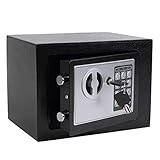
- STRONG & SECURE:Digital Locking- the Electronic Safety Lock Box Is Equipped with an Easy to Program Digital Keypad That Is Simple to Lock and Unlock by Entering Your Security Combination. Two Emergency Keys Are Included for Faster and More Immediate Access.
- SMART CAPACITY:0.2-cubic-feet, Exterior :9.05" x 6.69"x 6.69", Interior size: :6.29" x 8.9" x 5.12" (Pls pay full attention to the dimension for this MINI safe box),It gives you easy personal access to your valuables .
- STRONG & SECURE: The mini safe box is made of reinforced solid steel wall construction. Dual security steel door locking bolts & a corrosion & stain-resistant powder coat finish keeps the drop box safe.
- Durable powder coated finish, Magnetic lock for auto-locking;
- Easy to install: The home safe box has pre-drilled holes for wall or floor mounting, Includes mounting bolts.
Off-premises storage choices
Moving silver away from your residence can reduce the consequences of a home burglary, but it introduces facility, access and location-coverage questions. Before transferring the metal, confirm both the operator’s protections and your own policy’s treatment of property at that address.
Bank safe-deposit box
A bank safe-deposit box provides controlled access in a bank facility, but the contents are not insured by the bank. Ask your own insurer whether silver in that box is covered, which causes of loss apply and whether a location-specific limit or exclusion exists. Keep an inventory and copies of records outside the box; a box that is inaccessible after a building closure is not a backup for your documentation.
Private vault or precious-metals facility
For a private vault, evaluate who can enter, how identity is verified, whether activity is logged, how video surveillance is maintained and what happens during a power outage, fire, flood or other emergency. Ask whether holdings are individually identified or pooled, how an audit is performed and how you would access or retrieve the metal.
Outdated Drivers Are Slowing You Down
One free scan finds every outdated or missing driver and matches the right update for your exact hardware.Free scan · exact hardware matchWindows Errors? Fix Them Before They Spread
Repair common Windows errors and clear accumulated junk for a smoother, more stable PC - no reinstall needed.Free scan · no reinstallObtain the facility’s written terms for insurance or financial protection. Determine whether reimbursement is limited, whether it is based on actual cash value or replacement cost, what exclusions apply and whether coverage is provided by the operator or must be purchased separately. Confirm that your personal policy covers property at that location if you are relying on it.
Self-storage unit
Self-storage protection can be narrower than customers expect. III cautions that facility protection may have limits, use a square-footage-based reimbursement calculation, distinguish actual cash value from replacement cost and exclude certain causes of damage. Standard off-premises coverage can also have location or peril restrictions.
Read the rental agreement and any protection plan, then ask specifically whether bullion is accepted, how it is valued, what theft and disaster limits apply, and whether a deductible or inventory requirement exists. A locked unit alone does not establish adequate insurance.
Rank #4

- FIRE AND FLOOD PROTECTION FOR ESSENTIAL PAPERS: UL Classified to withstand high temperatures for up to thirty minutes and ETL Verified to protect contents during water exposure, helping safeguard critical paperwork during common home emergencies
- DESIGNED FOR IMPORTANT DOCUMENT STORAGE: Spacious interior fits hanging file folders and is ideal for organizing passports, birth certificates, insurance records, and legal paperwork
- KEY LOCK SECURITY YOU CONTROL: Durable key lock helps prevent unauthorized access and keeps the lid securely closed during fire events. Two keys are included for backup access
- HOME FRIENDLY SIZE WITH PORTABLE DESIGN: Compact footprint fits easily in closets, offices, or under desks while remaining portable enough to relocate when needed
- BUILT FOR EVERYDAY PEACE OF MIND: Black exterior offers a clean, neutral look that blends into home or office spaces while providing dependable document protection year round
| Storage location | Security questions | Insurance questions | Main trade-off |
|---|---|---|---|
| Home safe | Who knows the location? Who can open it? Is the safe anchored or otherwise protected against removal? | Is home-held bullion eligible? Are there theft sublimits, safe requirements or deductibles? | Immediate access, but the residence remains a single physical risk. |
| Bank safe-deposit box | How is access controlled, and what are the bank’s emergency and closure procedures? | The bank does not insure contents. Does your policy cover this location and for which perils? | Bank-facility security, but limited access and no automatic bank coverage. |
| Private vault | What controls, surveillance, emergency plans and audit procedures are documented? | What financial protection does the operator provide, and can your policy cover the facility address? | Purpose-built security may add cost and reduce convenient access. |
| Self-storage | What access controls, cameras, fire protection and flood procedures exist? | Are bullion and high-value property eligible? Are payments limited by square footage or actual cash value? | Convenient space, but protection and valuation can be especially restrictive. |
How to compare insurance options
Compare contracts on the same set of questions rather than comparing premium alone. A lower premium can reflect a lower limit, a narrower list of covered causes, actual-cash-value settlement or a high deductible.
| Comparison axis | What to verify |
|---|---|
| Bullion eligibility | Whether coins, bars and rounds are covered and how each is classified. |
| Covered causes | Theft, fire, water, accidental loss, disappearance and transit treatment. |
| Limits | Aggregate and per-item limits, theft sublimits and off-premises limits. |
| Valuation | Actual cash value, replacement cost, appraised value, purchase cost or stated/agreed amount. |
| Location scope | Home, bank box, private vault, self-storage and temporary locations. |
| Documentation | Receipts, photographs, serial or lot details, appraisals and inventory updates. |
| Security conditions | Safe, alarm, access-control or storage requirements and any inspection provisions. |
| Deductible and price | The deductible for each relevant loss and the recurring premium for the selected limit. |
| Exclusions and disputes | Excluded perils, concealment or fraud clauses, and the process for challenging a settlement. |
A written insurer checklist
Send the following questions to your insurer or licensed broker and save the response with your policy documents:
- Is physical investment silver bullion covered under this policy? How is it classified?
- What theft and other-loss limits apply? Are they aggregate or per item?
- What valuation basis would be used for coins, bars and rounds?
- Does coverage apply at my home, in a bank safe-deposit box, at a private vault, in self-storage and while in transit?
- Are there safe, alarm, storage-location or appraisal requirements?
- Which causes of loss are excluded, and what deductible applies?
- Is an endorsement, scheduled-property coverage, floater or separate valuables policy available for bullion in my jurisdiction?
- What records would support a claim, and how often must values or appraisals be updated?
When you receive an endorsement or separate policy, read its definitions, schedule, limits, exclusions and conditions. Keep the endorsement itself, not just an email summary, because the contract controls.
What to do after a loss
Preparation makes a claim less dependent on memory during a stressful event. If silver is stolen or damaged:
- Protect people first and follow emergency instructions. Do not enter an unsafe area to retrieve records.
- Notify law enforcement when appropriate and obtain a report or incident number.
- Notify the insurer promptly using the claim instructions in the policy. Ask what evidence and deadlines apply.
- Preserve photographs, receipts, inventory copies, facility agreements and written valuation information. Do not discard damaged packaging or documents unless the insurer authorizes it.
- Provide a clear item-by-item schedule and distinguish original purchase records from later market estimates.
- Ask the adjuster to identify the policy provision, limit, deductible and valuation method used for each disputed item.
- Keep copies of every submission and communication. If the insurer’s response is unclear, request the explanation in writing and consider advice from your state insurance regulator or a qualified professional.
Annual maintenance routine
Set a yearly calendar reminder to review both the metal and the protection:
- Count and identify every item against the inventory.
- Photograph additions, changed packaging and identifying marks.
- Save receipts for purchases, sales and transfers.
- Update estimated values and ask whether the policy limit still matches the holdings.
- Confirm that storage locations and access permissions remain accurate.
- Review deductibles, exclusions, endorsements and renewal changes.
- Test that an off-site or online inventory copy can be accessed by an authorized person.
- Ask the insurer whether any new storage condition or appraisal is required.
Update the inventory after a major purchase or sale rather than waiting for the annual review. Keep sold items and transfer records long enough to explain changes in the collection and ownership history.
Quick Recap
Common mistakes to avoid
- Assuming “personal property” means full bullion coverage: Special theft limits and classifications can override broad language.
- Assuming a safe creates insurance: A safe is a security measure, not proof that a claim will be paid.
- Relying on the bank for a safe-deposit box: The bank does not insure the contents.
- Using a generic collectibles policy without confirmation: Eligibility and valuation differ by contract; confirm that investment bullion is included.
- Keeping the only inventory inside the storage location: Store a copy away from the silver and the property.
- Comparing only premiums: Limits, exclusions, deductibles and valuation basis determine the protection you actually buy.
- Assuming off-premises limits are unlimited: Broad homeowners figures, including the often-cited 10% limit, are general examples and not a bullion quote.
- Leaving verbal assurances undocumented: Request the classification, limits and conditions in writing and retain the policy wording.
Product prices and availability are accurate as of the date/time indicated and are subject to change. Any price and availability information displayed on Amazon at the time of purchase will apply.




