
Recommended Free Tools
Some links on this page are affiliate links: if you buy through them we may earn a commission, at no extra cost to you.
To prepare GST records for an audit in India, build a traceable file for each GSTIN and financial year. Keep the statutory accounts required by section 35 of the Central Goods and Services Tax (CGST) Act, preserve the source documents listed in rule 56 of the CGST Rules, retain them for the section 36 period, and make every figure in a filed return traceable to a ledger and an underlying invoice or adjustment. A practical system uses one folder per tax period, a searchable invoice index, reconciliation working papers, and a documented exception list.
This guide addresses the central GST framework under the CGST Act and Rules. State GST provisions, your registration category, the nature of your business, additional places of business and the wording of an audit notice can add requirements. Check the amendments and rules applicable to the particular tax period before deleting records or answering a notice.
As an Amazon Associate I earn from qualifying purchases.
PC Slower Than It Used to Be?
A free scan shows the junk files, broken settings and background clutter dragging Windows down - then fixes them in one click.Free scan · Windows 10 & 11Crashes, No Sound, or Screen Glitches?
Random freezes, missing sound and display glitches usually trace back to one bad driver. Find and replace yours safely.Free scan · under a minuteWhat does a GST audit in India actually verify?
A GST audit is an examination of records, returns and other documents to check the correctness of turnover declared, taxes paid, refunds claimed, input tax credit (ITC) availed and compliance with the Act and Rules. Your filing system should therefore let an officer move from a return total to the tax ledger, then to a transaction listing and finally to the original document.
“Audit” means the examination of records, returns and other documents maintained or furnished by the registered person under this Act or the rules made thereunder or under any other law for the time being in force to verify the correctness of turnover declared, taxes paid, refund claimed and input tax credit availed, and to assess his compliance with the provisions of this Act or the rules made thereunder.
#1 Best Overall
 XKDOUS 2 Pack Invoice Books, 2-Part Carbonless Receipt Books | 50 Sets Per Book, 5-9/16" x 8-7/16" 2-Part Carbonless Invoice Receipt Book for Small Business Sales Records
- Two-Part Carbonless Invoice Book: Each invoice book has 50 sets of invoices, each with a white/light yellow section, with the yellow section retained in the invoice book to maintain detailed records.
- Consecutively Numbered: Enlarged red 6-digit numbers in the upper right corner of each invoice receipt book help you quickly navigate through your orders.
- Wraparound Divider Flap: A thick folded cardboard divider is integrated into the back of each invoice book for use between each two-part sales order to prevent the written content from rubbing off on subsequent copies of the invoice, resulting in wasted invoices.
- 2 Packs/50 Sets (100 Sets Total): Each invoice book provides 50 sequentially numbered carbonless sets of 2 invoice books for long-term use.
- Customizable Space: Each invoice book for small business has space at the top to add a company seal or sticker.
The practical objective is not to create a special “audit file” after receiving a notice. It is to maintain records throughout the year so that the same evidence supports the return, the accounts and an audit response.
Which GST accounts and source documents must you keep?
Section 35 requires true and correct accounts covering the business activities and tax positions that an audit will test. Rule 56 identifies the principal documents and registers that support those accounts. Treat the following as the core record set, then add documents required by your business activity or a specific notice.
Quick wins for a faster PC:
Repair Windows errors before they cause bigger problemsFix Now →Fix the driver behind crashes, sound loss and screen glitchesFind Drivers →| Record group | What to retain | What it helps establish |
|---|---|---|
| Production or manufacture | Production records and prescribed particulars where your business manufactures goods | How output and stock figures were derived |
| Inward supplies | Purchase invoices, import documents, receipt records and reverse-charge support | Purchases, tax charged and the basis for ITC |
| Outward supplies | Tax invoices, bills of supply, delivery challans and dispatch or supply records | Turnover, place and timing of supplies, and output tax |
| Stock | Opening balance, receipts, issues, closing balance, losses, write-offs, gifts and free samples where relevant | Whether physical movement and reported supplies reconcile |
| ITC | Eligible purchase and import records, tax invoices, credit notes, reversals and reconciliation working papers | Why each credit was claimed, adjusted or reversed |
| Output tax and payments | Tax collected, tax payable, payment challans and electronic-liability-ledger evidence | Whether the liability reported was paid or remains outstanding |
| Adjustments and refunds | Credit notes, debit notes, refund vouchers, advance receipts and related approvals or correspondence | Why a previously reported amount changed |
| Registers and identities | Registers of tax invoices, credit notes, debit notes and delivery challans, plus supplier and customer identities and goods-storage premises | Whether documents can be matched to real counterparties and locations |
Rule 56 also addresses records for imports, exports, reverse-charge supplies, advances and tax payable, collected and paid. Keep the document that proves the event, not merely a spreadsheet summary. If a document is unavailable, record the gap and the steps taken to resolve it rather than silently replacing the source.
How long should GST records be kept?
Section 36 sets a baseline of 72 months from the due date for furnishing the annual return for the year to which the records relate. That is not automatically six calendar years from the invoice date, nor is it necessarily measured from the day a return was filed.
The retention period can extend for records connected with an appeal, revision, proceeding or investigation. For that relevant subject matter, retain the records until one year after final disposal or until the ordinary period ends, whichever is later. Identify the affected invoices, ledgers and working papers when a proceeding begins so that an ordinary deletion cycle cannot remove them.
- Record the financial year and the annual-return due date used to calculate the ordinary 72-month period.
- Maintain a hold list for records connected with appeals, revisions, proceedings or investigations.
- Apply the rule to the actual tax period and subject matter; do not assume every file for every year has the same end date.
- Check current amendments, state GST requirements and the wording of any notice before disposing of records.
How should you structure GST folders by GSTIN and tax period?
A consistent hierarchy is a practical way to meet the statutory requirement that records be retrievable. It is not a government-prescribed folder template, so adapt names to your accounting system while preserving the same traceability.
Rank #2

- QUALITY INVOICES: Adams Order books provide a professional invoice or customer receipt; a great way to create and maintain a professional image for small businesses and service providers
- 50 TWO-PART CARBONLESS FORMS: Customers get the perforated white top copy; retain the canary and pink copies for your records
- WRAP-AROUND COVER: Fold the back cover between sets to keep invoices neat and legible
- ROOM FOR CUSTOMIZATION: A blank space at top leaves room for your company stamp; a big savings over custom-printed forms
- CONSECUTIVELY NUMBERED: Large 6-digit numbers in the upper right hand corner help you thumb through orders quickly
- Create a top-level folder for each GSTIN. Keep separate GSTIN folders even where one legal entity has several registrations. Include the registered principal place of business and identify additional places of business whose records are maintained elsewhere.
- Add the financial year. Use an unambiguous year label and keep the retention end date in a control register.
- Create one folder for each return or tax period. Put the filed return, portal acknowledgement, payment evidence, calculation workbook and reconciliation notes together.
- Separate transaction populations. Use distinct subfolders or ledgers for outward supplies, inward supplies and ITC, stock, tax payable or collected or paid, imports and exports, reverse charge, advances, refunds and adjustments when those categories apply.
- Store source documents with a searchable index. The index should point to the exact file path or document identifier, not just to a month-end total.
- Preserve an immutable source copy. If an invoice is corrected, retain the original, the credit or debit note and the replacement document. Add a cross-reference rather than overwriting the first file.
- Keep an exception register. List missing invoices, duplicate numbers, amended documents, return-to-ledger differences and unresolved supplier mismatches, with an owner, status and supporting resolution.
Use the same naming convention in paper and electronic systems. A useful pattern is GSTIN_FY_Period_DocumentType_Serial_Date; the exact syntax is your choice, but it should make an invoice retrievable without opening every file in a folder.
What should an invoice index contain?
Index invoices using the particulars that appear on a GST invoice, while checking the precise rule and any exception for the transaction. Supplier identity and GSTIN, the financial-year-unique serial number, issue date, recipient details where applicable, HSN or service accounting code, description, quantity where relevant and value are practical index keys.
Minimum searchable fields
- Supplier or issuer name and GSTIN
- Invoice, bill-of-supply, credit-note, debit-note or delivery-challan number
- Document date and financial year
- Recipient name and GSTIN where applicable
- HSN or service accounting code
- Description and quantity when relevant
- Taxable value, tax rate and tax amount, where shown
- Tax period, return line or ledger reference used internally
- File location, scan identifier or accounting-system link
The last two fields are internal controls rather than invoice-law particulars. They connect the legal document to the return and make an auditor’s sample request answerable. Do not assume that every field applies identically to every recipient or transaction; verify the relevant invoice rule and its exceptions.
What belongs in each return-period working-paper pack?
Keep the evidence that explains how the filed figures were produced in the same tax-period folder as the return. A complete pack normally contains the following practical components.
What’s actually slowing this PC down?
Pick the symptom - the matching free tool is one click away.
- The filed return and portal acknowledgement.
- Tax-payment challans and evidence of credits to the electronic liability ledger.
- Outward-supply and inward-supply listings used in the return calculation.
- ITC computation, reversals, ineligible-credit analysis and import or reverse-charge schedules where applicable.
- Output-tax, payment and refund calculations.
- Credit-note, debit-note and advance schedules linked to the original transactions.
- Reconciliation between the return, the GST ledgers and the financial accounts.
- A short explanation for every material variance, amendment or late correction.
- The period’s exception register and evidence that each item was resolved or carried forward.
Label calculations as working papers and retain the underlying source data. A spreadsheet that contains only final totals cannot demonstrate whether a number was calculated from complete records.
How do you reconcile GST returns to invoices and ledgers?
Reconciliation should be a repeatable control, not a one-time exercise performed after an audit notice. The following sequence creates an audit trail from source transactions to the filed return.
Rank #3

- QUALITY INVOICES: Adams Invoice books provide a professional invoice or customer receipt; easily customize by using the extra space at the top and your company stamp
- 50-TWO PART CARBONLESS FORMS: Customers get the perforated white top copy; retain the yellow copy for your records
- WRAP-AROUND COVER: Fold the back cover between sets to keep invoices neat and legible
- CONSECUTIVELY NUMBERED: Large 6-digit numbers help you thumb through invoices quickly
- STOCK UP: Each book includes 50 white/canary sets; order several to keep your favorite forms on hand
- Freeze the filed version. Save the exact return submitted and its acknowledgement. Do not replace it with a later workbook that happens to show a different total.
- Reconcile outward supplies. Compare the invoice register and credit or debit notes with the outward-supply figures reported for the period. Separate timing differences, amendments and cancelled transactions.
- Reconcile inward supplies and ITC. Tie purchase and import documents to the ITC ledger, identify reversals and classify unresolved supplier or document mismatches.
- Reconcile tax payable and paid. Match output-tax calculations to the liability ledger and payment challans, then document any balance that remained payable.
- Reconcile refunds and advances. Link each refund or advance adjustment to its voucher, invoice or subsequent adjustment and the relevant return entry.
- Sign off exceptions. For each difference, state the cause, amount, tax period, correcting document or action and the person who approved the resolution.
This cross-linking method is practical preparation based on what an audit verifies; it is not a prescribed government form. Keep the distinction clear in your procedures.
How should stock and movement records be organized?
If you deal in goods, stock records must explain how opening stock, receipts, supplies and closing stock relate to the returns. Keep separate records or system reports for each relevant location and connect movements to invoices, delivery challans and goods received.
Include unusual movements
- Losses and write-offs, with the internal approval and supporting evidence.
- Gifts and free samples, identified separately from ordinary taxable sales where relevant.
- Transfers or movements between places of business, with the document used for the movement.
- Imports, exports and goods held at third-party storage premises.
Do not force a stock schedule to agree by changing the closing balance. Investigate count differences, damaged goods and timing cut-offs, then preserve the explanation and correction.
What are the requirements for electronic GST records and backups?
Electronic records are permitted, but rule 57 requires a proper backup that can restore the records within a reasonable period. Records must be producible on demand in readable form, and the necessary access details must be available. The rule does not prescribe a particular vendor, technology or fixed recovery-time target.
- Keep a primary working copy and a separate backup, with access limited to authorized staff.
- Test restoration periodically by opening representative invoices, ledgers and return files in a readable format.
- Document where passwords, encryption keys and file codes are held and who can retrieve them.
- Preserve export formats that remain readable if the accounting application changes.
- Record backup dates and failed tests, then document the corrective action.
- Apply retention holds to backups as well as live folders when records are connected with a proceeding.
A cloud location can be part of this arrangement, but “stored online” alone does not prove that a file can be restored or produced. The control is the documented ability to retrieve readable records and the access information needed to do so.
How do you organize records for multiple places of business?
Keep records accessible at the registered principal place of business and account for additional places of business in the manner required by the Act and Rules. Your index should identify the GSTIN, location and custodian for every record set.
Rank #4
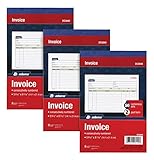
- This value 3 pack of Adams Invoice Books give you 150 two part carbonless invoices with a perforated white customer receipt and yellow duplicates for your records; 3 50-invoice books per pack
- Unique horizontal invoice sheets capture the purchased by and shipped to addresses; a compact 5-9/16 x 8-7/16 page still leaves plenty of room for details on up to 12 items sold
- Wraparound back cover prevents write-through between sets; pull out the perforated white customer receipt and the yellow carbonless duplicates stay behind for your records
- Unique 6 digit invoice numbers help you thumb through orders quickly; blank space up top gives you room for a company stamp—an affordable custom touch
- In value packs with three 50-invoice books for your small business; buy ahead to keep on site or take on the road for pop-up shop sales
- Use a location code in invoice, stock and delivery-challan indexes.
- Keep a central register showing where original paper documents and electronic masters are held.
- Give the audit team a map of local folders, systems and responsible contacts.
- Reconcile inter-location movements and transfers so that the same transaction is not counted twice or omitted.
If a location closes or records move, preserve the old location identifier and update the custody register rather than renaming historical files without a trace.
Independent reader supportYour contribution helps us test, update, and keep practical guides available for everyone.How should you respond when an audit notice or document request arrives?
First identify the GSTIN, tax periods, issues and documents actually requested. Then provide a controlled, indexed response that lets the officer verify each point without receiving an unstructured dump of unrelated files.
- Read the notice for the period, transaction type, deadline and requested format.
- Assign each request a response number and map it to the relevant return, ledger, invoice index and source files.
- Preserve the original data and create a read-only response copy.
- Prepare a schedule explaining totals, reconciliations and any exceptions instead of sending unexplained spreadsheets.
- Review personal, confidential and third-party information before disclosure while retaining the complete source internally.
- Record what was submitted, when, by whom and through which channel, together with proof of submission.
- Update the retention hold for every record connected with the notice or resulting proceeding.
An audit request may involve records maintained under the CGST Act, its Rules or another applicable law. Coordinate the GST response with your financial-accounting and statutory-record custodians so that figures and document versions do not conflict.
Should you use paper registers, electronic records, or both?
Electronic accounting is permitted, and a paper register is a convenience rather than an independent legal requirement. Choose the workflow that makes retrieval, linkage, backup and readable production reliable for your staff and locations.
| Decision area | Questions to ask before choosing |
|---|---|
| Retrieval | Can staff find a tax-period file by GSTIN, invoice number, date or location without searching every folder? |
| Linkage | Can a source document be linked to the ledger entry, return line and reconciliation note? |
| Backup and restore | Is there a tested backup that restores readable files within a reasonable period? |
| Access and export | Can an authorized person retrieve passwords or file codes and produce readable records on demand? |
| Retention and deletion | Can ordinary deletion be blocked for records under a section 36 proceeding-related hold? |
A hybrid process often works: scan and index paper invoices, retain legally significant originals where needed, and keep a controlled electronic register for search and reconciliation. The format is less important than complete, readable and traceable records.
What common record-keeping failures cause audit problems?
Most difficulties arise when a business has totals but cannot show the path to those totals. Correct the control weakness rather than merely explaining it in a cover letter.
Best Value

- 2 part carbonless forms (White originals, Canary duplicates) for invoicing customers
- Wraparound cover attached to back to place between sets
- Consecutively numbered within each book
- 50 sets per book
- Space at top for company stamp
- Only final spreadsheets are retained. Keep source invoices, ledgers, calculations and the filed return together.
- Original documents are overwritten. Preserve the first version and link every credit note, debit note or amendment to it.
- Invoice numbers cannot be searched. Maintain a register keyed to supplier, recipient, date, HSN or SAC and amount.
- Return and books differ with no explanation. Add a period-specific reconciliation and classify timing, amendment and correction differences.
- Stock records omit losses or free samples. Record those movements separately with approvals and supporting documents.
- Backups exist but have never been restored. Test readable recovery and document who controls access credentials.
- Records are deleted by calendar age. Calculate the 72-month period from the relevant annual-return due date and apply any proceeding-related extension.
- Multiple locations use different conventions. Standardize the index and maintain a location-and-custodian register.
What should you check before closing each financial year?
Use a year-end control review to prevent a missing document from becoming an audit-time emergency.
- Every GSTIN and place of business has an identified record owner.
- Each tax period contains the filed return, acknowledgement, payment evidence and calculations.
- Invoice, credit-note, debit-note and delivery-challan registers are complete and searchable.
- Inward, outward, stock, ITC and tax-ledger totals have documented reconciliations.
- Imports, exports, reverse-charge supplies, advances, refunds and adjustments are separately supported where applicable.
- Open exceptions have a resolution or a documented reason for carrying them forward.
- Electronic backups have been tested and access details are recorded.
- Retention dates and proceeding-related holds are current.
This review does not replace advice on a particular notice or tax position. It gives your adviser or internal tax team an organized evidence base from which to assess the issue.
Do these 3 things before closing this tab:
1Clear out junk files and repair common Windows errors2Fix the driver behind crashes, sound loss and screen glitches3Repair Windows errors before they cause bigger problemsFrequently Asked Questions
Can the 72-month GST retention period be shortened if a return was filed late?
The statutory clock is tied to the due date for the annual return for the relevant year, not to the date you happened to submit it. A late filing therefore does not, by itself, move the starting point to the filing date.
Do GST rules require a particular accounting software or backup provider?
No particular product is prescribed in the cited rules. The system you choose must be able to restore records within a reasonable period, produce them in readable form on demand and provide the access details needed for retrieval.
What should I do when a supplier invoice is missing during reconciliation?
List it in the exception register with the supplier, period, amount and the action taken to obtain or verify the document. Keep the original ledger and return figures intact, then document any later adjustment rather than deleting the unresolved entry.
Are stock records needed if my business mainly supplies services?
The stock-record obligation is relevant to businesses dealing in goods and to the stock particulars applicable to the registered person. If your activity has no goods inventory, document that fact in your accounting policy and retain the inward and outward service records, tax invoices and ledgers that support the returns.
The Tool Desk
Outbyte Driver Updater FREEFix the driver behind crashes, sound loss and screen glitchesFind Drivers →Outbyte PC Repair FREEClear out junk files and repair common Windows errorsFree Scan →Quick Recap
Product prices and availability are accurate as of the date/time indicated and are subject to change. Any price and availability information displayed on Amazon at the time of purchase will apply.




