
Quick wins for a faster PC:
Scan for outdated or missing drivers - takes under a minuteDriver Scan →Repair Windows errors before they cause bigger problemsFix Now →Net worth is your total assets minus your total liabilities. Add the current value of what you own, add every debt you owe, then subtract liabilities from assets. For example, $86,000 in assets minus $54,000 in liabilities produces a net worth of $32,000. Repeat the same calculation on a consistent schedule and save the dated totals and category balances so you can see what changed.
What net worth tells you
Net worth is a balance-sheet snapshot of your financial position at a particular date. It answers one narrow question: after subtracting what you owe from what you own, what remains?
As an Amazon Associate I earn from qualifying purchases.
A positive result means your assets are worth more than your liabilities. A negative result means your liabilities exceed your assets. A negative number is a starting measurement, not a judgment about you or your financial behavior. It can change as you pay debt, save, invest, receive property-value changes, or correct incomplete records.
What’s actually slowing this PC down?
Pick the symptom - the matching free tool is one click away.
Net worth is different from income. Income measures money coming in over a period; net worth measures accumulated assets and debts at one point in time. Someone with a high income can have little net worth if spending and borrowing are also high, while someone with a modest income can build substantial net worth through saving and debt reduction.
#1 Best Overall

- Neatly Track & Organize Your Finances: The accounting ledger book is here for you to stay on top of your spendings & income! Clearly & neatly structured, it offers ample space for all crucial information about checks, savings, bills & other expenses or income
- Perfect For Small Business Owners: Keep it simple, yet super effective - the undated income and expense log book is an absolute must-have among small business supplies! Register your financial data and use your debit & credit records to compile a trial balance
- Premium Style With A Sturdy Cover: With the 120-page finance tracker, you can manage your finances conveniently in one place. A solid cover, thick paper and a reliable ring binding ensure maximum durability
- Beautiful Modern Minimalistic Design: A visual highlight just like you can expect from ZICOTO! The sage green cover of the ledger book, look stunning with a modern golden floral on the front - makes bookkeeping simply beautiful!
- Super Handy - Always At Hand: Thanks to its practical size, the 8.6x6.1” ledger book fits into any bag easily and is therefore always by your side. Whether used as a checkbook register or to track other financial flow, with the log book you’ve got it all sorted!
The net-worth formula
Use this formula for an individual or a household:
Net worth = total assets − total liabilities
Assets are things you own that have financial value. Liabilities are debts and other obligations you still owe. List the two sides separately before doing the subtraction; that makes omissions and double-counting easier to find.
| Illustrative balance sheet | Amount |
|---|---|
| Cash, checking and savings | $12,000 |
| Investments | $38,000 |
| Home value | $240,000 |
| Total assets | $290,000 |
| Mortgage balance | $205,000 |
| Auto loan | $18,000 |
| Student loans | $22,000 |
| Credit-card balances | $4,000 |
| Total liabilities | $249,000 |
| Net worth | $41,000 |
The figures above are an illustration, not a benchmark or a target. Your result is meaningful only when the entries represent your own accounts and debts at the same date.
Which assets to include
The Department of Labor’s Savings Fitness balance-sheet worksheet uses cash, checking and savings, investments, and property as core asset categories. Use categories that help you find every account without counting the same value twice.
Cash and bank accounts
- Physical cash you intend to include in your household balance sheet.
- Checking accounts.
- Savings accounts, money-market deposit accounts, and similar cash accounts.
Use the balance as of your chosen snapshot date. If you are combining finances, decide whether the statement covers one person or the whole household and apply that choice consistently.
Investments
- Taxable brokerage accounts.
- Retirement accounts.
- Other investments that you own and can assign a current value to.
Record the account value, not the amount you originally contributed. Investment values move daily, so note the date and use the same timing convention each period, such as the statement balance on the last day of the month.
Property
Property can include a home and other assets with a meaningful current value. For a home with a mortgage, include the home’s value on the asset side and the outstanding mortgage on the liability side. Do not list only the equity and then also list the mortgage; that would count the debt twice or hide it from the balance sheet.
Rank #2

- PERFECT FOR RECORD KEEPING: The 2 Pack account ledger books are versatile and can be used to track finances, budgets, expenses, and other business or personal records. They are perfect for individuals, or small business owners who need a reliable and efficient way to keep track of their finances. With 100 pages, customers can record transactions over an extended period, making it a handy tool for bill planner, weekly budget planner, monthly budget planner.
- COMPACT AND LIGHTWEIGHT: The Budget Planner is compact and lightweight with each book weighing 7 ounces and measuring 8.5 x 6.25 inch, making them easy to carry around. You can take the budget notebook in a bag or briefcase, making them ideal for on-the-go use. This feature ensures that you can access your records at any time, whether you are at work or on the move.
- PREMIUM QUALITY: Elegant style with the words ''Account Tracker'' embossed in fancy Gold Foils. Water-proof and scratch resistant hard cover. Coil ring binding is a practical design feature that enhances the functionality of the account ledger books. It allows pages to turn smoothly and easily, making it effortless to flip through the book while keeping pages in place. The ring binding also ensures that pages won't fall out, preventing the loss of vital information.
- DURABLE WATER-PROOF COVER WITH GOLD FOIL LETTERS: The words ''Account Tracker'' embossed in shiny Gold Foil letters gives it a professional and fancy look that can fit in any setting. Additionally, the durable cover is scratch resistant, It provides a durable layer of protection that can withstand daily wear and tear, making it suitable for long-term use.
If you estimate a property value rather than using a recent transaction or statement, write down the method you used. Reuse that method at later snapshots unless you have a specific reason to change it. A change caused only by a different valuation method is not the same as money you saved or debt you paid.
Free tools Windows power users keep installed
One-click scans. No signup required.
Other owned items
You may include another owned item when its value is material and you can estimate it consistently. Avoid adding a long list of ordinary household goods whose resale value would be small or difficult to establish. The purpose is a useful, repeatable statement, not an inventory of everything in your home.
Which liabilities to include
The Department of Labor worksheet identifies mortgages, auto loans, student loans, and credit-card balances as common liabilities. Add every outstanding debt that belongs in the scope of your statement.
Secured loans
- Mortgage principal still owed.
- Auto loans and other vehicle financing.
- Other loans secured by property, when applicable.
Education and revolving debt
- Federal or private student-loan balances.
- Credit-card balances outstanding on the snapshot date.
- Other personal loans, lines of credit, or buy-now-pay-later balances that represent money you owe.
Use the current payoff or outstanding principal shown by the lender, following the same convention every time. Do not include a credit-card purchase twice: it belongs either in the account balance you owe or as an unpaid bill, not both.
How to calculate your net worth step by step
- Choose the statement date and scope. Decide whether you are measuring one person or a household and select a date, such as the last day of a month. Use the same scope and date rule for future snapshots.
- Gather recent balances. Collect bank and investment statements, current loan balances, credit-card statements, and a consistent estimate for property. Record the source and date beside each figure if that will help you reconcile changes.
- List assets separately. Enter each cash account, investment account, property value, and other material owned asset on its own line. Keep account-level detail even if you later show category totals.
- List liabilities separately. Enter each mortgage, auto loan, student loan, credit-card balance, and other debt on its own line. Check that joint debts are represented once in a household statement.
- Add the asset lines. Calculate a total-assets figure. Review the list for missing accounts and duplicate entries before moving on.
- Add the liability lines. Calculate a total-liabilities figure and compare it with lender statements or your debt list.
- Subtract liabilities from assets. Use
total assets - total liabilities. Keep the minus sign if liabilities are larger; that is the correct result. - Date and save the snapshot. Preserve the component balances, category totals, and final net worth together. A final number without its components will not show what drove a later change.
How to value property and fluctuating accounts consistently
Consistency matters more than false precision. A property estimate, investment balance, or other changing asset may not be exact, but using a similar method and timing each period makes the trend easier to interpret.
- Use the account or loan balance for the chosen date when a statement provides one.
- For investments, record the market value shown at that date and identify whether the value is from a statement or a same-day account view.
- For property, use a reasonable current estimate and document the basis, such as a recent valuation or a consistent online estimate. Do not switch methods without noting the change.
- When a valuation is revised, label the revision. A higher or lower estimate can change net worth even though no cash moved.
- Use the same currency and household scope in every snapshot.
Do not treat an estimated value as guaranteed cash. Net worth describes stated values on paper; the amount you could actually realize after selling costs, taxes, or other conditions may differ.
Rank #3

- PERFECT LEDGER BOOK FOR SMALL BUSINESSES: This accounting ledger book for small businesses will help you organize finances, sort and summarize transactions, create balance summaries and set you up for financial success.
- SWITCH TO EFFICIENT & STRESS-FREE ACCOUNTING: This accounting book is undated and lasts a whole year and has 113 pages, including 53 weekly views, an annual summary, empty note pages, and, at the back, a spacious pocket for receipts.
- TAKE CONTROL OF YOUR FINANCES & SUCCEED: With this detailed record of all transactions and totals, you will be able to easily analyze your finances and quickly prepare accurate financial statements.
- COMPACT A5 FORMAT & DURABLE DESIGN: This bookkeeping record book comes in A5 format (5.8 by 8.3 inches) and has an eco-leather hardcover, 120gsm no-bleed paper, elastic, pen loop, bookmark, pocket for notes, and a user guide.
- 60-DAY MONEY-BACK GUARANTEE: We will exchange or refund your receipt book for small business if you aren’t satisfied with your expense tracker notebook for any reason. Reach out to us via message to refund your small business supplies.
How often to update your net-worth statement
Investor.gov advises, “You’ll want to update your ‘net worth statement’ every year to keep track of how you are doing.” An annual snapshot is a reasonable minimum for a broad household view.
Monthly or quarterly updates are practical if you want a more detailed trend, provided you keep the interval consistent. A monthly series can show debt payments and contributions sooner; a quarterly series requires less data entry. Frequent updates can also make investment-market fluctuations look more important than they are, so interpret short intervals carefully.
Compare like intervals: month-end with month-end or quarter-end with quarter-end. If one snapshot uses an unusual date, record that fact rather than presenting the figures as a perfectly comparable series.
Do these 3 things before closing this tab:
1Fix the driver behind crashes, sound loss and screen glitches2Repair Windows errors before they cause bigger problems3Scan for outdated or missing drivers - takes under a minuteWays to record and track the history
The calculation does not require a paid service. Choose the record that you will keep private, update reliably, and understand later.
| Method | Setup effort | Privacy and data entry | Dated history | Best fit |
|---|---|---|---|---|
| Paper worksheet | Low | No account connection; all figures entered manually | Strong if each dated sheet is retained | Readers who prefer a physical record |
| Spreadsheet | Moderate | Flexible and local or cloud-based; manual entry unless you add imports | Easy to sort, chart, and compare | Readers who want category detail and calculations |
| Ledger or notebook | Low | Manual entry and personal storage | Clear chronological record when dates are consistent | Readers who want the simplest repeatable routine |
The Department of Labor provides a free Savings Fitness worksheet as a paper format. A spreadsheet or ordinary ledger works just as well for the arithmetic; the important features are complete categories, a date, and retained history.
A practical spreadsheet layout
Use one row per account or debt so that a category total can be traced back to its source. A simple sheet can contain these columns:
Rank #4
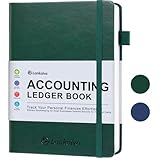
- KEEPING MONEY ORGANIZED: Our account ledger books offer versatile functionality for managing finances, budgets, expenses, and other vital records, catering to individuals, entrepreneurs, and small businesses alike.
- EASY TO USE: Tailored for both small business owners and individuals, this ledger book is an ideal tool for managing business finances or monitoring personal expenses, providing a clear overview of all transactions to detect any discrepancies.
- KEEP TRACK: With this accounting log book at your disposal, you gain the ability to comprehensively analyze your financial activities, understand your income and expenditure patterns, and generate accurate financial reports to support informed decision-making.
- COMPACT FOR EASY CARRY: Crafted from premium materials, including eco-leather hardcover and thick 100gsm paper, this A5 size columnar book is built to last. Features like a pen loop, elastic band closure, lay-flat binding, bookmark, and a pocket for loose notes ensure convenience and organization.
- PERFECT FOR YOUR NEEDS: If you struggle with managing your finances, often forgetting what you spend, where, and how much, then this companion is for you. Always by your side, it ensures you record every spend, everywhere you go. Give it a try and take control of your finances.
| Column | What to enter |
|---|---|
| Date | The snapshot date |
| Type | Asset or liability |
| Category | Cash, investment, property, mortgage, auto loan, and so on |
| Account or item | A recognizable label, without storing unnecessary login credentials |
| Balance | The value on that date |
| Notes | Valuation method, statement date, or an unusual change |
At the top or on a summary sheet, calculate total assets, total liabilities, and net worth for each date. If your spreadsheet supports formulas, use a conditional sum for rows marked “Asset” and another for rows marked “Liability,” then subtract the second total from the first. Keep an untouched copy of each completed period or use a date column that preserves every prior snapshot.
The Tool Desk
Outbyte PC Repair FREEClear out junk files and repair common Windows errorsFree Scan →Outbyte Driver Updater FREEScan for outdated or missing drivers - takes under a minuteDriver Scan →Protect the file with the device and storage security available to you. Do not place passwords, full account numbers, or security answers in the worksheet merely to make the labels more specific.
Independent reader supportYour contribution helps us test, update, and keep practical guides available for everyone.How to explain a change between snapshots
A higher or lower net worth is only the outcome. The component totals explain the cause. Compare the two dates in this order:
Debt reduction
A principal payment lowers liabilities and normally raises net worth by the amount of principal repaid, assuming the cash used was already included in the earlier asset balance. Interest, fees, and new spending can change the effect.
Saving and contributions
New money left in a bank account or contributed to an investment account increases assets. If it came from income received and spent during the same period, only the amount still owned at the snapshot belongs in assets.
Market movement
Investment values can rise or fall without a deposit or withdrawal. Separate market movement from contributions in your notes so a short-term change is not mistaken for a change in saving behavior.
Best Value

- Easy To Track Your Finances: HAUTOCO horizontal accounting ledger book keeps you on top of your expenses and income! Help you keep your money organized, spend well, and set and achieve financial goals
- Practical Design: The accounting book is PU leather hardcover, with double-wire spiral binding that allows it to lay flat 360°; 100gsm thick paper, comes with an elastic band, pen loop, bookmarks, and 2 large pockets for storing loose notes
- Plenty of Space: The expense tracking notebook measures 10.78 x 8'' and has 120 pages with 3000 lines of entries giving you enough space to record each of your transactions
- Manage Your Finances Effectively: Undated accounting books with number, date, description, account, payment or deposit amount, and total balance. You will be able to easily analyze your financial activities and quickly prepare accurate financial statements
- Ideal For Small Business or Personal Use: An accounting log journal can track your business or personal financial status. With a clear record of transactions, you can find unnecessary expenses or fraudulent charges
Property revaluation
A revised home or other property estimate can move net worth even when the mortgage balance is unchanged. Note whether the change reflects a new estimate, a sale, or an actual improvement to the property.
Corrections and scope changes
If you discover a missing account, duplicate debt, or a switch from individual to household scope, correct the record and explain the change. Otherwise, the apparent trend will mix a bookkeeping adjustment with a real financial change.
Common calculation mistakes and fixes
- Counting only assets. Fix it by maintaining a separate liability list and including every outstanding debt.
- Subtracting a mortgage from a home value twice. List the full home value as an asset and the mortgage balance once as a liability.
- Using purchase price instead of current value. Record a current, consistently estimated value for changing assets.
- Mixing dates. A bank balance from one month and a loan balance from another can distort the result. Align the dates as closely as practical.
- Double-counting a joint account or debt. Decide whether the statement is individual or household and include each shared item once within that scope.
- Replacing history with only the latest total. Keep account-level balances and notes so you can identify the reason for a change.
- Changing valuation methods silently. Record the method and explain revisions instead of treating them as savings or losses.
- Interpreting a negative number as a verdict. Treat it as a baseline that identifies the size and composition of the gap.
Net worth is not a complete financial-health score
Net worth is useful context, but it does not show whether this month’s bills are affordable, whether income is stable, or whether you feel secure and able to meet your goals. The Consumer Financial Protection Bureau states: “Because each person’s situation is unique, it is hard to measure financial well-being using only numbers like income, net worth, or credit score.”
Recommended Free Tools
Pair the balance-sheet snapshot with a cash-flow record showing income, regular bills, discretionary spending, and debt payments. Add the personal goals that matter to you, such as becoming current on debt, building a cash reserve, funding education, or preparing for retirement. These measures answer different questions; none replaces the others.
A repeatable review routine
Put the review on a calendar at the interval you chose. Before each update, use the same account list, valuation rules, and household scope. After calculating the result:
- Save the dated statement and a copy of the underlying balances.
- Compare total assets and total liabilities separately, not just the final net-worth number.
- Write one short note for any major debt payoff, contribution, withdrawal, market move, property revaluation, or correction.
- Check that the comparison uses the same interval and currency.
- Use the result to choose a cash-flow or goal action, rather than treating the number as a standalone grade.
With that discipline, the calculation remains simple while the history becomes increasingly useful: you can see whether changes came from saving, borrowing, repayment, ownership values, or recordkeeping corrections.
Quick Recap
Product prices and availability are accurate as of the date/time indicated and are subject to change. Any price and availability information displayed on Amazon at the time of purchase will apply.




