
Do these 3 things before closing this tab:
1Clear out junk files and repair common Windows errors2Scan for outdated or missing drivers - takes under a minute3Repair Windows errors before they cause bigger problemsA workable budget is a written plan for the money you expect to receive and spend. The simplest process is to know what comes in, know what goes out, make a plan, track what actually happens, and revise the plan without judgment.
You do not need a perfect spreadsheet, a special app, or a universal percentage rule. You need realistic numbers, a way to account for irregular expenses, and a short review routine that helps you make better decisions next month.
As an Amazon Associate I earn from qualifying purchases.
What a budget is—and what it is not
A budget shows how much money is available, where it needs to go, and whether your cash will last until the next paycheck. It can also help you redirect money toward an emergency fund, a planned purchase, retirement, or debt repayment.
That makes a budget a planning tool, not a punishment. If your first plan does not work, the answer is usually to improve the information or assumptions—not to conclude that budgeting is impossible. Consumer.gov describes a budget as a written monthly spending plan and recommends comparing income with bills and other expenses.
#1 Best Overall

- 【ACHIEVE YOUR FINANCIAL GOALS】This budget financial planner provides a simple and efficient money management instruments that allows you to plan and track your income, expenses and savings in one convenient place. Take control of your money on a daily, monthly and yearly basis with the budget planner, enabling you to manage your personal finance and make decisions to achieve financial goals.
- 【TRACK SAVINGS, DEBT & BILLS PAYMENTS】Keeping track of savings, debt, and bill payments can help you understand your income and expenses, giving you a clearer picture of your financial situation. In addition, you can identify spending habits and appropriately reduce unnecessary spending.
- 【WELL-DESIGNED】The monthly budget planner is undated and covers 16 months. Every month features a calendar, a budget plan, and 4 pages expense tracker. At the end of the month, review your performance and consider how to improve. Additional sections include 4 savings, 6 debt trackers and more, making it simple to stay on top of your finances.
- 【EASY TO USE】The financial planner notebook cover is made by premium Faux Leather/ Fabric, High quality and durability. A5 size (5.7'' × 8'') is perfect for on-the-go. 100gsm paper has no bleed through. It also comes with an elastic pen loop and pocket. In addition, 2 bookmarks is useful to find any page you need easily.
- 【PERFECT GIFT】A Budget Planner makes for an incredibly thoughtful and practical gift, as it helps individual keep track of their finances, set savings goals, and manage their spending more effectively. Whether for a friend, family member, or colleague, this essential tool fosters financial literacy and encourages responsible budgeting habits.
Percentage formulas such as assigning fixed shares of income to housing, savings, and discretionary spending can be useful as rough starting points. They are not universal requirements. Housing prices, family size, medical costs, debt, location, benefits, and income stability differ too much for one formula to fit every household.
1. Gather your financial information
Start with evidence rather than guesses. Collect:
- Recent pay stubs and benefit statements
- Bank-account and credit-card transaction histories
- Rent or mortgage statements, utility bills, insurance bills, and subscription charges
- Debt statements showing required minimum payments, balances, interest rates, and due dates
- Records of medical costs, transportation, childcare, school expenses, gifts, travel, repairs, and other occasional spending
- Receipts or cash-spending notes, if those purchases do not appear in an account history
Review several months of transactions—not just the most recent month. This is the best way to find expenses that occur quarterly, annually, seasonally, or unpredictably. CFPB guidance specifically recommends looking for less-frequent and miscellaneous costs, including medical expenses, gifts, vacations, school expenses, and support for family members.
If you prefer paper, a monthly budget planner with expense tracker can provide spaces for income, bills, savings, debt, and actual spending. It is optional: a notebook, spreadsheet, bank export, or reputable budgeting app can perform the same basic job. Do not share bank credentials, Social Security numbers, or other sensitive information with an unverified app or service.
2. Calculate usable monthly income
For a spending plan, use take-home income—the amount that actually reaches your account—rather than gross pay. Include income that is reasonably dependable, such as:
- Regular wages or salary after payroll deductions
- Reliable benefits or support payments
- Predictable self-employment or side-income amounts
- Other recurring income you can reasonably expect
If you are not paid monthly, estimate a monthly amount conservatively. One approach recommended by Consumer.gov is to total the income received during the prior year and divide by 12. If your income is falling or unusually uncertain, build essential expenses around a dependable baseline rather than an optimistic average.
For variable earnings, separate your plan into two layers:
- Baseline budget: essential bills and minimum obligations covered by dependable income.
- Flexible-income plan: instructions for additional money, such as adding to savings, paying extra toward debt, or funding irregular expenses.
Remember that a paycheck withholding amount is not the same thing as your final tax liability. For U.S. employees, federal withholding depends partly on Form W-4 information, while actual tax depends on your broader circumstances.
Recommended Free Tools
Check paycheck withholding when circumstances change
A job change, marriage, divorce, new child, second job, major income change, new deductions, or new tax credits can affect whether your paycheck withholding is appropriate. U.S. taxpayers can use the IRS Tax Withholding Estimator to review paycheck withholding. The estimator uses information such as filing status, income, deductions, adjustments, and credits; it is a planning aid, not a substitute for determining your complete tax return.
Rank #2

- Effective Budget Plan Book – Take control of your finances with the SUNEE budget account book. This all-in-one budget planner allows you to plan and track your income, expenses, savings, and financial goals. Its intuitive layout and easy-to-use sections help you stay organized and make smart decisions to reach financial success. Our financial planner also included a comprehensive guidebook with valuable tips and instructions to help you get the most out of your budgeting planner.
- Full-Page Calendars – Each month’s full-page calendar provides plenty of space to track paydays, bills due dates, appointments, and important events. No more cramped boxes or tight writing areas, you can easily plan and organize your schedule at a glance.
- Colorful Pages Layout and Tabs – This vibrant budget planner features a user-friendly design for easy navigation and organization. Each month includes dedicated budget pages to set financial goals, track income, and plan expenses. Additional sections like debt trackers, savings goals, and bill payment trackers make managing your finances a breeze. The colorful backgrounds on each page offer clear, instant visibility.
- Bonus 4 Stickers and Convenient Design – This monthly budget planner is built for convenience and durability. Water-resistant cover protects against spills, while the elastic band keeps everything secure, and the dual-sided pocket offers extra storage. Plus, we’ve included 4 adorable sticker sheets to personalize your planner and make budgeting more enjoyable. Experience a budget planner that combines practicality with lasting quality.
- UNDATED DESIGN & 1 YEAR USE - Undated finance books start with 1 page-financial goals, 1 page-Mind Map, 1 page-Financial Strategy, 1 page-Tactics, 2 pages-Important Dates, 4 pages-Bill Tracker, 4 pages-Saving Tracker, 8 pages-Debt Tracker, followed by 12 Months(10 pages per month, 1 unique color for each month). 2 pages-Christmas Budgeting, 2 pages-Yearly Summary, 2 pages-Check Register and 12 pages-Notes(dotted). It is UNDATED, so you could start at any time, suitable for 1 year use.
3. Sort expenses into categories that help you act
Categories are useful when they tell you what can change and when money will be needed. A practical structure is:
| Category | Examples | How to use it |
|---|---|---|
| Fixed recurring costs | Rent or mortgage, insurance, subscriptions, minimum debt payments | Record the amount and due date. Review recurring charges periodically. |
| Variable essentials | Groceries, utilities, fuel, medicine, household supplies | Use recent averages, but account for seasonal changes. |
| Discretionary spending | Dining out, entertainment, hobbies, shopping, some subscriptions | Set a deliberate limit rather than pretending these costs do not exist. |
| Irregular or annual expenses | Repairs, gifts, tuition, annual premiums, travel, seasonal costs | Convert known costs into monthly sinking-fund contributions. |
| Savings goals | Emergency savings, planned purchases, retirement, other long-term goals | Give each goal an amount and purpose. |
| Debt reduction | Required minimums and deliberate extra payments | Include every minimum before assigning extra money. |
Do not put an annual insurance premium or predictable car repair into a vague “miscellaneous” category and then act surprised when it arrives. If you expect a $600 expense once a year, setting aside $50 per month is more realistic than treating the bill as an emergency.
4. Build your first monthly budget
Write down the following equation:
Monthly take-home income − planned expenses − planned savings − planned debt payments = expected remainder
Free tools Windows power users keep installed
One-click scans. No signup required.
Your worksheet can look like this:
- Income: take-home pay, benefits, support, and reliable side income
- Essential bills: housing, utilities, insurance, transportation, food, healthcare, and minimum debt payments
- Flexible spending: dining, entertainment, clothing, shopping, and subscriptions
- Irregular expenses: repairs, gifts, annual fees, tuition, travel, and seasonal costs
- Goals: emergency savings, planned purchases, extra debt payments, retirement, or other long-term goals
Make sure the expected remainder is nonnegative. If it is negative, first check whether you missed income, annual bills, cash purchases, or debt payments. Then decide what can realistically change:
- Reduce or pause adjustable discretionary categories.
- Review subscriptions and other recurring charges.
- Ask whether a bill can be renegotiated or moved to a more affordable option.
- Change the timing assumptions if income and bills are not aligned.
- Increase dependable income where feasible.
- Contact creditors early if required payments are unaffordable.
Do not make the deficit disappear by omitting irregular expenses. Consumer.gov’s guidance is straightforward: a negative result means spending exceeds income, so the budget must be changed.
If the result is positive, assign the remainder intentionally. It might go toward an emergency fund, an irregular-expense fund, additional debt repayment, or a defined short-term goal. Unassigned money tends to become accidental spending.
5. Use a cash-flow budget when timing causes the problem
A monthly budget can balance on paper while your account still overdrafts. For example, you may have enough income for the month overall, but rent and an insurance payment may be due before your next paycheck.
The Tool Desk
Outbyte Driver Updater FREEFix the driver behind crashes, sound loss and screen glitchesFind Drivers →Outbyte PC Repair FREERepair Windows errors before they cause bigger problemsFix Now →Rank #3
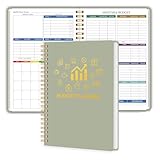
- Budget Planner: Stay on top of your finances and achieve your financial goals with our A5 Budget Planner. This beautifully designed budget book combines functionality and style, empowering you to effectively manage your budget month after month.
- Classic Design: The elegant green cover with the striking "Budget Planner" in gold adds a touch of sophistication to your financial planner. Carry it with pride and make a statement as you take charge of your financial.
- Comprehensive Layout: Our monthly budget planner features a well-thought-out layout that simplifies your budgeting process. With a dedicated monthly budget page, four expense tracking pages, a monthly summary, and a notes section, you have all the tools you need for effective financial planning.
- 14-Month Duration: Unlike many other planners on the market, ours covers a total of 14 months, giving you an extended period of financial organization. Now you can make income and expense records at any time, ensuring every financial decision aligns with your long-term goals.
- Premium Quality and Convenience: Crafted with attention to detail, this budget planner boasts superior quality. The sturdy green and gold coil binding allows for effortless flipping, while the A5 size makes it the perfect companion for your daily adventures, fitting into your bag or backpack without taking up too much space.
A cash-flow budget solves a different problem: whether money will be available on the date a payment is due. Build it by week or by paycheck, listing:
- Beginning account balance
- Each paycheck, benefit payment, or other expected deposit
- Every bill and expense by its expected date
- Planned savings transfers
- Ending balance after each period
CFPB’s budgeting resources include a cash-flow approach that tracks beginning balance, weekly income and benefits, weekly expenses, savings, and ending balance.
Use this view especially if you are paid weekly or biweekly, earn gig or seasonal income, support others, or have large bills concentrated around particular dates. The goal is not merely for income to exceed expenses over the month; it is for the account to have enough cash when each payment is due.
6. Track actual spending during the month
A budget is not finished when you write it. Use it as a monthly cycle:
- Before the month begins: make a plan using expected income, bills, savings, debt payments, and irregular expenses.
- During the month: record purchases and deposits.
- At the end of the month: compare actual amounts with the plan.
- For the next month: revise categories using what you learned.
Choose the lowest-friction tracking method you will actually maintain:
- A paper budget planner or notebook
- A spreadsheet with planned and actual columns
- A transaction export from your bank or card account
- A reputable personal-finance app, after reviewing its privacy and security information
Someone who dislikes detailed tracking can begin with three checks: total income, total essential outflows, and total flexible spending. More detail can be added if a particular problem—such as food spending, subscriptions, or cash withdrawals—needs investigation.
If paper organization helps, a budget binder with envelopes can separate cash categories, receipts, and irregular-expense funds. It is an organizational accessory, not a requirement and not a guarantee that the system will work.
7. Make savings a planned line item
Do not rely only on whatever happens to remain at the end of the month. Put savings into the plan as a planned outflow, just like a bill. Possible lines include:
Rank #4

- Easy To Track Your Finances: HAUTOCO accounting ledger book keeps you on top of your expenses and income! Help you keep your money organized, spend well, and set and achieve financial goals
- Premium Material: The A5 accounting ledger book has a total of 120 pages and 2040 lines of entries. It is made of 100gsm thick paper to reduce ink leakage; it is equipped with a waterproof and sturdy PP cover to protect the inner pages
- Practical Design: Compact 8.3 x 6.2'' expense tracker notebook is easy to carry and features information pages, 2025 calendar, yearly financial goals page, and PVC pocket for storing important tickets and loose items
- Manage Your Finances Effectively: Undated accounting books with number, date, description, account, payment or deposit amount, and total balance. You will be able to easily analyze your financial activities and quickly prepare accurate financial statements
- Ideal For Small Business or Personal Use: An accounting log journal can track your business or personal financial status. With a clear record of transactions, you can find unnecessary expenses or fraudulent charges
- Emergency savings
- Vehicle, home, medical, or technology repair funds
- Annual insurance, holiday, or travel funds
- Planned purchases
- Retirement or other long-term goals, where applicable
Even a small, consistent amount can establish the habit and reduce the need to use expensive credit for every unexpected cost. CFPB identifies a dedicated emergency fund as an important protective step and notes that recurring automatic transfers can make contributions consistent.
Automation needs a safety check. Monitor the source-account balance and upcoming withdrawals so a transfer does not trigger an overdraft fee or fail. The right amount to automate is an amount your cash-flow plan can support—not an aspirational figure that repeatedly causes problems.
There is no universal requirement that every household immediately save three to six months of expenses. That range is sometimes used as a larger emergency cushion, including in home-buying affordability discussions, but the appropriate target depends on income stability, dependents, insurance, debt, likely risks, and available cash. Start with a specific near-term target if a large reserve is not yet realistic.
Independent reader supportYour contribution helps us test, update, and keep practical guides available for everyone.8. Put debt payments into the plan
List every debt, its minimum payment, due date, balance, and interest rate. Your first obligation is to include the required minimum payment for each account. Only after minimums and essential costs are covered should you assign extra money to debt.
Quick wins for a faster PC:
Fix the driver behind crashes, sound loss and screen glitchesFind Drivers →Clear out junk files and repair common Windows errorsFree Scan →If your budget cannot cover required payments, contact creditors early. Ask about available hardship options, payment arrangements, or due-date changes, and get any agreement in writing. You may also consider reputable nonprofit or community-based credit counseling.
The Federal Trade Commission says a credit counselor should review your finances before recommending a debt-management plan. Such plans generally address unsecured debts and may involve a structured payment schedule with creditors; they are not automatically appropriate for every person or every type of debt. You can find reputable credit counseling information through the FTC before speaking with a provider.
Be cautious with debt-relief companies that:
- Demand payment before providing help
- Guarantee that they will eliminate all your debt
- Promise immediate or unusually fast results
- Tell you to stop communicating with creditors without clearly explaining the consequences
- Ask for sensitive information before explaining fees, services, and risks
Debt settlement, consolidation, balance transfers, bankruptcy, and specific payoff methods can each have trade-offs involving interest, fees, credit, debt type, income stability, and legal or tax consequences. None is universally best. A budget can show the size and timing of the problem, but it does not by itself determine which legal or financial remedy is suitable.
Best Value

- TAKE CONTROL OF YOUR MONEY & ACHIEVE YOUR FINANCIAL GOALS - Are you looking for the best monthly budget planner to keep your finances organized? Clever Fox Budget Book will help you keep your money organized, spend well and start saving.
- FIND THE BEST WAY TO ACHIEVE YOUR FINANCIAL GOALS - This budget organizer is not just a tool; it's a framework for achieving your financial goals. The finance planner helps you develop a strategy and break your ambitious goals into manageable monthly tasks.
- EASILY CONTROL YOUR SPENDING, DEBTS & SAVINGS - This money planner is undated and covers 12 months. Every month features a calendar, a budget plan, and an expense tracker. The budgeting planner also includes 8 savings and 12 debt trackers.
- USER GUIDE & BUDGETING STICKERS - Measuring 5.8 by 8.3 inches, this bill planner features a vegan leather hardcover, thick 120gsm paper, pen loop, elastic band, 3 bookmarks, pocket for receipts, budgeting stickers, and a user guide.
- 60-DAY GUARANTEE - We will exchange or refund your Budget Planner Organizer if you aren’t satisfied with your budgeting workbook for any reason. Reach out to us via message to refund your financial planner.
9. Review and revise once a month
Set aside 15 to 30 minutes for a monthly review. Ask:
Crashes, No Sound, or Screen Glitches?
Random freezes, missing sound and display glitches usually trace back to one bad driver. Find and replace yours safely.Free scan · under a minutePC Slower Than It Used to Be?
A free scan shows the junk files, broken settings and background clutter dragging Windows down - then fixes them in one click.Free scan · Windows 10 & 11- What did I plan to spend, and what did I actually spend?
- Which categories were consistently too low or too high?
- Did I miss an annual, seasonal, medical, family, or repair expense?
- Should that expense receive a monthly sinking-fund contribution?
- Will upcoming due dates line up with expected account balances?
- Are savings transfers affordable at their current amount?
- Are all minimum debt payments covered?
- What should change after a job change, move, new debt, household change, or major recurring bill?
A category that repeatedly runs over is information. Raise its planned amount and find another adjustment if necessary. A category that repeatedly comes in under may be overestimated, or the difference may be better assigned to a stated goal. The purpose is a more accurate next plan, not a perfect record of the last one.
A simple budget checklist
- Collect several months of income and spending records.
- Calculate dependable take-home income.
- List fixed, variable, discretionary, irregular, savings, and debt outflows.
- Convert known annual costs into monthly sinking-fund amounts.
- Check that income minus all planned outflows is nonnegative.
- Build a weekly or paycheck cash-flow schedule if timing is tight.
- Track actual spending during the month.
- Review and revise the plan before the next month begins.
- Keep personal and account information private when choosing tools or services.
Frequently Asked Questions
How much money should I put into each budget category?
There is no single percentage that fits every household. Start with your actual take-home income, required bills, debt minimums, healthcare, family responsibilities, location, and irregular costs. Then assign any remaining amount to savings, extra debt repayment, or a defined goal.
What should I do if my budget is negative?
Verify that you included all income and expenses, especially annual and irregular costs. Then reduce adjustable spending, review recurring bills, change timing assumptions, seek additional dependable income where possible, and contact creditors early if required payments are unaffordable.
Is a budget app necessary?
No. A paper planner, spreadsheet, bank transaction export, or notebook can work. Choose the method that you can maintain, and do not provide bank credentials or other sensitive information to an unverified service.
How much should I have in an emergency fund?
The appropriate target depends on your income stability, household obligations, insurance, debt, and likely risks. Begin with a realistic specific target. A three-to-six-month cushion is not a universal first-step requirement.
What is the difference between a monthly budget and a cash-flow budget?
A monthly budget compares total income and total outflows for a month. A cash-flow budget tracks the dates of deposits and payments, usually by week or paycheck, so you can identify whether money will be available when each bill is due.
The Bottom Line
The simplest budget that works is a living plan: use dependable take-home income, include the expenses that really occur, assign savings and debt payments deliberately, check cash by payment date, track actual spending, and revise the next month using what you learned.
Quick Recap
Product prices and availability are accurate as of the date/time indicated and are subject to change. Any price and availability information displayed on Amazon at the time of purchase will apply.
What’s actually slowing this PC down?
Pick the symptom - the matching free tool is one click away.




