Bitcoin mining is the process that allows the Bitcoin network to operate without a central authority. It performs two critical economic functions at the same time: it issues new bitcoins into circulation and it verifies that all transactions are legitimate. Without mining, Bitcoin would have no reliable way to agree on who owns what or to prevent fraud.
At its core, Bitcoin mining is a competitive accounting system. Independent participants, called miners, use specialized computers to validate recent transactions and package them into a new record known as a block. These blocks are added one after another to a public ledger called the blockchain, which serves as Bitcoin’s permanent transaction history.

As an Amazon Associate I earn from qualifying purchases.
Why Bitcoin Mining Exists
Traditional financial systems rely on trusted intermediaries such as banks to maintain account balances and process payments. Bitcoin removes intermediaries, which creates a fundamental problem: how to ensure that no one can spend the same bitcoin twice or rewrite transaction history. This problem is known as the double-spending problem.
Outdated Drivers Are Slowing You Down
One free scan finds every outdated or missing driver and matches the right update for your exact hardware.Free scan · exact hardware matchWindows Errors? Fix Them Before They Spread
Repair common Windows errors and clear accumulated junk for a smoother, more stable PC - no reinstall needed.Free scan · no reinstallBitcoin mining solves this by making transaction verification expensive, time-consuming, and economically incentivized to be honest. The system rewards miners for following the rules and makes cheating prohibitively costly. As a result, trust is shifted from institutions to economic incentives and cryptography.
#1 Best Overall

- Optimized Solo Mining Performance – Powered by ESP32-D0WD-V3 dual-core MCU and 2.8-inch 240*320 intelligent touchscreen, this board delivers a hashrate of up to 1060KH/s for Bitcoin solo mining (lottery mode). The pre-loaded firmware maximizes efficiency, allowing you to experience the thrill of block finding without expensive hardware.
- True Standalone Operation – No computer required! Built-in WiFi (802.11 b/g/n) and Bluetooth let it connect directly to the network. Simply power via 5V DC (Type-C or Micro USB) and start mining independently. The vivid display shows real-time stats: hash rate, network difficulty, BTC price, job counters, and share acceptance – all at a glance.
- Rich Visual Monitoring & LAN Management – The intuitive interface displays local IP, best difficulty, worker count, total LAN hashrate, and more. Supports multi-device monitoring via NMController software, making it easy to track all your miners on the same network.
- Extensive I/O for Custom Projects – Features RGB LED, TF card slot, temperature/humidity interface, SOP16, extended IO, speaker, and reset/boot buttons. Ideal for developers to integrate sensors, experiment with IoT, or build custom mining dashboards. Example programs and development tools are provided to accelerate your projects.
- Safe, Wide Power Input & Compact Design – Accepts DC 5-20V (0-6A) via 4P 1.25 power base or USB ports, with built-in voltage/current monitoring for stable operation. Compact dimensions (86×50×13.5mm) and wide operating temperature (-20~70°C) allow flexible placement in home labs or industrial environments.
The Role of Proof-of-Work
Bitcoin mining is based on a security mechanism called proof-of-work. Proof-of-work requires miners to perform large amounts of computational effort to propose a new block. This work consists of repeatedly guessing numbers until a cryptographic puzzle is solved.
A cryptographic hash is a fixed-length string of characters produced from data using a mathematical function. Bitcoin requires miners to find a hash that meets strict numerical conditions, which can only be achieved through trial and error. Verifying a correct solution is easy, but finding one is intentionally difficult.
Block Creation and Transaction Validation
When miners attempt to create a block, they collect recent Bitcoin transactions that have not yet been confirmed. Each transaction is checked to ensure the sender has sufficient balance and that the transaction follows network rules. Only valid transactions can be included in a block.
Once a miner finds a valid proof-of-work, the new block is broadcast to the network. Other participants independently verify the block, and if it is valid, it becomes part of the blockchain. This process repeats roughly every ten minutes, creating a steady and predictable rhythm for the network.
Mining Rewards and Bitcoin Issuance
Miners are compensated through a mining reward, which consists of newly created bitcoins plus transaction fees paid by users. This reward is the only way new bitcoins enter circulation. The creation of new bitcoin follows a fixed schedule defined in the protocol, with rewards decreasing approximately every four years in an event known as the halving.
This controlled issuance makes Bitcoin a scarce digital asset. The predictable supply schedule contrasts with traditional currencies, where central banks can increase supply at their discretion. Mining is therefore both a security mechanism and a monetary policy engine.
Difficulty Adjustment and Network Stability
Bitcoin automatically adjusts how difficult mining is through a process called difficulty adjustment. Every 2,016 blocks, roughly every two weeks, the network recalibrates the difficulty so that blocks continue to be produced about every ten minutes, regardless of how much computing power is participating.
If more miners join and total computing power increases, mining becomes harder. If miners leave, it becomes easier. This self-correcting mechanism allows Bitcoin to remain stable even as participation fluctuates globally.
Hardware, Energy, and Economic Costs
Modern Bitcoin mining requires specialized hardware known as ASICs, or application-specific integrated circuits. These machines are designed solely to perform Bitcoin’s proof-of-work calculations as efficiently as possible. General-purpose computers are no longer competitive.
Mining consumes large amounts of electricity because security is tied directly to energy expenditure. This energy cost is not incidental; it makes attacking the network extremely expensive. Any attempt to alter transaction history would require controlling vast amounts of hardware and power, making such attacks economically irrational.
Incentives That Secure the Network
Bitcoin mining aligns individual profit motives with network security. Miners earn rewards only by following consensus rules, validating transactions correctly, and extending the longest valid blockchain. Attempting to cheat risks wasted energy, lost rewards, and devalued holdings.
Free tools Windows power users keep installed
One-click scans. No signup required.
This incentive structure transforms self-interest into collective security. The more valuable the Bitcoin network becomes, the more resources miners commit to protecting it, reinforcing the system’s resilience without centralized control.
Why Bitcoin Mining Exists: Solving the Double-Spending Problem Without a Central Authority
To understand why Bitcoin mining is necessary, it is essential to understand the problem Bitcoin was designed to solve. Digital money, unlike physical cash, can be copied perfectly. Without safeguards, the same digital unit could be spent multiple times, a flaw known as the double-spending problem.
Traditional financial systems prevent double spending through centralized intermediaries such as banks, payment processors, and clearinghouses. These institutions maintain authoritative ledgers, verify balances, and reject invalid transactions. Bitcoin removes this central authority, requiring a different mechanism to ensure that each unit of value is spent only once.
The Double-Spending Problem Explained
Double spending occurs when the same digital asset is used in more than one transaction. In a decentralized network, participants may not trust each other or agree on which transaction occurred first. Without coordination, conflicting transaction histories can emerge.
The Tool Desk
Outbyte PC Repair FREERepair Windows errors before they cause bigger problemsFix Now →Outbyte Driver Updater FREEScan for outdated or missing drivers - takes under a minuteDriver Scan →Bitcoin addresses this by maintaining a single, shared transaction history called the blockchain. The blockchain is a public ledger that records all confirmed transactions in chronological order. The challenge lies in determining who gets to update this ledger and which version of it is considered valid.
Why Centralized Solutions Were Rejected
A central authority could easily decide which transactions are valid and update the ledger accordingly. However, this approach introduces reliance on trust, censorship risk, and single points of failure. Control over money becomes concentrated in the hands of an institution that can exclude users, reverse transactions, or alter monetary rules.
Bitcoin was designed to operate in an open, global environment where no single entity has ultimate control. This design goal required a system where consensus could be reached among independent participants without trusting any one party. Mining is the mechanism that makes this possible.
Proof-of-Work as a Neutral Decision Process
Bitcoin mining is based on proof-of-work, a process that requires participants to perform computationally expensive calculations. These calculations serve as a measurable demonstration of real-world resource expenditure, primarily electricity and hardware usage. Proof-of-work makes participation costly and verifiable.
What’s actually slowing this PC down?
Pick the symptom - the matching free tool is one click away.
Miners compete to create the next block of transactions by solving a cryptographic puzzle. The first miner to find a valid solution earns the right to add a new block to the blockchain. This process provides an objective, rule-based method for deciding whose version of transaction history becomes authoritative.
How Mining Prevents Double Spending
When a block is added to the blockchain, it confirms the transactions it contains and links them to all previous blocks. Altering a past transaction would require redoing the proof-of-work for that block and every block after it. As the blockchain grows, this becomes exponentially more expensive.
An attacker attempting to double spend would need to control a majority of the network’s total computing power to consistently override valid blocks. The economic and energy costs of such an attack make it impractical under normal conditions. Mining therefore transforms transaction finality into a matter of economic reality rather than trust.
Decentralized Consensus Through Economic Competition
Mining creates consensus through open competition rather than coordination or voting. Any participant with sufficient hardware and electricity can attempt to mine, and success depends on computational effort rather than identity or reputation. This openness preserves decentralization while maintaining order.
Recommended Free Tools
The longest valid blockchain, defined as the one with the most accumulated proof-of-work, is accepted by the network as the true transaction history. Miners are incentivized to follow this rule because deviating from it leads to rejected blocks and lost rewards. Consensus emerges naturally from rational economic behavior.
Why Mining Is Fundamental to Bitcoin’s Existence
Bitcoin mining is not an optional feature or an arbitrary process. It is the mechanism that allows a decentralized network to agree on ownership without trust, enforcement, or central oversight. Mining converts energy and capital into security, making the ledger costly to manipulate and reliable to use.
By solving the double-spending problem without a central authority, mining enables Bitcoin to function as a global, permissionless monetary system. Every transaction confirmation reflects not only computation but also the economic incentives and constraints that hold the entire system together.
How Bitcoin Transactions Become Blocks: From User Payments to the Blockchain
Bitcoin mining begins with individual transactions, but it reaches completion only when those transactions are organized, validated, and secured into blocks. This process transforms user payments into permanent entries on a decentralized ledger. Each step follows strict rules that ensure consistency, security, and economic integrity across the network.
Transaction Creation and Broadcast
A Bitcoin transaction is created when a user digitally signs a payment using cryptographic keys that prove ownership of previously received bitcoin. The transaction specifies inputs, which are prior unspent outputs, and outputs, which define new ownership amounts. This structure prevents users from spending the same bitcoin more than once.
Once created, the transaction is broadcast to the Bitcoin network and shared among thousands of independent computers called nodes. Nodes perform initial checks to ensure the transaction follows protocol rules, such as valid signatures and sufficient balance. Valid transactions are temporarily stored in a public waiting area known as the mempool, short for memory pool.
Rank #2
Transaction Validation and Selection by Miners
Miners monitor the mempool and select transactions to include in a new block. Selection is typically based on transaction fees, which are optional payments attached by users to incentivize faster processing. Higher fees increase the likelihood that a transaction is included sooner.
Before inclusion, miners independently verify each transaction again. This includes checking that inputs have not already been spent and that all cryptographic conditions are satisfied. Transactions that fail these checks are discarded, regardless of potential fees.
Quick wins for a faster PC:
Fix the driver behind crashes, sound loss and screen glitchesFind Drivers →Repair Windows errors before they cause bigger problemsFix Now →Scan for outdated or missing drivers - takes under a minuteDriver Scan →Constructing a Candidate Block
After selecting valid transactions, a miner assembles them into a candidate block. The block includes a list of transactions, a reference to the previous block, and a special transaction called the coinbase transaction. The coinbase transaction creates new bitcoin and assigns transaction fees to the miner, forming the mining reward.
Transactions within the block are organized into a structure called a Merkle tree, which allows efficient verification of transaction data. The root of this tree, known as the Merkle root, summarizes all transactions in a single cryptographic value. This value becomes part of the block’s header, which is used in the mining process.
Proof-of-Work and Block Finalization
To make the block valid, miners must perform proof-of-work, a process that requires finding a cryptographic hash below a specific target value. A hash is the output of a mathematical function that produces a fixed-length string from input data. Because hashes are unpredictable, miners must perform large numbers of trial calculations.
This computational effort consumes electricity and specialized hardware, creating a real-world cost to block creation. The network automatically adjusts the difficulty of this task roughly every two weeks to maintain an average block production time of ten minutes. Difficulty increases as more computing power joins the network and decreases if power leaves.
Do these 3 things before closing this tab:
1Clear out junk files and repair common Windows errors2Scan for outdated or missing drivers - takes under a minute3Repair Windows errors before they cause bigger problemsBlock Propagation and Confirmation
When a miner successfully finds a valid proof-of-work, the completed block is broadcast to the network. Other nodes independently verify the block’s transactions, structure, and proof-of-work. If valid, the block is added to their copy of the blockchain.
Once included, the transactions in the block receive their first confirmation. Each subsequent block added on top increases the number of confirmations, making reversal progressively more expensive. Through this process, individual payments become part of an immutable, globally shared transaction history secured by economic competition and energy expenditure.
Proof-of-Work Explained: How Miners Compete Using Computing Power
Proof-of-work is the mechanism that determines which miner earns the right to add the next block to the Bitcoin blockchain. It transforms block creation into an open competition based on measurable computational effort. This process ensures that no single participant can easily control transaction history without incurring substantial real-world costs.
The Hashing Puzzle at the Core of Mining
At the center of proof-of-work is a cryptographic hash function called SHA-256. A hash function takes input data and produces a fixed-length output that appears random, even when the input changes slightly. In Bitcoin mining, the input includes the block header, which contains the Merkle root, timestamp, and a variable number called a nonce.
Miners repeatedly change the nonce and recompute the hash of the block header. The goal is to produce a hash that is numerically lower than a target value set by the network. Because the output of SHA-256 cannot be predicted, the only way to succeed is through repeated trial and error.
Difficulty and the Meaning of Competition
The target value defines how hard the hashing puzzle is to solve and is commonly referred to as mining difficulty. A lower target means fewer valid hashes exist, requiring more attempts on average. The Bitcoin network adjusts difficulty approximately every 2,016 blocks to keep block production close to one block every ten minutes.
This adjustment mechanism ensures that competition remains consistent regardless of how much computing power participates. If new miners join and total hash rate increases, difficulty rises. If miners leave and hash rate falls, difficulty decreases, preserving predictable issuance and network stability.
Specialized Hardware and Energy Consumption
Early Bitcoin mining could be performed using standard computer processors, but competition quickly made this impractical. Today, mining relies on application-specific integrated circuits, or ASICs, which are chips designed solely to perform SHA-256 hashing as efficiently as possible. These devices maximize hash output while minimizing energy per calculation.
Do these 3 things before closing this tab:
1Scan for outdated or missing drivers - takes under a minute2Repair Windows errors before they cause bigger problems3Fix the driver behind crashes, sound loss and screen glitchesEnergy consumption is an inherent feature of proof-of-work, not a side effect. Electricity expenditure anchors digital block creation to physical resources, making attacks economically expensive. Any attempt to rewrite transaction history would require reproducing the cumulative energy spent securing previous blocks.
Economic Incentives and Network Security
Miners participate in proof-of-work because successful block creation yields a financial reward. This reward consists of newly issued bitcoin from the coinbase transaction and transaction fees paid by users. Revenue is probabilistic, meaning individual miners are rewarded based on their share of total computing power over time.
This incentive structure aligns individual self-interest with network security. Honest participation is economically rational, while dishonest behavior is costly and unlikely to succeed. Proof-of-work therefore converts raw computing power and energy into a decentralized security system that operates without trust in any central authority.
Step-by-Step: What Actually Happens When a Miner Mines a Block
With the economic incentives and hardware foundations established, the mining process itself can be understood as a structured sequence of actions governed by fixed protocol rules. Each step is deterministic in design, even though outcomes are probabilistic due to competition among miners.
Free tools Windows power users keep installed
One-click scans. No signup required.
Step 1: Transactions Are Broadcast and Collected
Bitcoin transactions originate when users submit them to the network. These transactions are broadcast to thousands of independent nodes, which verify that each transaction follows the protocol rules, such as having valid digital signatures and sufficient balances.
Miners collect verified, unconfirmed transactions from a shared waiting area known as the mempool, short for memory pool. The mempool contains transactions that are valid but not yet included in a block.
Step 2: The Miner Constructs a Candidate Block
A block is a data structure that groups transactions together. To construct a candidate block, a miner selects transactions from the mempool, typically prioritizing those offering higher transaction fees, since fees contribute to miner revenue.
The block also includes a special transaction called the coinbase transaction. This transaction creates new bitcoin according to the issuance schedule and assigns both the block subsidy and collected transaction fees to the miner’s address.
Step 3: The Block Is Linked to the Existing Blockchain
Each block contains a reference to the previous block in the form of a cryptographic hash. A hash is a fixed-length output generated by running data through a cryptographic function, in this case SHA-256.
By including the previous block’s hash, the new block becomes part of a chain of historical records. Any attempt to alter an earlier block would change its hash, breaking the link and revealing tampering.
Step 4: The Miner Performs Proof-of-Work Calculations
Once the candidate block is assembled, the miner begins the proof-of-work process. Proof-of-work requires repeatedly hashing the block’s data while changing a small adjustable value called a nonce, which is simply a number that can be incremented.
The goal is to produce a hash that is numerically lower than the network’s current target. Because cryptographic hashes are unpredictable, the only way to find a valid hash is through trial and error, performing trillions of calculations per second.
What’s actually slowing this PC down?
Pick the symptom - the matching free tool is one click away.
Step 5: Difficulty Determines How Hard the Puzzle Is
The difficulty target defines how rare a valid hash must be. A lower target means fewer hashes qualify, increasing the number of attempts required on average.
Difficulty does not change how hashing works; it changes how selective the network is about which hashes are acceptable. This ensures that, regardless of total computing power, blocks are found at a stable rate over time.
Step 6: A Valid Block Is Found and Broadcast
When a miner finally produces a hash below the target, the proof-of-work requirement is satisfied. The miner immediately broadcasts the completed block to the network.
Rank #3

- 1.2TH/s Hashrate — Bitaxe Gamma 601 Bitcoin Miner Powered by BM1370 ASIC chip for efficient SHA-256 Bitcoin mining.
- Low Power Consumption — Bitaxe Gamma 601 1.2TH/S Solo Miner ASIC Miner Only around 15–17W, ideal for desktop and home mining setups.
- 🔓 OPEN-SOURCE BITCOIN MINER – Built on the open-source Bitaxe platform and running AxeOS firmware, this miner gives users full control over configuration, monitoring, firmware updates, and customization. Ideal for developers, makers, and Bitcoin enthusiasts.
- 📶 EASY WI-FI SETUP WITH WEB INTERFACE – Features built-in Wi-Fi and an intuitive browser-based AxeOS dashboard. Configure mining pools, adjust frequency and voltage, monitor hashrate, and view system status without additional software.
- Compact Desktop Design — Small, quiet, and perfect for crypto enthusiasts, collectors, and hobby miners.
Other nodes independently verify the block by checking the proof-of-work, validating each transaction, and confirming adherence to protocol rules. If valid, the block is accepted and added to the blockchain.
Recommended Free Tools
Step 7: Competing Blocks and Probabilistic Finality
Occasionally, two miners may find valid blocks at nearly the same time, temporarily creating competing versions of the blockchain. The network resolves this naturally by continuing to build on the chain that accumulates the most proof-of-work.
Over time, blocks buried under additional blocks become increasingly difficult to reverse. This probabilistic finality means transaction confidence grows with each subsequent block added.
Step 8: The Mining Reward Becomes Spendable
Although the block reward is assigned immediately in the coinbase transaction, newly created bitcoin cannot be spent right away. The protocol enforces a waiting period of 100 additional blocks before the reward becomes spendable.
This delay reduces incentives for short-term chain reorganizations and reinforces honest participation. Through this process, mining transforms energy, computation, and competition into a secure and continuously updated financial ledger.
Mining Rewards and Bitcoin Issuance: How New Bitcoins Enter Circulation
With a valid block accepted by the network and the waiting period enforced, mining now connects directly to Bitcoin’s monetary system. Mining is not only a security mechanism but also the process through which new bitcoins are created and distributed. This design replaces a central issuer with transparent, rule-based issuance enforced by software.
The Block Reward: Payment for Securing the Network
Each newly accepted block includes a special transaction called the coinbase transaction. This transaction creates new bitcoin out of nothing, according to predefined rules, and assigns it to the miner who found the block.
The block reward serves two purposes. It compensates miners for the costs of electricity, hardware, and infrastructure, and it provides the economic incentive that motivates miners to follow the protocol honestly.
Bitcoin Issuance Is Algorithmic, Not Discretionary
Bitcoin’s issuance schedule is fixed in the protocol and cannot be altered by miners, developers, or governments without overwhelming network consensus. The software specifies exactly how many new bitcoins are created per block and how that amount changes over time.
The Tool Desk
Outbyte PC Repair FREERepair Windows errors before they cause bigger problemsFix Now →Outbyte Driver Updater FREEScan for outdated or missing drivers - takes under a minuteDriver Scan →This contrasts with traditional monetary systems, where central banks can expand or contract the money supply at their discretion. In Bitcoin, monetary issuance is predictable, transparent, and verifiable by anyone running a node.
Block Subsidy and Transaction Fees
The mining reward consists of two components: the block subsidy and transaction fees. The block subsidy is the newly created bitcoin issued with each block.
Transaction fees are paid by users who include transactions in that block. As block space is limited, users compete by attaching fees, and miners prioritize transactions offering higher fees, especially during periods of congestion.
The Halving: Controlled Supply Reduction Over Time
Approximately every 210,000 blocks, or about once every four years, the block subsidy is reduced by half in an event known as the halving. This process gradually decreases the rate at which new bitcoins enter circulation.
When Bitcoin launched in 2009, the block subsidy was 50 bitcoin per block. It has since fallen through successive halvings and will continue to decline until it eventually reaches zero.
The 21 Million Bitcoin Supply Cap
Because the block subsidy decreases geometrically over time, the total number of bitcoins that will ever exist is capped at 21 million. This cap is enforced by the consensus rules and is not a target or estimate but a hard limit embedded in the protocol.
As issuance slows, Bitcoin transitions from a system dominated by new supply to one increasingly supported by transaction fees. This long-term design aligns network security with actual usage of the system.
Economic Incentives and Network Security
Mining rewards align individual profit motives with collective network security. To earn rewards, miners must follow the rules, produce valid blocks, and contribute real computational work.
Quick wins for a faster PC:
Clear out junk files and repair common Windows errorsFree Scan →Fix the driver behind crashes, sound loss and screen glitchesFind Drivers →Any attempt to cheat, such as creating invalid blocks or rewriting history, requires immense cost and offers uncertain rewards. This incentive structure makes honest behavior economically rational and underpins Bitcoin’s resistance to fraud and manipulation.
From Issuance to Circulation
Once the mandatory waiting period passes, mined bitcoin becomes fully spendable and can enter the broader economy through exchanges, payments, or long-term holding. At this point, newly issued bitcoin is indistinguishable from any other bitcoin in circulation.
Through this mechanism, Bitcoin converts energy and computation into a scarce digital asset with no central issuer. Mining rewards are the bridge between network security and monetary issuance, ensuring that both emerge from the same competitive and transparent process.
Independent reader supportYour contribution helps us test, update, and keep practical guides available for everyone.Difficulty Adjustment: How Bitcoin Maintains a Predictable 10-Minute Block Time
As newly issued bitcoin enters circulation and mining rewards align incentives, the network must also regulate how quickly new blocks are produced. Without such regulation, changes in mining participation would cause block production to speed up or slow down unpredictably. Bitcoin addresses this challenge through an automatic mechanism known as difficulty adjustment.
Why Block Timing Matters
Bitcoin is designed to produce a new block approximately every 10 minutes. This predictable rhythm supports reliable transaction confirmation, orderly issuance of new bitcoin, and stable network operation.
If blocks were created too quickly, the system would issue new bitcoin faster than intended and increase the risk of blockchain splits. If blocks were created too slowly, transactions would take longer to confirm and network activity would become inefficient.
What Mining Difficulty Means
Mining difficulty is a measure of how hard it is to find a valid block. More precisely, it determines how low a block’s cryptographic hash must be to satisfy the network’s rules.
A hash is the output of a cryptographic function that converts data into a fixed-length string of characters. In Bitcoin mining, miners repeatedly change a variable called a nonce and compute new hashes until one meets the required difficulty threshold.
How Difficulty Adjustment Works
Bitcoin adjusts mining difficulty automatically every 2,016 blocks, which is roughly every two weeks. The network compares how long it actually took to produce the last 2,016 blocks with the expected time of about 20,160 minutes.
If blocks were mined faster than expected, difficulty increases, making valid blocks harder to find. If blocks were mined more slowly, difficulty decreases, making block discovery easier.
Adapting to Changes in Mining Power
The total computational power devoted to mining is known as the hash rate. Hash rate fluctuates as miners enter or exit the network, upgrade hardware, or respond to changes in electricity costs and market conditions.
Difficulty adjustment ensures that these fluctuations do not alter Bitcoin’s issuance schedule. Regardless of whether the hash rate doubles or halves, the system recalibrates to maintain the target 10-minute block interval over time.
Windows Errors? Fix Them Before They Spread
Repair common Windows errors and clear accumulated junk for a smoother, more stable PC - no reinstall needed.Free scan · no reinstallCrashes, No Sound, or Screen Glitches?
Random freezes, missing sound and display glitches usually trace back to one bad driver. Find and replace yours safely.Free scan · under a minuteRank #4
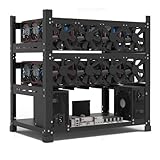
- SLOT - 6/8/12 GPU slots, support 2 ATX power supplies.
- MATERIAL - The open air mining frame case made up of the highest quality stainless steel material, strong, durable and available. Fully protecting your GPU and eectronic device.
- PERFECT DESIGN - Professional design for mining rig frame, accelerating the air convection, super cooling design for heat dissipation. Enough space reserved between the graphics cards.
- EASY TO INSTALL - Easy to install and strong structure. Keep all cables clean and organized, along with everything in your mining machine.
- NEED TO ASSEMBLE BY YOURSELF - For installation steps, please refer to the user manual. The Frame Only, Not includes Fans or other CPU, GPU, PSU, Motherboards, Cables. If you are not 100% satistifed with this Miner, please feel free to contact us, we will offer you a satisfactory soluiton within 24 hours.
Difficulty, Competition, and Energy Use
As difficulty increases, miners must perform more computational work to find a valid block. This competition drives the use of specialized hardware and significant energy consumption, both of which represent real-world costs.
These costs are not incidental. They make block production expensive to fake, ensuring that rewriting transaction history or attacking the network requires sustained and economically prohibitive effort.
A Self-Regulating Monetary System
Difficulty adjustment connects Bitcoin’s monetary rules to physical reality. Issuance is not controlled by a schedule alone but enforced through continuous competition and measurable work.
By automatically responding to changes in mining participation, Bitcoin maintains a stable block cadence without central oversight. This self-regulating mechanism allows the network to remain predictable, secure, and resilient as conditions evolve.
Quick wins for a faster PC:
Scan for outdated or missing drivers - takes under a minuteDriver Scan →Repair Windows errors before they cause bigger problemsFix Now →Mining Hardware and Energy Use: From CPUs to ASICs and Why Electricity Matters
The rising difficulty and competition described previously directly shape how Bitcoin is mined in practice. As finding a valid block requires more computational work, miners must rely on increasingly specialized hardware and substantial energy inputs to remain competitive. Mining is therefore not only a cryptographic process but also an industrial activity tied to physical resources.
The Evolution of Mining Hardware
In Bitcoin’s early years, mining could be performed using standard CPUs, or central processing units, found in personal computers. At that time, total network hash rate was low, and general-purpose hardware was sufficient to discover blocks at reasonable intervals.
As more participants joined and difficulty increased, miners transitioned to GPUs, or graphics processing units, which are better suited for repetitive mathematical calculations. GPUs significantly increased hash rate but also raised electricity consumption and hardware costs.
From GPUs to ASICs
The next major shift was the introduction of ASICs, or application-specific integrated circuits. ASICs are custom-designed chips built exclusively to perform Bitcoin’s hashing algorithm, known as SHA-256.
What’s actually slowing this PC down?
Pick the symptom - the matching free tool is one click away.
Unlike CPUs or GPUs, ASICs cannot be repurposed for other tasks. Their sole function is to compute hashes as efficiently as possible, measured in hashes per second per unit of electricity consumed. This specialization makes ASICs vastly more efficient and effectively mandatory for competitive Bitcoin mining today.
Hash Rate, Efficiency, and Capital Investment
Modern mining competitiveness depends on two primary factors: hash rate and energy efficiency. Hash rate reflects how many hash calculations a machine can perform per second, while efficiency measures how much electricity is required to perform those calculations.
ASIC mining hardware represents a significant upfront capital investment. However, because difficulty adjusts to total network hash rate, improved hardware does not make mining easier overall; it simply raises the baseline level of competition across the network.
Why Electricity Is the Dominant Cost
Electricity is the largest ongoing operating expense in Bitcoin mining. Every hash calculation consumes energy, and miners must run their equipment continuously to have a chance of earning block rewards.
Because mining rewards are fixed by the protocol, profitability depends largely on minimizing electricity costs. This reality explains why mining operations tend to cluster in regions with abundant, low-cost power, such as areas with excess hydroelectric, wind, or natural gas energy.
Energy Use as a Security Mechanism
The energy consumed by mining is not a byproduct of inefficiency but a core component of Bitcoin’s security model. Proof-of-work requires miners to expend real-world resources to propose new blocks, making dishonest behavior economically costly.
To alter transaction history or disrupt the network, an attacker would need to control a majority of the total hash rate and sustain the associated energy costs. This requirement ties digital consensus to physical constraints, reinforcing the system’s resistance to manipulation.
Economic Incentives and Physical Constraints
Mining hardware and electricity costs ensure that participation in block production is governed by economic incentives rather than trust. Miners are rewarded only when they contribute valid work accepted by the network, aligning individual profit motives with collective security.
As hardware improves and energy markets change, miners continuously adapt, but the underlying dynamics remain constant. Bitcoin’s design embeds computation, capital investment, and energy consumption into a single competitive process that enforces the rules of the network without centralized control.
Economic Incentives and Network Security: Why Mining Keeps Bitcoin Honest
The competitive and resource-intensive nature of mining leads directly to Bitcoin’s security. Because miners must invest real capital in hardware and electricity, their behavior is shaped by economic self-interest rather than trust or goodwill. The protocol is designed so that following the rules is consistently more profitable than attempting to break them.
At this stage, mining is no longer just a technical process of block creation. It becomes a financial mechanism that aligns individual incentives with the collective integrity of the network.
Block Rewards and Transaction Fees
Miners are compensated through two sources: block rewards and transaction fees. The block reward consists of newly issued bitcoin created by the protocol, while transaction fees are paid by users to have their transactions included in a block.
Do these 3 things before closing this tab:
1Scan for outdated or missing drivers - takes under a minute2Repair Windows errors before they cause bigger problems3Fix the driver behind crashes, sound loss and screen glitchesThese rewards provide a clear financial incentive to contribute computing power honestly. If a miner produces an invalid block, the network rejects it, and the miner earns nothing despite incurring full energy and hardware costs.
Why Honest Mining Is the Rational Strategy
Bitcoin’s consensus rules are enforced automatically by every node on the network. Miners cannot alter these rules unilaterally, and any attempt to do so results in wasted resources.
From an economic perspective, dishonest behavior is unprofitable. A miner who follows the rules has a predictable chance of earning rewards, while a miner who attempts to cheat sacrifices revenue without gaining lasting control over the system.
The Cost of Attacking the Network
The most commonly discussed threat to Bitcoin is a majority hash rate attack, often referred to as a 51% attack. This would require an attacker to control more computational power than the rest of the network combined.
Recommended Free Tools
Achieving this level of dominance would demand massive upfront investment in hardware and continuous spending on electricity. Even then, the attacker could not create bitcoin freely or steal funds outright; they could only attempt limited transaction reversals while sustaining enormous ongoing costs.
Difficulty Adjustment and Long-Term Stability
Bitcoin’s difficulty adjustment plays a critical role in preserving these incentives over time. As more miners join and total hash rate increases, mining becomes harder, preventing block rewards from becoming easier to obtain.
This self-regulating mechanism ensures that no technological breakthrough permanently undermines the security model. Economic competition, rather than technological advantage alone, determines success in mining.
Why Incentives Replace Trust
Traditional financial systems rely on trusted intermediaries to enforce rules and resolve disputes. Bitcoin replaces this trust with incentives that make rule-following the most economically rational choice for all participants.
Mining transforms abstract cryptographic rules into real-world financial consequences. By linking digital consensus to energy, capital, and competition, Bitcoin maintains a secure and decentralized network without centralized oversight.
Mining as the Foundation of Bitcoin’s Integrity
Mining is not merely a method of issuing new bitcoin. It is the mechanism that secures transaction history, enforces monetary rules, and aligns individual profit motives with network-wide stability.
Through proof-of-work, economic incentives, and physical constraints, Bitcoin creates a system where honesty is not assumed but continuously enforced. This incentive-driven design is what allows a decentralized network of strangers to reliably agree on a single, shared financial ledger.
Quick Recap
Product prices and availability are accurate as of the date/time indicated and are subject to change. Any price and availability information displayed on Amazon at the time of purchase will apply.
Free tools Windows power users keep installed
One-click scans. No signup required.