
Do these 3 things before closing this tab:
1Scan for outdated or missing drivers - takes under a minute2Repair Windows errors before they cause bigger problems3Fix the driver behind crashes, sound loss and screen glitchesPaying only the minimum keeps a credit-card account current under its terms, but it usually makes repayment take longer and increases total interest. The exact payoff date depends on your balance, APR for each balance category, minimum-payment formula, payment timing, and any promotional terms.
Your statement’s payoff disclosure is a useful account-specific estimate, not a promise. Check its assumptions against your card agreement, stop adding purchases for the scenario you are testing, and choose a payment you can sustain.
As an Amazon Associate I earn from qualifying purchases.
Why a minimum payment can leave the balance barely moving
A credit-card payment does two jobs: it covers amounts the issuer has charged under the account terms, and whatever remains reduces the balance. Interest works in the opposite direction by adding to what you owe. When the payment is only a little larger than the interest and other amounts due, principal falls slowly.
Many issuers calculate interest each day using a daily periodic rate and an average daily balance. The exact method is controlled by your card agreement. A card can also use different APRs for purchases, cash advances, balance transfers, or other balance categories. That is why dividing one advertised APR by 12 is not necessarily the same as the interest shown on your statement.
#1 Best Overall

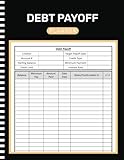
- Comprehensive Debt Management Tool:The debt payoff planner log offers a detailed table design to help users manage debt information comprehensively. Each page includes creditor details, target payoff dates, credit types, starting balances, minimum payments, interest rates, and other key data, ensuring users have a clear overview of each debt. With systematic tracking, users can create effective repayment plans and work towards becoming debt-free.
- High-Quality Materials and Practical Design:Featuring 110 pages of 80gsm high-quality paper with double-sided printing and a sturdy copperplate cover, this debt payoff tracker is both durable and professional. The 8.5 x 11-inch large page size is perfect for desktop use and portable enough to carry around. The spiral-bound design allows the debt payoff planner spiral bound to lay flat at 180 degrees for easy writing, and it works seamlessly with gel pens, ink pens, or pencils without smudging.
- User-Friendly Table Design:The credit card debt payoff planner features a simple and intuitive table layout, making it easy to add entries and track repayment progress. Each page includes columns for dates, starting and ending balances, payment amounts, confirmation numbers, and notes, enabling users to efficiently monitor every payment. This straightforward design simplifies debt management, even for first-time users.
- Versatile Use Cases:Whether for personal debt management, family financial planning, or small business cash flow tracking, the debt snowball planner is a versatile tool. Finance planner is ideal for students, professionals, freelancers, and small business owners, helping them clearly record and track debt in various scenarios. By staying organized, users can better manage their finances and reduce financial stress.
- Improve Credit Scores and Reduce Stress:With systematic debt tracking and repayment planning, the fbill tracker notebook helps users reduce their debt burden and improve credit scores over time. Clear repayment progress and goal-setting features provide peace of mind, empowering users to tackle financial challenges with confidence and work towards financial freedom.
Payment timing matters on accounts that accrue interest daily. A payment that posts earlier can reduce the balance used in later daily calculations, although the effect depends on the issuer’s posting rules, your balance history, and whether a grace period applies. The statement and agreement are the authority for your account.
What the minimum-payment warning on your statement means
For covered U.S. credit-card accounts, Regulation Z requires a minimum-payment warning. The standard warning says: “Minimum Payment Warning: If you make only the minimum payment each period, you will pay more in interest and it will take you longer to pay off your balance.” The disclosure is designed to show the cost of making the smallest required payment rather than to predict every future statement.
The issuer calculates the estimate using its minimum-payment formula, the applicable APRs, and the balance shown for the statement period. Federal calculation rules also set assumptions about how promotional rates and different portions of the balance are treated. Some accounts do not receive the full estimate when the calculated repayment period is three years or less.
If the calculation indicates that the balance will not amortize, the warning can say: “Minimum Payment Warning: Even if you make no new charges using this card and each month you pay only the minimum payment, we estimate you will never pay off your balance because your payment will be less than the interest charged each month.” This is a warning about the stated assumptions, not a prediction that every account will remain permanently unpaid.
Rank #2

- Organize Debts with a Debt Payoff Planner - Track all your debts efficiently using this debt payoff planner, including starting balances, minimum payments, due dates, and interest rates.
- Monitor Payments with a Debt Payoff Tracker - Log each payment, track end balances, and store confirmation numbers in this debt payoff tracker to stay on top of your finances.
- Plan Your Strategy with a Debt Snowball Planner - Prioritize debts, set goals, and create repayment strategies with this debt snowball planner for faster debt elimination.
- Track Bills with a Bill Tracker Notebook - Keep track of recurring bills, payment dates, and amounts with this bill tracker notebook, ensuring nothing is missed.
- Stay Motivated with a Debt Management Planner - Celebrate milestones and monitor progress using this debt management planner, perfect for anyone seeking control over their finances and achieving debt freedom.
What the “36-month payment” on a statement tells you
Many statements show a second figure: the monthly amount that would repay the balance shown in about 36 months under the disclosure assumptions. It is a comparison point, not a required payment and not a promise that the account will be paid off on that date.
The 36-month figure is based on the balance as of the statement date. It does not include purchases you make later. If you keep charging the card, your actual payoff time and interest will be different. Promotional balances, changing APRs, fees, and multiple balance categories can also change the result.
Use the figure as a practical benchmark: compare it with a fixed amount you can actually pay every month. If that amount is lower, expect a longer timeline; if it is higher and you do not add new debt, repayment will generally be faster and less expensive.
What’s actually slowing this PC down?
Pick the symptom - the matching free tool is one click away.
How to estimate your own payoff timeline
No one can give you a reliable payoff date from the card balance alone. Gather the following information from your latest statement and agreement:
Rank #3

- Organize Debts with a Debt Payoff Planner - Track all your debts efficiently using this debt payoff planner, including starting balances, minimum payments, due dates, and interest rates.
- Monitor Payments with a Debt Payoff Tracker - Log each payment, track end balances, and store confirmation numbers in this debt payoff tracker to stay on top of your finances.
- Plan Your Strategy with a Debt Snowball Planner - Prioritize debts, set goals, and create repayment strategies with this debt snowball planner for faster debt elimination.
- Track Bills with a Bill Tracker Notebook - Keep track of recurring bills, payment dates, and amounts with this bill tracker notebook, ensuring nothing is missed.
- Stay Motivated with a Debt Management Planner - Celebrate milestones and monitor progress using this debt management planner, perfect for anyone seeking control over their finances and achieving debt freedom.
- Statement balance and, if shown separately, balances for purchases, transfers, cash advances, and promotional offers.
- Minimum payment due and the due date.
- APR for every balance category, including any variable-rate language.
- How the issuer calculates the minimum payment and applies payments.
- Promotion end dates, deferred-interest deadlines, and conditions that could terminate a promotional rate.
- Any annual, late, cash-advance, or other fees that could be added.
Then use this process:
- Choose the scenario. Decide whether you are modeling the current balance with no new purchases. A no-new-purchases assumption is the cleanest way to compare payment amounts.
- Set a fixed monthly payment. Pick an amount that fits your budget every month, rather than an amount you can make only in a good month. Check that it is at least the required minimum while the balance remains outstanding.
- Start with the statement disclosures. Compare your chosen payment with the statement’s minimum-payment estimate and its 36-month payment amount. Those figures incorporate the issuer’s formula better than a generic calculator.
- Check the assumptions. Confirm whether the estimate assumes no new charges, which APRs are used, how promotions are handled, and whether fees are included. Verify the details in the card agreement.
- Model separate balances when necessary. If one balance has a promotional or deferred-interest deadline and another has a high APR, a single blended APR can hide the risk. Track each balance and its deadline separately.
- Recheck after changes. Recalculate when an APR changes, a promotion ends, a fee posts, or your payment amount changes. A payoff estimate is a snapshot, not a permanent schedule.
Online calculators can illustrate how a different payment changes estimated months and interest, but they cannot override your issuer’s terms. The statement estimate should be your starting reference.
How payments are applied when APRs differ
When an account has more than one APR, the allocation of a payment can affect the timeline. Consumer Financial Protection Bureau guidance says amounts paid above the minimum generally go first to the balance with the highest APR. The issuer generally has more discretion over how the minimum-payment portion is allocated, subject to applicable rules and the agreement.
For example, paying extra may attack a high-rate purchase balance while the minimum portion is distributed among other balances according to the issuer’s method. Read the payment-allocation section of your agreement rather than assuming every dollar goes to the balance you would choose.
PC Slower Than It Used to Be?
A free scan shows the junk files, broken settings and background clutter dragging Windows down - then fixes them in one click.Free scan · Windows 10 & 11Crashes, No Sound, or Screen Glitches?
Random freezes, missing sound and display glitches usually trace back to one bad driver. Find and replace yours safely.Free scan · under a minuteMake sure payments are credited by the due date. A payment submitted on time but posted later can have a different interest effect from one credited earlier. Your issuer’s cutoff times, electronic-payment rules, and posting schedule control.
Deferred interest is not the same as a standard 0% APR offer
A deferred-interest promotion can say no interest is due during a promotional period, but the condition is often that the promotional balance must be paid in full by a stated deadline. If it is not, the issuer may add the interest accrued from the purchase date. That retroactive charge is different from an ordinary introductory APR offer, where interest generally begins only after the promotional rate ends (subject to the offer’s terms).
To manage a deferred-interest balance:
- Record the promotion’s exact end date and the balance subject to it.
- Divide the promotional balance by the number of billing periods remaining, then add a buffer for timing, fees, or additional charges. This is a planning calculation, not a guarantee of the issuer’s required payment.
- Pay enough to retire the promotional balance before the deadline while continuing to meet minimums on other balances.
- Review how extra payments are allocated. A high-APR balance may receive extra payments first, leaving the deferred-interest balance exposed if the agreement or applicable rules direct payments differently.
- Do not assume the words “no interest” mean the same thing as a 0% APR period. Read the promotional disclosure and the full agreement.
Compare payoff choices without misleading yourself
When deciding whether to pay the minimum, the 36-month amount, or another fixed payment, compare the same facts for each scenario:
- Monthly payment required.
- Estimated months to payoff.
- Estimated total interest and fees.
- Whether new purchases are excluded.
- APR changes, variable rates, and promotion end dates.
- Whether multiple balance categories are modeled separately.
- Whether the payment is realistic for your budget every month.
A larger payment is generally cheaper and faster when the balance and terms stay otherwise unchanged, but the best amount is not universal. Do not set a payment so high that you miss essentials, fall behind on another account, or need to use the card again for routine expenses. A sustainable fixed payment is more useful than an ambitious amount you cannot maintain.
Quick wins for a faster PC:
Repair Windows errors before they cause bigger problemsFix Now →Scan for outdated or missing drivers - takes under a minuteDriver Scan →Clear out junk files and repair common Windows errorsFree Scan →If you cannot afford the minimum
Contact the issuer before the due date if possible. Explain what you can afford and ask whether hardship assistance, a changed payment arrangement, or another option is available. Ask for the terms in writing, including any effect on APR, fees, credit reporting, account access, and the total amount to be repaid. Do not stop paying without understanding the consequences.
Best Value

- 1 Complete Debt Payoff Planner: This debt payoff planner spiral bound includes 120 pages with 60 double sided sheets in a large 8.5 x 11 inch format Ideal for tracking credit card balances personal loans and monthly payments while also serving as a Monthly Expense Tracker Bill Payment Tracker Notebook and Budget Planner for everyday financial management
- 2 Detailed Financial Tracking Layout: Each debt payoff tracker includes fields for Month Year Creditor Address Relationship Phone Starting Balance Credit Type Account Number Interest Rate Payoff Date Due Date Minimum Payment Credit Limit Payment End Balance Confirmation Number and Notes helping organize every repayment step and maintain accurate financial records
- 3 Durable Spiral Bound Design: Made with a sturdy 350 gsm kraft paper cover durable spiral binding and smooth 80 gsm paper this Money Management Ledger lays flat for comfortable writing and supports long term debt planning budgeting and expense tracking
- 4 Better Budget And Payment Organization: Track balances record every payment monitor remaining debt and review repayment progress with confidence Use this Bill Payment Tracker Notebook to organize credit card payments loan schedules monthly expenses and household budgets in one place
- 5 Ideal For Personal Finance Planning: Suitable for individuals families students freelancers and small business owners this Debt Payoff Log Book also works as a Monthly Expense Tracker Budget Planner Money Management Ledger and Credit Card Payoff Tracker for managing debt repayment and improving personal financial organization
Nonprofit credit counseling can provide a confidential review of your budget and debts. The National Foundation for Credit Counseling describes counseling and, when appropriate, debt-management plans; costs and availability vary by provider and state. A plan can affect card use and has eligibility and disclosure requirements, so compare the fees, services, and obligations before enrolling.
Be cautious with for-profit debt-relief promises. No legitimate provider can guarantee a specific reduction, settlement, or approval before reviewing your situation. Understand all fees, the services actually delivered, and what happens while you are waiting for help.
Common mistakes that change the estimate
- Continuing to charge the card. The statement’s 36-month figure excludes future purchases, so new spending can extend repayment.
- Using one APR for every balance. Purchases, transfers, and cash advances may have different rates and interest rules.
- Ignoring posting dates. A payment’s effect depends on when the issuer credits it, not only when you click “submit.”
- Treating a promotion as permanent. Promotional rates have expiration conditions; deferred interest can create a retroactive charge.
- Assuming extra money goes to a chosen balance. Check the issuer’s allocation rules, especially when balances have different APRs.
- Relying on a generic calculator without checking terms. A calculator may omit fees, daily-balance methods, variable APRs, or promotional conditions.
- Missing the minimum while pursuing a payoff strategy. A plan that saves interest but causes late fees or delinquency is not working as intended.
Practical tracking tools
A paper debt log can help you record each statement balance, payment, interest charge, promotion deadline, and target payoff date. The Consumer Financial Protection Bureau’s printable debt booklet includes a credit-card debt log and payoff-goal worksheet. A tracker records information; it does not calculate interest or replace the issuer’s agreement.
A payoff calculator, such as the educational calculator offered by Credit.org, can help compare payment amounts and estimated interest savings. Enter the same assumptions for every scenario and treat the output as an estimate. Reconcile it with your statement after each billing cycle.
Bottom line for your next payment
Paying only the minimum is the amount required to keep the account current, not the amount that usually minimizes cost. Interest can accrue daily, different balances can carry different APRs, and promotional terms can change the result. Start with your statement’s minimum-payment and 36-month disclosures, verify the assumptions in your agreement, choose a fixed payment you can sustain, and avoid new purchases in the scenario you are evaluating. If the minimum itself is unaffordable, contact the issuer promptly and seek qualified nonprofit counseling rather than waiting for the account to fall behind.
Quick Recap
Product prices and availability are accurate as of the date/time indicated and are subject to change. Any price and availability information displayed on Amazon at the time of purchase will apply.




