
Quick wins for a faster PC:
Scan for outdated or missing drivers - takes under a minuteDriver Scan →Repair Windows errors before they cause bigger problemsFix Now →Fix the driver behind crashes, sound loss and screen glitchesFind Drivers →Yes—but it is a plausible pathway, not a settled outcome. Artificial-intelligence data centers are creating a rapid need for reliable electricity. In the United States, natural gas has a short-term advantage because gas turbines are dispatchable, familiar to utilities, and adaptable to onsite or local generation. The financial risk is that plants, pipelines, power contracts, and grid investments built as an emergency response could remain in service for 20 to 40 years.
That matters beyond climate policy. The costs could influence household electricity bills, utility investment returns, public subsidies, local pollution, and the future price of power-intensive technology. But “more gas generation” does not automatically mean permanent gas dominance: renewables, storage, nuclear power, transmission, efficiency, and flexible computing could still supply much of the growth.

As an Amazon Associate I earn from qualifying purchases.
The AI electricity surge is real, but AI is not the whole story
Global data centers consumed approximately 415 terawatt-hours (TWh) of electricity in 2024, or about 1.5% of global electricity use, according to the International Energy Agency. The IEA’s base case projects consumption to more than double to roughly 945 TWh by 2030 and reach about 1,200 TWh by 2035.
Those figures cover all data-center activity, not just AI. Cloud services, storage, networking, streaming, enterprise computing, cooling, and cryptocurrency-related workloads also consume power. AI is an increasingly important source of growth, but it should not be treated as synonymous with total data-center demand.
#1 Best Overall

- This comes with a 10-year parts limited warranty provided it is installed by a qualified installer and registered online with 60 days of installation
The United States accounted for about 45% of global data-center electricity consumption in 2024. The U.S. Department of Energy, citing Lawrence Berkeley National Laboratory scenarios, says data centers could consume between 9.5% and 15.3% of U.S. electricity by 2030, with a central estimate of 11.8%. These are modeled scenarios—not a guaranteed share of future consumption. The range reflects uncertainty over AI adoption, server efficiency, data-center construction, utilization, and other demand.
In the IEA’s analysis, data centers could account for nearly half of U.S. electricity-demand growth through 2030. That is large enough to affect utility planning and investment decisions even if the final number falls below current projections.
U.S. electricity demand overall is also expected to grow. The Energy Information Administration’s AEO2026 scenarios project annual U.S. electricity-demand growth of roughly 0.9% to 1.6% through 2050, with data-center server use a major factor. Its high-electricity-demand case reaches 818 billion kilowatt-hours of data-center server use in 2050. Again, this is a scenario assumption, not a prediction that every announced facility will operate at full scale.
What’s actually slowing this PC down?
Pick the symptom - the matching free tool is one click away.
Why natural gas has the “speed-to-power” advantage
Gas can provide firm power
AI facilities generally need continuous, high-quality electricity. Training and inference workloads may run around the clock, and interruptions can be expensive. Gas turbines can generate electricity when wind and solar output is low, and some gas technologies can ramp relatively quickly.
That makes gas attractive when a data center cannot wait for a larger grid upgrade. The key distinction is between energy and firm capacity: a solar or wind project may produce substantial annual energy, but an always-on campus also needs power during periods of low renewable output.
Existing infrastructure lowers execution risk
Utilities, developers, and lenders already understand gas-plant engineering, fuel procurement, dispatch, maintenance, permitting, and cost recovery. Many likely data-center locations are also near established pipeline systems and major electricity markets.
By contrast, a clean-power project may need new transmission, substations, transformers, storage, and interconnection approvals before it can serve a specific campus. The IEA says new transmission lines in advanced economies can take four to eight years to build, while transformer and cable wait times have also lengthened.
The Tool Desk
Outbyte PC Repair FREEClear out junk files and repair common Windows errorsFree Scan →Outbyte Driver Updater FREEFix the driver behind crashes, sound loss and screen glitchesFind Drivers →Gas is not always faster. Turbine deliveries can take several years, and a renewable project with an existing interconnection and strong local resources may move more quickly. But in a constrained region, gas may be the most familiar way to obtain dependable capacity on the required schedule.
Data centers are concentrated in grid-constrained clusters
Nearly half of U.S. data-center capacity is located in five regional clusters, according to the IEA. Concentration makes local grid bottlenecks more severe. A dedicated gas plant, behind-the-meter generator, fuel cell, or hybrid microgrid can appear more practical than waiting for a new transmission corridor.
Companies such as GE Vernova and Siemens Energy market gas turbines, batteries, microgrids, fuel cells, and grid infrastructure for data centers. These pages demonstrate commercial momentum and available product categories; they are not independent proof that gas is the cheapest, cleanest, or best option for every project.
The evidence points to more gas—but not gas alone
EPRI’s 2026 analysis projects annual U.S. natural-gas capacity additions of approximately 6.6 to 13.7 gigawatts per year from 2025 through 2030 under reference-policy scenarios. Its scenario without new data-center demand has about 3.3 GW of annual additions. This is a model-based range, not a list of plants certain to be built. Announced projects may be delayed, downsized, canceled, or gradually ramped.
Crashes, No Sound, or Screen Glitches?
Random freezes, missing sound and display glitches usually trace back to one bad driver. Find and replace yours safely.Free scan · under a minuteWindows Errors? Fix Them Before They Spread
Repair common Windows errors and clear accumulated junk for a smoother, more stable PC - no reinstall needed.Free scan · no reinstallThe IEA’s global base case is more balanced. It projects natural gas to provide about 175 TWh of additional generation for data-center demand by 2035, with the United States a particularly important contributor. It also projects more than 450 TWh of additional renewable generation serving data-center demand, while nuclear power contributes an amount broadly comparable to gas.
That outlook does not support the claim that natural gas will power all—or even most—future AI growth globally. The gas-dependence argument is strongest in the United States and in regions with existing gas infrastructure, constrained transmission, fast-growing data centers, and weak or unenforced clean-energy requirements.
How a temporary gas solution can become a decades-long commitment
The central issue is not simply how much gas is burned next year. It is whether decisions made to meet the first wave of AI demand create infrastructure that is difficult to retire.
Multi-decade asset economics
Gas plants can be designed, financed, and permitted around multi-decade economics. Even if a plant later runs less frequently, its owner may keep it available for peak demand, reliability events, or capacity-market obligations. A rise in gas capacity therefore does not necessarily equal an equivalent rise in gas generation or emissions—but it can preserve gas as an option for decades.
Depreciation and utility cost recovery
When a regulated utility receives approval to build a plant or pipeline, it may recover the investment from customers over a long depreciation period. Early closure can create stranded-cost disputes: shareholders, lenders, regulators, and customers may disagree over who should pay for the remaining balance.
Rank #3
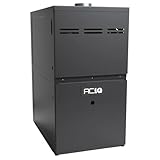
- CERTIFIED ACiQ SELLERS: Everything you need for reliable HVAC solutions!
- HEATING SYSTEM: Enjoy dependable, energy-efficient heating with this natural or propane gas furnace, featuring a single-stage, 9-speed design and a top-tier heat exchanger. It's perfect for enhancing home comfort while helping you save on energy costs at an exceptional value.
- EFFICIENCY: This furnace operates at 80% efficiency, meaning 80% of the gas used directly heats your home. Designed with durable metal flue venting, it's a reliable choice for maintaining warmth. Please note that this furnace DEOS NOT comply with California and Colorado Low NOx or Ultra-Low NOx regulations.
- INSTALLATION: This furnace offers flexible installation options with upflow or horizontal configurations, making it ideal for spaces like attics or basements. Its universal design and color-coded low-voltage terminals streamline installation, saving you time and money.
- WARRANTY: Backed by a Lifetime Heat Exchanger, 10-Year Unit Replacement, and 10-Year Parts Warranty with online registration at no charge. Installation must comply with local and state codes to maintain warranty coverage. (Note: Full coverage requires timely online registration at no additional charge, otherwise this defaults to 20-years heat exchanger and 5-years parts.)
This is not an automatic outcome. Regulators can reject uneconomic projects, impose cost-allocation rules, or require data-center operators to pay for dedicated infrastructure. But once an investment enters a utility’s rate base, retiring it early becomes more complicated than canceling an unbuilt proposal.
Long-term contracts and local incentives
Large data centers may sign long-term power-purchase, tolling, or fuel-supply agreements. Such contracts can make gas generation financially attractive even if renewable power later becomes cheaper in the short run.
Gas projects can also create local tax revenue, construction jobs, maintenance contracts, and political support. Pipeline expansions, land-use decisions, trained workforces, and capacity-market commitments add institutional momentum. Together, these forces can turn a bridge into a durable part of the energy system.
Do these 3 things before closing this tab:
1Fix the driver behind crashes, sound loss and screen glitches2Clear out junk files and repair common Windows errors3Scan for outdated or missing drivers - takes under a minuteMore gas capacity is not the same as permanent gas dominance
A gas plant built for emergency backup may operate only during a limited number of hours. A gas plant used as continuous prime power has a much larger effect on fuel consumption, emissions, and operating costs.
To judge whether AI is truly locking in gas, examine:
- Power source: grid electricity, onsite gas, fuel cells, nuclear, renewables, or a hybrid.
- Utilization: backup, peaking, or continuous operation.
- Contract length: short-term bridge arrangements versus decade-long commitments.
- Carbon accounting: physical emissions, renewable certificates, offsets, and hourly matching.
- Cost allocation: whether the data-center operator, utility shareholders, taxpayers, or ordinary customers pay.
- Replacement flexibility: whether the equipment can be economically retired or genuinely converted to lower-carbon fuels.
Behind-the-meter generation also does not make a facility independent of the energy system. It still needs fuel infrastructure, cooling, local permits, maintenance, and often a grid connection for redundancy.
Why renewable contracts do not automatically mean hourly clean power
Renewables can supply a large share of AI demand, but the accounting matters. A data center may sign a virtual power-purchase agreement or buy renewable-energy certificates while physically drawing electricity from a grid whose marginal generator is gas.
There is a meaningful difference between:
- annual renewable-energy matching;
- hourly clean-energy matching;
- physical delivery from a nearby project;
- virtual contracts settled financially; and
- behind-the-meter renewable generation.
Wind and solar also need transmission, interconnection capacity, storage, and grid services. Batteries can shift solar output and provide rapid reserves. The Tesla Megapack, for example, is marketed for utility-scale storage and grid services. But battery duration, degradation, fire safety, land, materials, and multi-day weather events remain relevant limitations. Four-hour storage is not the same as several days of firm supply.
Rank #4

- CERTIFIED ACiQ SELLERS: Everything you need for reliable HVAC solutions!
- HEATING SYSTEM: Enjoy dependable, energy-efficient heating with this natural or propane gas furnace, featuring a single-stage, 9-speed ECM design and a top-tier heat exchanger.
- EFFICIENCY: This furnace operates at 96% efficiency, meaning 4% is lost during its operation. It requires plastic/PVC flue venting and is a reliable choice for maintaining warmth. This furnace DOES comply with California and Colorado Low NOx BUT NOT Ultra-Low NOx regulations.
- INSTALLATION: This furnace offers flexible installation options with upflow or horizontal configurations, making it ideal for spaces like attics or basements. Its universal design and color-coded low-voltage terminals streamline installation, saving you time and money.
- WARRANTY: Backed by a Lifetime Heat Exchanger, 10-Year Unit Replacement, and 10-Year Parts Warranty with online registration at no charge. Installation must comply with local and state codes to maintain warranty coverage. (Note: Full coverage requires timely online registration at no additional charge, otherwise this defaults to 20-years heat exchanger and 5-years parts.)
What could prevent decades of gas dependence?
Build transmission and interconnections faster
Faster permitting, better regional planning, additional transformers, and clearer interconnection rules would reduce the incentive to build local gas simply because the wider grid is slow to connect.
Extend existing nuclear plants and develop new capacity
Existing nuclear facilities can provide firm, low-carbon electricity, but life extensions, restarts, licensing, fuel supply, and new construction are separate issues. New nuclear projects may not arrive quickly enough for every current data-center proposal. The IEA expects the first small modular reactors in its outlook around 2030, but commercial scale and economics remain important uncertainties.
Use longer-duration storage where it is valuable
Long-duration storage could complement batteries and renewables during prolonged periods of low wind or solar output. It is especially relevant when the alternative is building gas capacity that may operate for only a small number of hours.
Make some AI workloads flexible
Non-urgent model training could move to regions or hours with abundant clean power. Inference could be geographically distributed, and selected workloads could be curtailed during grid emergencies.
The IEA describes data-center flexibility as underexplored, while also noting that AI facilities are highly capital-intensive and may have limited tolerance for interruption. Flexibility is therefore a potential grid resource, not a free or universal solution.
Improve efficiency without assuming total demand will fall
More efficient chips, models, cooling systems, and software can reduce electricity per task. But lower costs can encourage more AI use—a rebound effect. In the IEA’s high-efficiency case, 2035 data-center electricity demand is about 20% below its base case, while the organization’s broader scenarios range from roughly 700 to 1,700 TWh.
Set enforceable clean-power and cost-allocation rules
Policymakers could require large data centers to procure additional clean generation, match consumption hourly, pay for transmission and grid upgrades, meet emissions-intensity standards, and disclose electricity, water, and emissions impacts.
Recommended Free Tools
Some U.S. states have pursued policies addressing data-center clean-energy procurement and grid costs. Proposed legislation can change, and enacted rules are jurisdiction-specific, so claims about a particular state should be checked against current law.
Best Value
- CERTIFIED ACiQ SELLERS: Everything you need for reliable HVAC solutions!
- HEATING SYSTEM: Enjoy dependable, energy-efficient heating with this natural or propane gas furnace, featuring a single-stage, 9-speed ECM design and a top-tier heat exchanger.
- EFFICIENCY: This furnace operates at 96% efficiency, meaning 4% is lost during its operation. It requires plastic/PVC flue venting and is a reliable choice for maintaining warmth. This furnace DOES comply with California and Colorado Low NOx BUT NOT Ultra-Low NOx regulations.
- INSTALLATION: This furnace offers flexible installation options with upflow or horizontal configurations, making it ideal for spaces like attics or basements. Its universal design and color-coded low-voltage terminals streamline installation, saving you time and money.
- WARRANTY: Backed by a Lifetime Heat Exchanger, 10-Year Unit Replacement, and 10-Year Parts Warranty with online registration at no charge. Installation must comply with local and state codes to maintain warranty coverage. (Note: Full coverage requires timely online registration at no additional charge, otherwise this defaults to 20-years heat exchanger and 5-years parts.)
The costs that matter to households and investors
For personal finances, the most important question is not whether AI uses electricity in the abstract. It is who pays for the additional system.
If a utility builds generation and transmission for a large customer but spreads costs across its broader customer base, households and small businesses could face higher bills. If regulators require a hyperscaler to fund dedicated infrastructure or guarantee minimum payments, the risk to ordinary ratepayers is lower—but the data center may face higher operating costs.
Gas also exposes consumers and businesses to fuel-price volatility and future carbon or methane regulation. Renewable generation has no fuel cost, but its total system cost includes transmission, storage, balancing, land, and financing. Nuclear and storage can provide valuable reliability while carrying substantial upfront costs. The cheapest option on a wholesale-price chart is not necessarily the cheapest complete electricity system.
Free tools Windows power users keep installed
One-click scans. No signup required.
Local effects should also be counted: gas plants can produce nitrogen oxides and noise, while pipelines and power projects disturb land. Data centers themselves can affect water use, local infrastructure, housing, and electricity rates.
What to watch through 2030
- Whether proposed gas plants reach final investment decision, construction, and operation.
- Turbine, transformer, cable, and interconnection delivery times.
- Data-center cancellations, downsizing, and actual utilization rather than announced megawatts.
- Utility decisions on who pays for new generation and transmission.
- Hourly clean-energy procurement requirements and emissions standards.
- Nuclear restarts, life extensions, and new-project schedules.
- Battery projects with durations longer than the standard daily-shifting model.
- Actual AI workload growth and efficiency per task.
- Methane rules and the measured performance of carbon-capture projects.
Vendor claims about “hydrogen-ready” turbines, carbon-capture compatibility, or lower-emissions gas should be read narrowly. Hydrogen-ready does not mean affordable low-carbon hydrogen is available. Carbon-capture-compatible does not mean emissions have been captured and permanently stored at commercial scale. A fuel cell is not automatically zero-carbon if its fuel is derived from natural gas.
The bottom line for the energy system
AI is giving natural gas a genuine near-term advantage in the race to provide reliable electricity, particularly in the United States. The risk is not that every AI data center will burn gas forever. It is that utilities and developers may build gas plants, pipelines, contracts, and rate structures that continue to shape the grid long after the initial shortage of power has passed.
Whether that becomes decades-long dependence will be determined by decisions made now: how quickly transmission is built, whether clean power is matched hourly rather than annually, how much flexibility data centers provide, whether firm low-carbon resources expand, and whether large customers pay the full cost of the infrastructure they require.
Quick Recap
Product prices and availability are accurate as of the date/time indicated and are subject to change. Any price and availability information displayed on Amazon at the time of purchase will apply.




