
Do these 3 things before closing this tab:
1Clear out junk files and repair common Windows errors2Scan for outdated or missing drivers - takes under a minute3Repair Windows errors before they cause bigger problemsSome links on this page are affiliate links: if you buy through them we may earn a commission, at no extra cost to you.
Your capital-gains tax is based on your gain after selling costs and adjusted basis—not simply the sale price multiplied by one tax rate. For a typical taxable stock or fund sale, calculate the gain, classify it as short-term or long-term, net it with your other gains and losses, and then apply your filing status, taxable income, the 2026 federal thresholds, possible Net Investment Income Tax, and state tax.
This guide is for U.S. individual taxpayers estimating tax on assets sold during 2026. A 2025 sale generally belongs on your 2025 federal return filed in 2026; a 2026 sale generally belongs on your 2026 return filed in 2027. The estimate is most reliable for ordinary taxable brokerage transactions. Home sales, rental property, cryptocurrency, inherited or gifted assets, employee stock, collectibles, installment sales, and business interests require additional rules.
As an Amazon Associate I earn from qualifying purchases.
Free tools Windows power users keep installed
One-click scans. No signup required.
Capital gains tax calculator: enter these numbers first
For a useful estimate, gather the following information. If you already have a tax projection, use taxable income before the sale rather than salary or gross income. That input lets the calculation place the new gain in the correct federal brackets without silently guessing your deductions.
Basic calculator inputs
- Tax year: Use 2026 for a sale occurring from January 1 through December 31, 2026.
- Filing status: Single, married filing jointly, married filing separately, head of household, or qualifying surviving spouse.
- Taxable income before the sale: Your projected taxable income before adding this sale, not gross income or your paycheck amount.
- Gross sale proceeds: The amount reported or received for the asset.
- Adjusted basis: Your tax basis after improvements, commissions, depreciation, distributions, splits, compensation adjustments, and other required changes.
- Selling expenses: Commissions, transaction fees, and other costs that reduce the amount realized when permitted.
- Purchase and sale dates: These determine short-term or long-term treatment in ordinary cases.
- Other capital gains and losses: Enter net short-term and net long-term amounts separately.
- Capital-loss carryover: Include unused losses from prior years, preserving their short-term or long-term character.
- State: A federal-only result is not a complete estimate of your total tax.
Advanced calculator inputs
A more complete estimate may also need adjusted gross income, modified adjusted gross income, qualified dividends, deductions, asset type, depreciation claimed or allowable, home-sale exclusion details, wash-sale adjustments, employee compensation already included in basis, collectibles gain, qualified small-business stock, Section 1256 contracts, installment-sale details, and amounts from partnership, S corporation, or trust schedules.
Popular on Amazon

- Profitability calculations; cash flow function Calculates NPV and IRR for uneven cash flows
- Time-value-of-money and Amortization keys solve problems including: pension calculations, loans, mortgages, etc.
- Ideal calculator for students, managers and statisticians
- Built-in functionality : List-based one- and two-variable statistics with four regression options: linear, logarithmic, exponential and power
- The BA II Plus calculator is approved for use on the following professional exams: Chartered Financial Analyst exam. GARP Financial Risk Manager (FRM) exam. Certified Management Accountants exam
The core formulas
For an ordinary taxable transaction:
Amount realized = gross proceeds − selling expenses
Capital gain or loss = amount realized − adjusted basis
Crashes, No Sound, or Screen Glitches?
Random freezes, missing sound and display glitches usually trace back to one bad driver. Find and replace yours safely.Free scan · under a minutePC Slower Than It Used to Be?
A free scan shows the junk files, broken settings and background clutter dragging Windows down - then fixes them in one click.Free scan · Windows 10 & 11The most useful result is the incremental tax caused by the sale:
Tax attributable to sale = estimated tax with sale − estimated tax without sale
That is different from your total tax bill. Your filing-time balance will also depend on withholding, estimated payments, credits, deductions, and other income.
2026 federal long-term capital-gain rates
For tax year 2026, most net long-term capital gains and qualified dividends use a 0%, 15%, or 20% preferential rate structure. The thresholds below are based on taxable income, not gross income or MAGI. They are marginal thresholds, so a single gain can occupy more than one rate band. The figures are from IRS Revenue Procedure 2025-32, published in Internal Revenue Bulletin 2025-45.
Recommended Free Tools
| Filing status | 0% rate up to | 15% rate up to | 20% rate above |
|---|---|---|---|
| Single | $49,450 | $545,500 | $545,500 |
| Married filing jointly or qualifying surviving spouse | $98,900 | $613,700 | $613,700 |
| Married filing separately | $49,450 | $306,850 | $306,850 |
| Head of household | $66,200 | $579,600 | $579,600 |
| Estates and trusts | $3,300 | $16,250 | $16,250 |
These rates do not apply uniformly to every long-term gain. Collectibles, unrecaptured Section 1250 gain, qualified small-business stock, Section 1256 contracts, and other special categories can follow different rules.
2026 ordinary-income rates for short-term gains
An asset held for one year or less generally produces a short-term gain or loss. Short-term gains are added to ordinary taxable income and taxed through the ordinary brackets. They are not automatically taxed at 0%, 15%, or 20%.
| Rate | Single or MFS | Head of household | Married filing jointly |
|---|---|---|---|
| 10% | $0–$12,400 | $0–$17,700 | $0–$24,800 |
| 12% | $12,400–$50,400 | $17,700–$67,450 | $24,800–$100,800 |
| 22% | $50,400–$105,700 | $67,450–$105,700 | $100,800–$211,400 |
| 24% | $105,700–$201,775 | $105,700–$201,750 | $211,400–$403,550 |
| 32% | $201,775–$256,225 | $201,750–$256,200 | $403,550–$512,450 |
| 35% | $256,225–$640,600 | $256,200–$640,600 | $512,450–$768,700 |
| 37% | Over $640,600 | Over $640,600 | Over $768,700 |
Married filing separately uses the single thresholds through the 35% bracket; its 37% bracket begins above $384,350. Qualifying surviving spouses generally use the married-filing-jointly thresholds. See the IRS 2026 tax rate schedules in Publication 505.
How to calculate capital gains tax step by step
1. Find the amount realized
Start with what you received, then subtract eligible selling expenses. For securities, a broker’s gross proceeds are not automatically your taxable gain. A commission or transaction fee normally reduces the amount realized or appears as an adjustment on Form 8949, depending on how the transaction is reported.
The Tool Desk
Outbyte Driver Updater FREEScan for outdated or missing drivers - takes under a minuteDriver Scan →Outbyte PC Repair FREEClear out junk files and repair common Windows errorsFree Scan →A taxable disposition does not always involve cash. Receiving property, cryptocurrency, or services in exchange for an asset can also create a reportable amount realized. The IRS Publication 550 discussion of basis and investment sales explains the general rules.
2. Determine adjusted basis
Basis generally starts with what you paid, but the tax basis used at sale may be very different from the original purchase price:
Adjusted basis = original cost + permitted increases − required reductions
Potential increases include acquisition commissions, capital improvements, taxable reinvested distributions, and other permitted costs. Potential reductions include depreciation, return-of-capital distributions, certain nontaxable distributions, and other required adjustments.
For securities, review your broker’s basis records, but do not assume they are complete or correct. Check for:
Also popular on Amazon

- PROFESSIONAL FINANCIAL CALCULATOR : Built-in TVM, IRR, NPV. Engineered for business analysts, real estate investors, accountants, and finance students.
- ADVANCED CASH FLOW & AMORTIZATION : Execute time value of money, break-even analysis, depreciation schedules, and bond pricing. Trusted for professional exam prep, MBA coursework, and banking certifications.
- CATIGA CF-300 : Flip-open hard case with a snap-close design for a secure fit. Compact and portable: designed for daily professional use in office, classroom, or on-site.
- ALL-IN-ONE FOR PROFESSIONALS : From NPV/IRR for real estate analysis to statistical calculations for business analysts. Handles probability, linear regression, and complex financial formulas.
- MORTGAGE, LOAN & INVESTMENT CALCULATOR : Covers bond pricing, loan amortization, investment analysis, and exam-level computations. Your go-to accounting calculator, business calculator, and real estate calculator in one device.
- Stock splits and nontaxable stock dividends.
- Reinvested mutual-fund or ETF distributions.
- Return-of-capital distributions, which generally reduce basis.
- Shares transferred between accounts or brokers.
- Wash-sale adjustments.
- Compensation already reported for restricted stock, options, or employee stock purchases.
Example: You bought fund shares for $20,000 and paid a $50 purchase commission. You later reinvested a taxable $600 distribution and received a $200 return-of-capital distribution. Your adjusted basis before the sale may be $20,450, before any other adjustments. If you sell for $25,000 and pay a $75 selling commission, the amount realized is $24,925 and the gain is $4,475.
3. Determine the holding period
Generally, an asset held for one year or less is short-term, while an asset held for more than one year is long-term. The IRS generally counts from the day after acquisition through the day of disposition. For exchange-traded securities, the holding period generally starts the day after the purchase trade date and ends on the sale trade date. See IRS Publication 550 for holding-period rules.
- Bought January 31, 2025 and sold January 29, 2026: generally short-term.
- Bought January 31, 2025 and sold February 6, 2026: generally long-term.
- Inherited property is generally treated as long-term when sold, regardless of how long the heir held it.
- Gifted property may include the donor’s holding period when the donor’s basis carries over.
4. Net gains and losses in the correct order
Do not combine every gain and loss in one undifferentiated calculator field. The usual process is:
- Net short-term gains against short-term losses.
- Net long-term gains against long-term losses.
- Cross-net the resulting short-term and long-term amounts.
- Apply capital-loss carryovers according to their character.
- Determine whether the result is net capital gain, net short-term gain, or net capital loss.
If an individual’s total capital losses exceed gains, the taxpayer can generally deduct up to $3,000 against other income each year, or $1,500 when married filing separately. Unused losses generally carry forward. The IRS Schedule D instructions and Publication 550 contain the detailed ordering rules.
A loss on personal-use property, such as a personal car or home, is generally not deductible. A loss may also be deferred rather than currently deductible when the wash-sale rules apply.
5. Layer long-term gain over taxable income
Long-term gains are marginal. The gain is stacked on top of your other taxable income to determine how much remains in the 0%, 15%, and 20% bands. You can therefore have part of a gain taxed at 0%, another part at 15%, and a higher part at 20%. The IRS Qualified Dividends and Capital Gain Tax Worksheet is designed for this type of calculation.
6. Add NIIT when applicable
The 3.8% Net Investment Income Tax is calculated separately from regular income tax. It generally applies to the lesser of:
Quick wins for a faster PC:
Fix the driver behind crashes, sound loss and screen glitchesFind Drivers →Repair Windows errors before they cause bigger problemsFix Now →- Net investment income, or
- The amount by which modified adjusted gross income exceeds the filing-status threshold.
| Filing status | MAGI threshold |
|---|---|
| Single or head of household | $200,000 |
| Married filing jointly or qualifying surviving spouse | $250,000 |
| Married filing separately | $125,000 |
Capital gains can be net investment income, but not every gain or business activity qualifies in the same way. A qualifying excluded gain from the sale of a principal residence is excluded from NIIT to the extent it is excluded for regular income-tax purposes. Review IRS Topic 559 and the IRS NIIT guidance.
7. Add state tax separately
A federal estimate is not a final total. States differ widely: some tax capital gains as ordinary income, some offer a deduction or preferential rate, and some impose a separate capital-gains tax. Residency, part-year residency, the location of real estate, and sourcing rules can change the result.
Washington, for example, imposes a separate tax on certain long-term capital gains. Most states with individual income taxes generally include capital gains in their income-tax systems, but the details vary. See the Tax Foundation 2026 state tables and, for Washington, the Washington Department of Revenue guidance.
Label your result clearly as federal only, federal plus estimated state tax, or a state-specific estimate. No state individual income tax does not necessarily mean that every type of capital gain is free from state tax.
Worked 2026 examples
These examples isolate the capital-gain calculation. They are not complete tax-return projections and exclude state tax, credits, qualified dividends, special asset rules, and other income unless stated.
Example 1: one long-term gain crosses the 0% and 15% bands
A single filer has $30,000 of taxable income before the sale and a $40,000 net long-term capital gain. Total taxable income after the sale is $70,000. The 2026 single-filer 0% threshold is $49,450, so $19,450 of the gain fits in the 0% band:
$19,450 × 0% = $0$20,550 × 15% = $3,082.50
The estimated regular federal tax attributable to the gain is $3,082.50, before any NIIT or state tax. Applying 15% to the entire $40,000 would overstate this particular estimate.
Example 2: a long-term gain entirely within the 15% band
A single filer has $100,000 of taxable income before a $40,000 net long-term gain. The full gain falls above the 0% threshold and below the 2026 20% threshold of $545,500, so the estimated regular federal tax on the gain is:
Also popular on Amazon
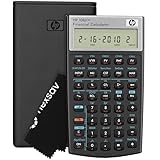
- HP 10BII+ FOR STUDENTS & PROFESSIONALS – This HP calculator is built for business, finance, accounting, and statistics courses. Perfect for learners and professionals who need to solve common financial problems quickly without memorizing formulas or relying on spreadsheets.
- 100+ FUNCTIONS FOR REAL WORLD MATH – Quickly solve time value of money, interest rates, loan payments, NPV, IRR, cash flows, and more. The 10bII+ also includes probability distributions for statistics courses—a feature not often found in financial calculators.
- ALGORITHMIC INPUT WITH DEDICATED KEYS – This high-school/college calculator uses algebraic and chain logic with minimal keystrokes. Layout appears the same as standard calculators for easy learning. Dedicated keys give quick access to commonly used financial and statistical functions
- APPROVED FOR MAJOR EXAMS – The HP 10bII+ algebra calculator is permitted for use on SAT, PSAT/NMSQT, and AP tests. An ideal statistics calculator and business calculator for school finance and accounting students preparing for class, coursework, or standardized exams.
- INCLUDES TRAVEL CASE, CLEANING CLOTH & BATTERIES– Slim, durable, and easy to keep on hand or store in a backpack or locker. Includes a protective case, cleaning cloth, and batteries so it’s ready out of the box. Large screen with clear contrast (non-backlit) is easy to read during exams or lectures.
$40,000 × 15% = $6,000
This is an estimate of the incremental tax on the gain, not the person’s entire tax bill.
Example 3: a short-term gain is ordinary income
A single filer has $80,000 of taxable income before a $20,000 short-term gain. The combined taxable income is $100,000, which remains inside the 2026 single-filer 22% ordinary bracket. The estimated additional ordinary tax is approximately:
$20,000 × 22% = $4,400
A short-term gain is not automatically taxed at the taxpayer’s highest possible rate. It fills the remaining ordinary brackets progressively; if the gain crosses a bracket boundary, different portions can have different rates.
Example 4: losses offset gains, then the annual limit applies
Suppose you have a $30,000 long-term gain and a $10,000 short-term loss. After netting the categories, the result is generally a $20,000 net long-term gain, subject to the applicable ordering rules. The short-term loss does not disappear; it offsets the long-term gain through the cross-netting process.
If instead your total net capital loss for the year is $8,000, you can generally deduct $3,000 against other income, leaving $5,000 to carry forward. A married person filing separately generally uses the $1,500 annual limit.
Example 5: NIIT is a separate layer
A single taxpayer has $210,000 of MAGI before a sale and $80,000 of net investment gain. After the sale, MAGI is $290,000, which is $90,000 above the $200,000 single-filer threshold. The NIIT base is the lesser of $80,000 and $90,000, or $80,000:
$80,000 × 3.8% = $3,040
The $3,040 is added separately to the regular federal income tax calculation. It is not a substitute for the regular long-term capital-gain rate.
Example 6: basis and selling costs change the gain
You purchase stock for $20,000, pay a $50 acquisition commission, reinvest $600 of taxable fund distributions, and receive a $200 return-of-capital distribution. Your adjusted basis is $20,450. You sell for $25,000 and pay a $75 commission, producing $24,925 of amount realized and a $4,475 gain. A calculator that uses $25,000 as the gain would be materially wrong.
What’s actually slowing this PC down?
Pick the symptom - the matching free tool is one click away.
Example 7: qualifying primary-home exclusion
You sell a home for $800,000, pay $40,000 of selling expenses, and have a $400,000 adjusted basis. The gain is:
($800,000 − $40,000) − $400,000 = $360,000
If you qualify for the individual home-sale exclusion, up to $250,000 may be excluded, leaving an estimated $110,000 of potentially taxable gain before other rules. A qualifying married couple filing jointly may be eligible for up to $500,000, but neither amount is automatic.
Special situations that can make a basic calculator wrong
Primary residence
You may be able to exclude up to $250,000 of gain as a qualifying individual or up to $500,000 for certain married couples filing jointly. The general ownership and use tests require owning and using the property as your main home for at least two years during the five-year period ending on the sale date. The exclusion may also depend on whether you used it for another sale during the relevant period.
A calculator should ask whether the property was your main home, whether you met the ownership and use tests, whether you previously used the exclusion, and whether a partial exclusion may apply because of a qualifying change in employment, health issue, or unforeseen circumstance. A loss on the sale of a personal residence is generally not deductible. Use IRS Publication 523 and the IRS sale-of-residence guidance.
What’s actually slowing this PC down?
Pick the symptom - the matching free tool is one click away.
Rental or business real estate
A rental or business-property sale is not necessarily an ordinary stock-style capital gain. Depreciation claimed or allowable can create ordinary-income recapture, unrecaptured Section 1250 gain generally subject to a maximum 25% rate, and remaining long-term capital gain. Depreciation can matter even when you did not claim every deduction that was allowable.
Use the depreciation information and Form 4797 data in the Schedule D calculation. A simple stock calculator should exclude rental and business-property sales or route them to an advanced workflow. See IRS Publication 544 and the Schedule D instructions.
Inherited property
Inherited property generally receives a basis based on its fair market value at the decedent’s death, subject to special rules. It is generally treated as long-term when sold regardless of how long the heir owned it. Do not enter only the decedent’s original purchase price.
Also popular on Amazon

- Solves time-value-of-money calculations such as annuities, mortgages, leases, savings, and more
- Performs cash-flow analysis for up to 32 uneven cash flows with up to 4-digit frequencies
- Calculates various financial functions: Net Future Value Net present Value Modified Internal Rate of Return Internal Rate of Return Modified Duration Payback Discounted Payback
- The Texas Instruments BAII Plus Professional features an Automatic Power Down (APD) function for extended battery life
- Prompted display guides you through financial calculations showing current variable and label. Ten-digit display
Gather the date of death, estate valuation or alternate valuation if applicable, later improvements, depreciation or other reductions, and selling expenses. The relevant guidance is in IRS Publication 551 and Publication 550.
Gifted property
Gift basis can have a dual-basis result. The donor’s adjusted basis generally carries over for determining gain. When the property was worth less than the donor’s basis on the gift date, the fair-market-value basis can affect the loss calculation. A sale price between the applicable gain and loss bases can produce neither a gain nor a deductible loss.
Ask for the donor’s adjusted basis, the property’s fair market value on the gift date, the gift date, later adjustments, and selling costs. The recipient’s value at the eventual sale is not enough. See IRS Publication 551.
Cryptocurrency and other digital assets
Digital assets can create taxable gain or loss when exchanged for U.S. dollars, another currency, another digital asset, goods, services, or certain transaction costs. The tax result requires the U.S.-dollar value and basis for each disposed unit or lot.
Collect these inputs:
- Digital-asset type and units disposed.
- Acquisition date and time, disposal date and time, and acquisition method.
- U.S.-dollar fair market value at disposal.
- Basis, including permitted acquisition costs and any gift or transfer history.
- Transaction fees and whether the transaction occurred through a U.S. or foreign broker.
For 2025 transactions, brokers generally began using Form 1099-DA, but many 2025 forms did not include basis. You must report taxable digital-asset transactions even if you do not receive a form. See the IRS Form 1099-DA guidance, IRS digital-asset reminders, and IRS digital-asset FAQs.
Recommended Free Tools
RSUs, ISOs, ESPPs, and other employer stock
Employer-stock sales can contain both ordinary compensation income and capital gain or loss. For nonstatutory options, the amount treated as wages generally becomes part of the stock’s basis. If you omit compensation already reported on Form W-2, a calculator may count the same income twice or overstate the capital gain.
Incentive stock options and employee stock purchase plans have special holding-period and ordinary-income rules. An ISO exercise can also create alternative minimum tax exposure. Do not estimate an RSU, ISO, or ESPP sale from only the grant price, sale price, and dates. Review IRS Topic 427 and Publication 525.
Collectibles and qualified small-business stock
Long-term gains from collectibles can be subject to a maximum 28% rate. Collectibles include artwork, rugs, antiques, metals, gems, stamps, coins, and alcoholic beverages. Certain qualified small-business stock gains may qualify for special Section 1202 treatment. Use an asset-type selector rather than applying the ordinary 0%, 15%, or 20% long-term rates to every asset. See the Schedule D instructions and Publication 550.
Installment sales and business interests
An installment sale can recognize gain as payments are received rather than treating the entire amount as current-year gain. It generally requires a separate gross-profit and payment calculation, often reported on Form 6252. Sales of partnership interests, S corporation interests, or other business assets can also produce ordinary-income components, depreciation recapture, or Schedule K-1 items. These transactions are outside a basic single-asset calculator.
Mutual funds, ETFs, REITs, and qualified dividends
You can owe tax on a mutual fund, ETF, or REIT capital-gain distribution even when you did not sell your shares. Capital-gain distributions are generally reported as long-term capital gains. Qualified dividends use the preferential rate structure but are dividends, not capital gains.
Check Form 1099-DIV for Box 2a capital-gain distributions and qualified dividends. Also account for return-of-capital distributions, reinvested distributions, and any mutual-fund average-basis election. An undistributed capital gain reported on Form 2439 can require additional reporting.
See IRS Topic 404. An apparent difference between a fund’s share-sale gain and your tax result may come from distributions that were already reported separately.
Tax-advantaged retirement accounts
First identify where the investment was held. Selling an investment inside a traditional IRA, Roth IRA, 401(k), 403(b), or another qualified account generally does not create a separate capital-gain tax at the time of the internal sale. Traditional IRA distributions are generally taxable when distributed, while qualified Roth IRA distributions can be tax-free.
A taxable brokerage sale and a sale inside an IRA are therefore not interchangeable calculator inputs. See IRS Topic 451 and the IRS IRA guidance.
Independent reader supportYour contribution helps us test, update, and keep practical guides available for everyone.Wash-sale adjustments: the loss may be deferred
A wash sale can defer a loss when you sell stock or securities at a loss and acquire substantially identical stock or securities during the period beginning 30 days before and ending 30 days after the sale. The disallowed loss is generally added to the basis of the replacement property rather than deducted immediately. See IRS Publication 550.
Also popular on Amazon

- Brand New in box; The product ships with all relevant accessories
- Dedicated keys allow easy access to common financial and statistics functions
- Easy-to-use design provides business, finance and statistical calculations fast
- Specially designed to meet the mathematical needs
A calculator should include a wash-sale adjustment field. Do not assume the broker’s Form 1099-B captures every wash sale, especially when purchases occurred in another account, through another broker, or in a spouse’s account. Check Form 1099-B Box 1g and use Form 8949 adjustment code W where applicable. Keep the replacement shares’ adjusted basis and holding-period information for a later sale.
Why two capital-gains calculators can produce different answers
Many online tools use the word income without saying whether it means gross income, AGI, taxable income before gains, taxable income after gains, or MAGI for NIIT. That ambiguity alone can materially change the result.
Free tools Windows power users keep installed
One-click scans. No signup required.
- SmartAsset’s calculator highlights purchase price, sale price, holding period, and tax bracket. Its simplified examples can be useful for orientation but may obscure bracket stacking, deductions, NIIT, state tax, and special gain categories.
- NerdWallet’s rate guidance provides consumer-level 2025 and 2026 rate tables and explains short-term versus long-term treatment, but a rate table is not a transaction-level basis, wash-sale, depreciation, inherited-property, or multi-state calculator.
- Forbes Advisor’s calculator page illustrates why a tool should show its tax year, update date, deduction assumptions, federal-versus-state scope, NIIT treatment, and whether it reports total tax or incremental tax.
A credible result should disclose the tax year, define every income input, identify excluded rules, and show the tax before and after the sale. A single number without those assumptions can create false precision.
How capital gains are reported
For a typical securities transaction, the federal reporting path is:
Form 8949 → Schedule D → Form 1040
Form 8949 generally reconciles transaction-level proceeds, basis, and adjustments. Schedule D summarizes capital gains and losses, including carryovers and special worksheets. Form 1040 incorporates the result into the overall return.
Other forms may apply:
- Form 1099-B: Broker-reported sales of securities.
- Form 1099-DA: Broker-reported digital-asset transactions.
- Form 4797: Sales of business property and related depreciation information.
- Form 6252: Installment-sale reporting.
- Form 8960: Net Investment Income Tax.
- Form 6251: Alternative minimum tax calculations, which can matter in situations such as certain ISO exercises.
- Form 2439: Undistributed long-term capital gains reported by certain regulated investment companies and REITs.
Broker-reported basis is not a guarantee that the tax basis is complete. You remain responsible for correcting missing basis, wash-sale adjustments, transferred lots, and other errors.
Estimated payments after a large gain
A large gain can create an estimated-tax obligation even if the sale occurred only once. The IRS generally considers whether you expect to owe at least $1,000 after withholding and refundable credits and whether withholding and credits satisfy the applicable safe-harbor tests. If the gain occurred in one part of the year, annualizing income may be relevant.
Important: This estimate shows potential annual tax attributable to the sale. It does not determine whether you must make a quarterly estimated payment or whether an underpayment penalty applies. Review the IRS estimated-tax guidance for large gains.
When a basic calculator is appropriate—and when it is not
A basic estimate is usually reasonable when:
- You sold stock, an ETF, or a mutual fund in a taxable brokerage account.
- You know the adjusted basis and selling expenses.
- The holding period is clear.
- There are no unusual wash-sale, gift, inheritance, compensation, or depreciation issues.
- You can provide taxable income before the sale and your filing status.
Use tax software or a tax professional when:
- You sold rental or business property or need depreciation recapture.
- You sold a home that was rented or used for business.
- You received the asset by gift or inheritance and basis is uncertain.
- You exercised ISOs, have a complex ESPP transaction, or need an AMT calculation.
- You have a large crypto transaction history or incomplete digital-asset basis records.
- You sold collectibles, qualified small-business stock, partnership interests, or S corporation interests.
- You used installment-sale treatment.
- You have substantial NIIT exposure, multiple states, nonresident issues, or expatriate tax issues.
- You need to calculate estimated-tax payments or an underpayment penalty.
Capital-gains calculator checklist
- Confirm that the asset was sold or otherwise disposed of. An increase in value that has not been realized is generally not reported as a regular capital gain merely because the asset appreciated.
- Use the correct tax year: 2025 sales go on 2025 returns filed in 2026; 2026 sales go on 2026 returns filed in 2027.
- Enter adjusted basis, not just the original purchase price.
- Subtract eligible selling expenses from proceeds.
- Confirm whether the holding period is one year or less or more than one year.
- Net short-term and long-term gains and losses separately before cross-netting.
- Include capital-loss carryovers and observe the $3,000 or $1,500 annual deduction limit.
- Check for wash-sale adjustments and missing basis on Forms 1099-B or 1099-DA.
- Use the home-sale exclusion only after checking the ownership, use, prior-use, partial-exclusion, and depreciation rules.
- Calculate NIIT using MAGI and net investment income rather than applying 3.8% to every gain.
- Add a documented state estimate instead of assuming federal treatment applies in your state.
- Interpret the result as incremental tax from the sale, not automatically the amount due when filing.
Frequently Asked Questions
Is capital-gains tax based on the sale price or the profit?
It is generally based on the profit: the amount realized, usually proceeds minus eligible selling expenses, minus adjusted basis. The original purchase price may not be the current basis after commissions, reinvested distributions, stock splits, depreciation, gifts, inheritances, or other adjustments. See IRS Publication 550.
Do I owe capital-gains tax if I have not sold the investment?
Usually, appreciation that has not been realized by a sale or other taxable disposition is not reported as a regular capital gain. However, dividends, mutual-fund capital-gain distributions, digital-asset exchanges, and certain other events can create taxable income without a conventional cash sale.
Do these 3 things before closing this tab:
1Scan for outdated or missing drivers - takes under a minute2Repair Windows errors before they cause bigger problems3Fix the driver behind crashes, sound loss and screen glitchesAre all long-term capital gains taxed at 15%?
No. For 2026, most net long-term gains use marginal 0%, 15%, and 20% thresholds based on taxable income. A gain can span more than one band. Collectibles, unrecaptured Section 1250 gain, qualified small-business stock, and other special categories can have different treatment.
Does a Form 1099-B or Form 1099-DA tell me my taxable gain?
Not always. These forms may report proceeds and basis, but basis can be missing or incomplete, and broker reporting may not capture every wash sale or transferred lot. Compare the form with your own records and make required adjustments on Form 8949.
Does selling an investment inside an IRA create capital-gains tax immediately?
Generally, no separate capital-gain tax is due when an investment is sold inside a traditional IRA, Roth IRA, 401(k), or similar qualified account. Tax treatment generally occurs when distributions are taken, subject to the account’s rules.
Will a capital-gains calculator tell me how much estimated tax to pay?
Not by itself. A calculator can estimate annual tax attributable to the gain, but estimated-payment requirements depend on withholding, credits, prior-year tax, safe harbors, timing, and potentially annualized income. A large gain may require a separate estimated-tax analysis.
The Tool Desk
Outbyte Driver Updater FREEFix the driver behind crashes, sound loss and screen glitchesFind Drivers →Outbyte PC Repair FREERepair Windows errors before they cause bigger problemsFix Now →The Bottom Line
Bottom line: For a normal taxable stock or fund sale, calculate sale proceeds minus selling costs minus adjusted basis, classify the result as short-term or long-term, net it with other gains and losses, and layer it onto your 2026 taxable income. Then check NIIT and state tax. Treat the result as an estimate of the tax caused by the sale—not automatically the amount you will owe at filing—and use professional guidance for real estate, crypto, employee stock, gifts, inheritances, collectibles, business assets, and other special situations.




