
For most professionally operated sites in 2026, an AI data center offers the better profit opportunity per constrained megawatt—but only when GPU capacity is contracted, highly utilized and backed by reliable power. Bitcoin mining can still win when electricity is exceptionally cheap, stranded or interruptible, because ASICs are faster to deploy, easier to curtail and simpler to restart.
There is no universal revenue-per-megawatt winner. The defensible choice depends on a site’s all-in electricity price, hardware efficiency, cooling and networking, financing, utilization, downtime, contract terms and ability to manage risk. The comparison below shows how to model those variables instead of relying on a headline revenue figure.
As an Amazon Associate I earn from qualifying purchases.
The decision in one sentence
Choose AI compute when you can secure long-term GPU demand, maintain high utilization and fund specialized high-density infrastructure. Choose Bitcoin mining when your power is unusually inexpensive, can be curtailed during expensive hours, or would otherwise be stranded—and when you can tolerate revenue that moves with Bitcoin’s price, network difficulty, block reward and global hashprice.
Quick wins for a faster PC:
Clear out junk files and repair common Windows errorsFree Scan →Scan for outdated or missing drivers - takes under a minuteDriver Scan →These businesses monetize electricity differently. A miner converts power into cryptographic work and receives a protocol-linked reward. An AI facility sells GPU-hours or contracted capacity to customers. Mining revenue is transparent but volatile; AI revenue can be steadier under contract but is harder to build, finance and operate.
#1 Best Overall

- SLOT - 6/8/12 GPU slots, support 2 ATX power supplies.
- MATERIAL - The open air mining frame case made up of the highest quality stainless steel material, strong, durable and available. Fully protecting your GPU and eectronic device.
- PERFECT DESIGN - Professional design for mining rig frame, accelerating the air convection, super cooling design for heat dissipation. Enough space reserved between the graphics cards.
- EASY TO INSTALL - Easy to install and strong structure. Keep all cables clean and organized, along with everything in your mining machine.
- NEED TO ASSEMBLE BY YOURSELF - For installation steps, please refer to the user manual. The Frame Only, Not includes Fans or other CPU, GPU, PSU, Motherboards, Cables. If you are not 100% satistifed with this Miner, please feel free to contact us, we will offer you a satisfactory soluiton within 24 hours.
How Bitcoin mining generates revenue
The revenue unit is hashprice
Mining economics are usually expressed as hashprice: the Bitcoin revenue earned per unit of computing power, commonly quoted in US dollars per petahash per second per day (US$/PH/s/day). A simple gross-revenue equation is:
daily mining revenue = fleet hashrate (PH/s) × hashprice (US$/PH/s/day)
Net profit subtracts electricity, hosting, labor, repairs, pool fees, insurance, financing, taxes, depreciation and any curtailment or demand charges. IREN says Bitcoin-mining revenue is affected principally by Bitcoin’s market price, the global network hashrate and the block reward; electricity availability, cost and fleet efficiency determine whether that revenue becomes cash flow.
Why the block reward matters
The April 2024 halving reduced the subsidy paid in each Bitcoin block to 3.125 BTC. The next halving is expected in 2028, although the exact date depends on block production. Unless Bitcoin’s price or transaction-fee revenue rises enough to compensate, each halving reduces the protocol revenue available to miners.
Hashprice has recently pressured inefficient fleets
CoinShares reported a monthly average hashprice of US$27.7/PH/s/day in June 2026, an all-time low in its series. Its first-quarter 2026 analysis put hashprice around US$36–US$38/PH/s/day. CoinShares estimated that miners operating below S19 XP-class efficiency at electricity prices of US$0.06/kWh or higher were losing money at approximately US$30/PH/s/day; it estimated those less-efficient machines represented 15–20% of the global fleet.
The threshold is not a universal shutdown price. It changes with machine efficiency, pool fees, cooling overhead, hosting terms, Bitcoin price and hashprice. It does show why a small change in power cost can determine whether an older fleet runs, curtails or shuts down.
Rank #2

- Genuine New Canaan Avalon Q Miner with full manufacturer warranty. Trust a reliable seller – no used or refurbished units
- Maximize profits with 90TH/s hash rate at just 18.6J/TH – one of the most energy-efficient ASIC miners for home or business mining
- Ready to mine right out of the box! Includes a 110V-240V power cord for seamless setup in any standard outlet
- Designed for home-friendly mining with advanced noise reduction – mine Bitcoin without disturbing your household
- Note: All products we offer are brand new and in pristine condition. Returns are accepted. If the return is not due to a verified product failure, a restocking fee will be deducted from your refund to cover handling and logistics costs.
Power is the dominant marginal cost
Riot Platforms described power as “overwhelmingly the largest marginal input cost in mining bitcoin.” Company results illustrate the exposure. MARA reported purchased energy cost of US$38,956 per bitcoin in 2025 at its owned sites, up from US$29,084 in 2024. Ionic Digital reported that energy costs represented 51.1% of cryptocurrency-mining revenue at its owned and leased sites in 2025, and an average cost to earn one bitcoin including depreciation of US$93,330 in the first quarter of 2026. Those figures are company-specific, not a market-wide average: accounting, hedges, curtailment credits, machine mix and depreciation differ.
How AI data centers generate revenue
The revenue unit is a GPU-hour or contracted capacity
An AI facility sells access to accelerators, memory, networking and the surrounding software stack. Revenue may be metered as GPU-hours, reserved capacity, a managed service or a multi-year contract. A basic equation is:
daily AI revenue = sellable GPUs × available hours × utilization × realized price per GPU-hour
Realized price is not the same as a public list price. Discounts, minimum commitments, free credits, failed jobs, support, storage, network traffic and customer payment risk affect the amount collected. A signed contract can reduce price volatility, but it does not remove utilization, counterparty or technology risk.
IREN’s illustrative assumption
An IREN 2025 presentation used an illustrative AI Cloud revenue assumption of US$2.00–US$2.50 per GPU-hour at an electricity price of US$0.045/kWh. This is an assumption for modeling, not an industry-wide realized rate or a guarantee for a particular GPU, contract or region. To use it responsibly, replace the rate with your expected contract price and model utilization, power overhead, staffing, financing and hardware depreciation separately.
Free tools Windows power users keep installed
One-click scans. No signup required.
Demand is expanding, but so are infrastructure requirements
The International Energy Agency reported that global data-center electricity demand grew 17% in 2025, while AI-focused data-center demand grew 50%. Five major technology companies spent more than US$400 billion on capital expenditure in 2025; the IEA expected a further 75% increase in 2026. Its base case projects global data-center electricity consumption from 485 TWh in 2025 to 950 TWh in 2030.
Rank #3

- ⚡ Efficient Home ASIC Miner – Up to 1.1 TH/s hashrate with just 18W power consumption (15 J/TH), perfect for home or small office use.
- 🇪🇺 Made in Europe – Designed and manufactured in Europe with premium components for reliability and long-term performance.
- 🔧 BM1370 ASIC Chip (Antminer S21 Pro) – Same chip used in the Antminer S21 Pro for professional-grade mining power in a compact, open-source form.
- 📡 Wi-Fi & USB-C Connectivity – No monitor or keyboard required – configure and monitor easily via web interface
- 🎁 Complete Kit Included – Delivered fully assembled with EU/UK/US 5V 6A power supply, premium fan, 3D-printed stand, and OLED display.
AI-server power density increased elevenfold from 2020 to 2025, according to the IEA, and could increase another fourfold by 2027. More compute per rack improves revenue density when utilization is high, but it demands liquid cooling or other advanced thermal systems, higher-capacity power distribution, fast networking and tighter operational tolerances.
Bitcoin mining versus AI data centers: the operating comparison
| Decision axis | Bitcoin mining | AI data center |
|---|---|---|
| Revenue unit | Hashprice per PH/s/day, plus transaction-fee share | GPU-hour, reserved capacity or contracted AI service |
| Revenue volatility | Directly exposed to Bitcoin price, global hashrate, difficulty and the halving schedule | Depends on contract duration, utilization, realized pricing, customer credit and competition; contracts can smooth volatility |
| Power profile | Large, comparatively uniform and often interruptible; can curtail during high-price periods | High-density, low-interruption load; customers generally expect consistent performance and availability |
| Hardware cycle and residual value | ASICs are specialized and can become uneconomic quickly when hashprice falls; resale value follows fleet efficiency and Bitcoin conditions | GPUs and networking equipment have broader uses but face rapid product cycles, supply constraints and obsolescence risk |
| Cooling and networking | Air cooling is common, with immersion or other systems for some designs; networking requirements are relatively modest | High-capacity cooling, power delivery, low-latency fabric, storage and monitoring are essential for dense clusters |
| Capex and financing | ASIC purchase, containers or buildings, transformers, mining infrastructure and working capital | Accelerators, servers, high-speed interconnects, cooling, backup systems, software, construction and substantial working capital |
| Site and grid lead time | Can often deploy in an existing industrial site and scale in modules, subject to interconnection and permitting | Grid interconnection, transformers, chips, cooling design, permitting and financing can delay revenue even when demand is strong |
| Downside and restart flexibility | Can shut down or curtail quickly; restarting is relatively simple if machines remain economically efficient | Less flexible because customers, service-level commitments and thermal systems require continuity; idle equipment still incurs capital costs |
| Regulatory and permitting exposure | Electricity tariffs, noise, land use, emissions associated with power supply and local restrictions | Construction and grid approvals, water or thermal-system requirements, data handling, customer contracts and potentially export or supply-chain constraints |
How much can one megawatt make?
No authoritative, standardized industry statistic converts one megawatt into a universal Bitcoin or AI revenue figure. A megawatt is a power limit, not a business model. The result depends on what portion is usable by IT equipment, equipment efficiency, uptime, pricing and non-power costs.
Mining: convert megawatts into hashrate first
For a mining fleet, estimate the hashrate supported by the site:
Outdated Drivers Are Slowing You Down
One free scan finds every outdated or missing driver and matches the right update for your exact hardware.Free scan · exact hardware matchWindows Errors? Fix Them Before They Spread
Repair common Windows errors and clear accumulated junk for a smoother, more stable PC - no reinstall needed.Free scan · no reinstallfleet PH/s ≈ (IT megawatts × 1,000,000 watts ÷ machine efficiency in joules per terahash) ÷ 1,000
Then apply uptime and site overhead. For example, a site with 1 MW of total utility capacity cannot necessarily devote all 1 MW to ASICs; transformers, fans, pumps, controls and distribution consume part of it. Multiply the resulting PH/s by the current or scenario hashprice to estimate gross daily revenue, then subtract electricity and all other costs.
Energy alone consumes 24,000 kWh per day for every continuously operated megawatt. At US$0.06/kWh, that is US$1,440 per day before demand charges, taxes, cooling overhead or other fees. The comparison with hashprice must use the same time period and include the actual machine efficiency; otherwise a per-megawatt claim is misleading.
Rank #4

- SUPERIOR HASHING POWER: Unlock 13.8 TH/s of mining performance with the updated Rev 3.1 architecture. Engineered for SHA-256 algorithm efficiency, this unit provides a powerful and consistent hashrate for Bitcoin and compatible cryptocurrency mining.
- ULTRA-LOW ENERGY CONSUMPTION: Experience the perfect balance of performance and efficiency. Running at a remarkably low 230W, this miner maximizes your output while keeping your electricity costs manageable, making it the ideal choice for 24/7 sustainable home mining.
- WHISPER-QUIET LIQUID COOLING: Designed specifically for home environments, our advanced integrated hydro-cooling system dissipates heat effectively while maintaining near-silent operation. Enjoy high-performance mining without the noise disturbance typical of industrial-grade equipment.
- PLUG-AND-PLAY SETUP: Get started in minutes with our user-friendly, open-source interface. The device features integrated Wi-Fi connectivity and an intuitive dashboard, allowing both beginners and experienced enthusiasts to manage their mining pool settings with ease.
- COMPACT & ROBUST DESIGN: Built with durability in mind, the Rev 3.1 features a sleek, space-saving form factor that fits perfectly on any desk or shelf. It includes a high-quality power supply unit (PSU) and is ready for immediate deployment in your home or office.
AI: count sellable GPU-hours, not just facility megawatts
For AI, determine how many GPUs the electrical and thermal design can support, how many hours are sellable, and the utilization and price achieved. A 1 MW connection may include cooling, networking, storage, backup and reserve capacity, leaving less than 1 MW for GPUs. The facility’s power-usage effectiveness (PUE) therefore matters.
The Tool Desk
Outbyte Driver Updater FREEFix the driver behind crashes, sound loss and screen glitchesFind Drivers →Outbyte PC Repair FREEClear out junk files and repair common Windows errorsFree Scan →At US$0.045/kWh, a continuously powered 1 MW load costs US$1,080 per day in electricity before PUE and demand charges. That arithmetic does not establish AI revenue: the number of GPUs, their power draw, the contract rate and utilization are still required. Applying the illustrative US$2.00–US$2.50 GPU-hour assumption without those inputs would create a false revenue-per-megawatt statistic.
Three profitability scenarios
Scenario 1: exceptionally cheap or stranded power with strong Bitcoin conditions
Mining can be the better use when the site has a genuinely low all-in energy cost, excess generation that cannot be sold at attractive prices, or a tariff that rewards curtailment. High Bitcoin prices and favorable network conditions improve hashprice. Modular ASIC deployment lets an operator begin with part of the site, shut down during expensive hours and add machines as economics permit.
The risks are concentration and speed of deterioration. A Bitcoin-price decline, difficulty increase, halving, machine failure or tariff change can compress margins quickly. The model should include a shutdown trigger and cash reserves rather than assuming continuous operation.
Scenario 2: ordinary industrial power and current hashprice
At mainstream industrial electricity prices, an older fleet is particularly vulnerable. CoinShares’ US$0.06/kWh observation for sub-S19-XP efficiency is a warning that energy cost can exceed mining revenue at weak hashprice. Newer machines may remain viable, but only after accounting for hosting, cooling, financing and downtime.
Do these 3 things before closing this tab:
1Repair Windows errors before they cause bigger problems2Fix the driver behind crashes, sound loss and screen glitches3Clear out junk files and repair common Windows errorsThis is the scenario in which a miner should resist using a single Bitcoin price forecast. Calculate a range of hashprice outcomes, include the next halving, and test whether the fleet still covers cash operating costs and debt service in the downside case.
Best Value
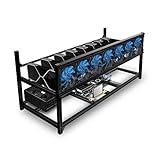
- ✅Premium Aluminum Construction: Constructed from high-quality aluminum for enhanced durability and heat dissipation, ensuring longevity and optimal performance.
- ✅ Accommodates 8 GPUs: Designed to house up to 8 graphics cards, providing ample space for expanding your mining setup and maximizing efficiency.
- ✅ Superior Airflow and Cooling: Engineered with optimized airflow design to prevent overheating and maintain optimal operating temperatures for prolonged mining sessions.
- ✅ Easy Assembly: Simple and straightforward assembly process allows for quick setup, getting you up and running in no time.
- ✅ Sleek and Space-Saving Design: Compact and minimalist design saves space while adding a professional touch to your mining rig setup.
Scenario 3: contracted GPU demand and reliable power
AI generally has the stronger expected revenue density when customers commit to capacity, utilization is high and the site can deliver the required power quality and cooling. Contracted demand can make financing easier than relying entirely on spot Bitcoin revenue, and the IEA’s demand growth indicates a large expanding market.
AI is not automatically superior. Construction delays, transformer shortages, chip availability, liquid-cooling failures, underutilized GPUs or a customer cancellation can leave an expensive facility producing little revenue. A contract should be reviewed for minimum payments, take-or-pay terms, uptime obligations, escalation clauses, collateral and termination rights.
Independent reader supportYour contribution helps us test, update, and keep practical guides available for everyone.Should a Bitcoin miner convert its power to GPUs?
Conversion is a site-specific capital-allocation decision, not a simple hardware swap. ASIC buildings may have land, substations and fiber but lack the floor loading, liquid-cooling distribution, high-speed fabric, redundant power paths and software operations required by AI clusters.
What’s actually slowing this PC down?
Pick the symptom - the matching free tool is one click away.
Conditions that support conversion
- A signed or highly credible GPU customer with a minimum utilization commitment.
- Interconnection capacity that can support dense, low-interruption loads rather than only interruptible mining.
- A cooling and power design that has been engineered for the target GPUs, racks and PUE.
- Enough capital to fund GPUs, networking, commissioning, spares and several months of ramp-up.
- A realistic plan for hardware refreshes as accelerator generations change.
- Contract terms that compensate the operator for uptime, reserved capacity and stranded-capacity risk.
Conditions that favor keeping ASICs
- Electricity is stranded, curtailed or priced well below the level at which comparable fleets lose money.
- The site can interrupt load without penalties and restart quickly.
- The existing electrical and cooling infrastructure is already optimized for mining.
- No bankable GPU demand exists, or customers will only buy uncertain spot capacity.
- The operator values modular deployment and is not prepared for AI’s networking, support and service-level requirements.
A lower-risk transition path
- Measure 12 months of hourly electricity prices, curtailment opportunities, demand charges and actual mining uptime.
- Audit the substation, transformers, switchgear, fiber, floor loading, cooling and fire systems against the proposed GPU design.
- Obtain a customer-backed GPU demand forecast with minimum volumes, pricing, uptime and payment protections.
- Build a pilot cluster in a separately metered area and verify power quality, thermal performance, network throughput and realized utilization.
- Compare the pilot’s after-tax cash flow with continuing ASIC operation under the same power-price and downtime assumptions.
- Expand only when the pilot meets technical and contractual thresholds; retain an ASIC block if its curtailment value diversifies the site.
Build a site-specific break-even model
Step 1: define the boundary
Use the same boundary for both alternatives. Include purchased electricity, demand charges, transmission, taxes, hosting, cooling, labor, repairs, insurance, software, networking, financing, depreciation, taxes and decommissioning. Separate cash costs from accounting costs so you can see both operating survival and long-term return on capital.
Step 2: model Bitcoin in hourly or daily periods
- Enter machine count, hashrate and efficiency for each ASIC model.
- Apply the site’s actual uptime and curtailment schedule.
- Calculate gross revenue from scenario hashprice, including a separate assumption for transaction-fee revenue if used.
- Subtract energy at the site’s hourly tariff, plus cooling, hosting, pool fees, labor, repairs and financing.
- Run cases for low, central and high Bitcoin price; network difficulty; hashprice; electricity price; and the 2028 halving.
- Set a shutdown or curtailment rule based on cash margin, not on a hoped-for future Bitcoin price.
Step 3: model AI by contract and utilization
- List each GPU type, installed count, power draw, useful life and expected resale value.
- Convert facility capacity into sellable GPU-hours after PUE, maintenance reserves and hardware failures.
- Enter contracted price, utilization, discounts, support revenue and customer payment terms separately.
- Subtract electricity, cooling water or thermal-system costs, networking, storage, software, staffing, insurance, financing and refresh capex.
- Stress-test delayed energization, a six- or twelve-month utilization ramp, a customer default, lower realized GPU-hour pricing and accelerated hardware obsolescence.
- Calculate return on invested capital and debt-service coverage, not just gross revenue.
Step 4: compare flexibility as an option value
Mining has a valuable ability to turn off when power is expensive. AI capacity may earn more when operating but can be less interruptible and more contractually constrained. Add the value of curtailment, restart time, resale, stranded capacity and alternative customers to the financial comparison.
Common analytical mistakes
- Comparing gross revenue with net profit. Hashprice and GPU-hour rates are revenue measures; they do not include power, cooling, financing or downtime.
- Using one company’s cost as an industry average. MARA’s energy cost and Ionic Digital’s cost to earn a bitcoin reflect their own fleets, sites and accounting.
- Ignoring utilization. A GPU earns nothing while idle, and an ASIC may still incur hosting or financing costs while curtailed.
- Treating a megawatt as fully usable IT load. Transformers, cooling, networking and reserves consume capacity.
- Assuming old ASICs have stable resale value. Their economics can change abruptly when hashprice falls or more efficient machines enter the network.
- Assuming AI contracts eliminate risk. Read minimum-volume, uptime, payment and termination provisions; a headline contract value is not guaranteed cash flow.
- Ignoring lead time. AI projects can wait on grid interconnection, transformers, chips, permitting, cooling design and financing even when customers are ready.
- Mixing forecasts and reported results. IEA demand projections, IREN’s GPU-hour assumption and CoinShares hashprice snapshots are different kinds of evidence and should remain labeled as such.
What the market is signaling
Public miners are increasingly testing AI and high-performance computing because GPU contracts can provide a different revenue profile from Bitcoin. CoinShares reported that one operator’s AI Cloud revenue reached US$70.5 million in the second quarter of 2026, overtaking its US$66.7 million mining revenue. It also reported that AI/HPC deals signed by miners in 2025 and early 2026 exceeded US$70 billion in aggregate. These developments demonstrate strategic interest, not proof that every conversion will be profitable; contract quality, utilization and infrastructure readiness still decide the outcome.
A practical go/no-go checklist
- Do you know your all-in delivered electricity cost for every hour, including demand and transmission charges?
- Can the grid connection legally and technically support the proposed continuous load?
- What portion of the connection is available to IT equipment after cooling and electrical overhead?
- For mining, what hashprice and machine-efficiency level covers cash costs and debt service?
- For AI, what contracted GPU-hours and minimum payments cover the ramp period?
- How quickly can each option be curtailed, restarted, repaired or repurposed?
- What happens after the next Bitcoin halving or the next accelerator generation?
- Which permits, environmental controls, data obligations and customer service levels apply?
- Can the project survive a year of lower utilization or weaker revenue without emergency financing?
- Are reported figures, forecasts and illustrative assumptions clearly separated in the model?
Bottom line: the profitable use depends on the power and the contract
AI data centers have the better expected opportunity per constrained megawatt when GPU demand is contracted, utilization is high and the operator can deliver reliable, high-density infrastructure. Bitcoin mining remains compelling for flexible or stranded power, very low electricity costs and operators who value rapid deployment and curtailment. Use site-specific cash-flow models, not a universal revenue-per-megawatt claim, and make the decision only after testing power prices, utilization, downtime, hardware cycles, financing and the relevant downside cases.
Quick Recap
Product prices and availability are accurate as of the date/time indicated and are subject to change. Any price and availability information displayed on Amazon at the time of purchase will apply.




