The Tool Desk
Outbyte Driver Updater FREEFix the driver behind crashes, sound loss and screen glitchesFind Drivers →Outbyte PC Repair FREERepair Windows errors before they cause bigger problemsFix Now →The U.S. 25-year import rule can make an overseas vehicle easier to bring into the country, but it is not a “no paperwork” rule and it does not make an import tax-free. It is primarily a NHTSA safety exemption: once a vehicle reaches 25 years from its actual date of manufacture, it may generally enter without meeting applicable U.S. Federal Motor Vehicle Safety Standards (FMVSS).
You may still have to satisfy EPA emissions rules, file customs documents, pay duty and tariffs, and meet your state’s title, inspection, and registration requirements. The age calculation, vehicle modifications, and paperwork are where many expensive mistakes begin.
What the 25-year import rule actually exempts
NHTSA’s rule removes the need to show that an eligible vehicle complies with applicable FMVSS. That matters because many vehicles originally sold outside the United States were never built or certified for U.S. safety standards. Without an exemption, an importer may need to use a registered importer to modify and certify the vehicle.
For the federal safety exemption, the importer claims the vehicle is at least 25 years old on DOT Form HS-7, selecting Box 1.
Outdated Drivers Are Slowing You Down
One free scan finds every outdated or missing driver and matches the right update for your exact hardware.Free scan · exact hardware matchPC Slower Than It Used to Be?
A free scan shows the junk files, broken settings and background clutter dragging Windows down - then fixes them in one click.Free scan · Windows 10 & 11#1 Best Overall

- Envelopes measure 9" H x 12" W
- Sold in packages of 100
- Convenient thumb-cut for easy document access
- Ideal for organizing and storing important paperwork
- Helps maintain efficiency in dealership operations
The exemption does not automatically waive:
- EPA emissions requirements;
- customs entry and ownership documentation;
- import duty, tariffs, processing fees, or port charges;
- state title, registration, inspection, insurance, or emissions rules; or
- requirements that apply to particular vehicle types or equipment.
How to calculate the 25 years
NHTSA uses the vehicle’s date of manufacture, not just its model year. The relevant date is normally found on the manufacturer’s certification label or another reliable production record.
For example, a vehicle manufactured on August 10, 2001, reaches the federal safety exemption on August 10, 2026. A vehicle made on August 9, 2001, generally reaches it one day earlier. A listing that says only “2001 model” is not enough to establish the exact eligibility date.
| Information | Why it matters |
|---|---|
| Model year | Useful for identifying the vehicle, but not conclusive for NHTSA’s 25-year calculation. |
| Actual manufacture date | Determines when the safety exemption becomes available. |
| VIN | Helps customs, the DMV, and insurers identify the vehicle. |
| Original title or registration | Supports ownership and may help establish the vehicle’s age if the label is incomplete. |
Manufacturers often build a model-year vehicle during the preceding calendar year. That is why a 2001 model may have been manufactured in 2000 or 2001, while two vehicles with the same model-year label can become eligible on different dates.
If the permanent label does not show the production date, NHTSA identifies possible supporting evidence such as an original invoice, an old registration showing the vehicle was registered at least 25 years ago, a manufacturer letter, or documentation from a recognized vehicle historical society. Keep copies of whatever evidence you use before the vehicle ships.
The 21-year EPA rule is different
The 25-year NHTSA exemption is commonly confused with EPA’s separate 21-year emissions exclusion. They address different federal requirements.
EPA Form 3520-1 uses import code E for a vehicle that is at least 21 years old under EPA’s calendar-year calculation and remains in its original, unmodified configuration. In 2026, this generally points to vehicles manufactured in calendar year 2005 or earlier, assuming the other EPA conditions are satisfied.
“Original configuration” is important. The EPA exemption is not permission to import any old car with any engine or emissions setup. EPA states that an older vehicle with a replacement engine generally does not qualify unless the replacement engine and emissions-control system are equivalent to, or newer than, the certified original equipment.
Rank #2

- Holds Vehicle Registration and Insurance Cards and Much More - here at High Road, we share the road with you. We know what American drivers need and use, which is why we gave fresh thinking to what's stored in glove boxes 10 years ago, and why we came up with a new kind of car organizer with 7 expanding file compartments to hold documents, receipts, coupons and cards in easy to view clear file pockets
- Clear Front Card Pockets - 2 card pockets in front hold gas, insurance, roadside assistance and reward cards, making them fast and easy to access when needed
- Multipurpose document holder for truck, car, van or SUV - each file compartment has a tab slot on top for easy organization, includes pre-printed tab inserts and a convenient service log to keep track of important maintenance dates
- Slim and Compact Car Paperwork Organizer - offers more storage than most registration and insurance card holders by organizing the loose paperwork that makes up glovebox clutter, and there's just the right amount of compartments to keep our organizer slim while making it easy to find what you need, when you need it
- Sturdy Construction and Quality Materials - structured panels with elastic loop closure are covered with 500D polyester to protect important documents, based in Portland Maine, High Road has designed problem solving car organizers for over 30 years
A practical way to think about the two rules is:
| Requirement | Agency | Typical form or claim | Main age threshold |
|---|---|---|---|
| Federal vehicle safety standards | NHTSA/DOT | HS-7, Box 1 | 25 years from manufacture date |
| Vehicle emissions requirements | EPA | Form 3520-1, code E when eligible | 21 years under EPA’s calendar-year test, plus original configuration |
A normal gray-market vehicle that qualifies under both exemptions will generally need both forms at entry. Being 25 years old does not eliminate the need to address EPA requirements.
Recommended Free Tools
Do modifications or restorations affect eligibility?
Modifications can affect the two federal exemptions differently. NHTSA’s 25-year safety exemption concerns the age of the vehicle and FMVSS compliance. A qualifying vehicle may still be modified and use the safety exemption.
EPA’s code E exemption is stricter about the vehicle’s configuration. An engine swap, altered emissions equipment, or other major change may prevent the vehicle from qualifying under the 21-year emissions exclusion.
Age also belongs to the vehicle, not to its individual parts. Installing an engine, body, or other components that are 25 years old does not make a recently manufactured chassis eligible. A newly assembled replica is not automatically an old vehicle just because it uses vintage parts. If the vehicle has a replacement chassis or extensive reconstruction, obtain an agency determination or professional import advice before shipping it.
Documents required at import
The exact process depends on the port, shipping method, vehicle type, and whether you use a customs broker. Common documents include:
What’s actually slowing this PC down?
Pick the symptom - the matching free tool is one click away.
- the original title or a certified copy;
- the bill of sale or purchase invoice;
- the vehicle identification number and manufacture-date evidence;
- completed DOT Form HS-7;
- completed EPA Form 3520-1;
- bill of lading and other shipping documents;
- customs entry information; and
- any documents required for special vehicle classifications or state registration.
Declare the vehicle to U.S. Customs and Border Protection (CBP) and make the applicable safety and emissions claims at entry. After the formal entry is processed and charges are paid, CBP issues Form 7501, Entry Summary. Keep it permanently with the title file. States commonly require proof of CBP entry before issuing a title or registration.
A vehicle that entered without a proper formal entry can create serious problems later. The DMV may refuse to register it, and CBP warns that selling a vehicle that was never properly entered may be illegal and could expose the vehicle to seizure.
Rank #3
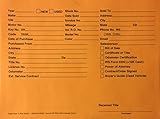
- Quantity: 500
- Color: Orange
- Size: 12" x 9", 32# paper stock (medium weight)
- Item: AP-DSA-546
- Dealer jacket sealed on 3 sides with top (long edge) opening with thumb cut for easy access
How much does it cost?
The 25-year rule can reduce compliance and conversion costs, but it does not determine the total cost of importing a vehicle. Budget for the vehicle itself plus:
- international shipping and marine insurance;
- customs broker and port fees;
- import duty and any applicable tariff programs;
- the Merchandise Processing Fee;
- Harbor Maintenance Fee for qualifying ocean shipments;
- storage, inspection, and inland transport;
- repairs needed for safe operation;
- state title, sales, use, registration, and inspection charges; and
- insurance, which may be more expensive or harder to obtain for a gray-market vehicle.
CBP’s traditional guidance lists base rates of 2.5% for passenger automobiles, 25% for trucks, and 2.4% or free for motorcycles depending on classification. Those figures are not a guaranteed current total. Country of origin, vehicle classification, trade agreements, Section 232 duties, reciprocal tariffs, and other Chapter 99 provisions can change the amount.
Free tools Windows power users keep installed
One-click scans. No signup required.
CBP guidance issued in February 2026 lists the formal-entry Merchandise Processing Fee at 0.3464%, subject to the applicable minimum and maximum amounts in effect at the time. Confirm the current treatment in the HTSUS and with CBP or your broker before committing to a purchase.
For a personal-finance estimate, separate your costs into three buckets:
| Bucket | Examples | Budgeting warning |
|---|---|---|
| Purchase and transport | Purchase price, auction fees, shipping, insurance | Currency conversion and port delays can change the final amount. |
| Federal import costs | Duty, tariffs, processing, broker, storage | The 25-year exemption does not make these costs disappear. |
| Road-ready and ownership costs | Repairs, tires, lights, title, registration, tax, insurance | A vehicle that clears customs may still fail a state inspection or be costly to insure. |
State registration is a separate decision
Federal import approval does not require a state DMV to title or register the vehicle. Before buying, contact the DMV in the state where you intend to keep it and ask for its requirements for a foreign-market vehicle.
Possible state requirements include:
- CBP Form 7501 and proof of customs entry;
- the foreign title and a translated title;
- VIN inspection or physical inspection;
- odometer documentation;
- insurance from a company willing to cover the vehicle;
- safety inspection;
- state emissions testing; and
- salvage, reconstructed, gray-market, or other title branding.
Some states have classic or antique registration programs with limits on mileage, use, or eligibility. Those programs do not replace federal import compliance and may not be suitable if you plan to use the vehicle as a daily driver.
Quick wins for a faster PC:
Repair Windows errors before they cause bigger problemsFix Now →Fix the driver behind crashes, sound loss and screen glitchesFind Drivers →A practical import checklist
- Confirm the manufacture date. Ask for a photograph of the manufacturer’s label and verify the VIN. Do not rely solely on the model year.
- Inspect the title history. Check for salvage, export-only, theft, finance, or ownership issues in the source country.
- Review modifications. Identify engine swaps, emissions changes, replacement chassis work, and replica construction before deciding that EPA code E applies.
- Ask the destination DMV for written guidance. Find out whether the vehicle can be titled and what inspections or translations are required.
- Estimate the landed cost. Include duty, current tariffs, broker charges, shipping, storage, repairs, taxes, and registration—not just the seller’s price.
- Prepare both federal forms. Use HS-7 Box 1 for the NHTSA safety exemption when eligible. Use EPA Form 3520-1 code E only when the vehicle satisfies EPA’s age and original-configuration conditions.
- Arrange formal customs entry. Work with CBP or a qualified customs broker and retain every entry document, especially Form 7501.
- Complete state title and registration. Do this only after confirming the state’s requirements and arranging insurance.
Other ways to import a vehicle
The 25-year exemption is not the only possible pathway. Depending on the vehicle and your circumstances, alternatives can include a vehicle that was manufactured to comply with U.S. standards, a Canadian-certified vehicle, importation through a registered importer, or special programs for racing, research, testing, display, or show-and-display vehicles.
Rank #4

- PRE-PRINTED AUTO BODY SHOP FILE JACKETS: Pre printed body shop jackets designed for organizing auto repair orders, collision repair paperwork, service estimates, insurance claim documents, invoices, and work orders in automotive repair shops and dealership service departments.
- LARGE 12 X 9-3/8 INCH WITH 1/2 INCH EXPANSION: Spacious 12 x 9-3/8 inch automotive file folder with 1/2 inch extension accommodates repair estimates, parts lists, technician notes, customer authorization forms, and service department documentation without folding.
- DURABLE 100# BUFF STOCK 8 PT CONSTRUCTION: Manufactured from heavy duty 100 lb buff stock with 8 pt thickness, these body shop file jackets provide sturdy document protection for collision centers, auto repair businesses, mechanical service shops, and dealership service departments.
- ORGANIZED WORKFLOW FOR REPAIR FACILITIES: Designed to support efficient document management in busy auto body shops, these repair order folders help keep service records, inspection reports, labor details, and billing paperwork organized and easily accessible.
- PACK OF 100 FOR HIGH-VOLUME OPERATIONS: Shrink-wrapped pack of 100 heavy duty body shop jackets suitable for high-volume automotive repair shops, collision centers, car dealerships, fleet service departments, and independent auto service businesses.
A nonresident may also temporarily import a foreign-registered vehicle for personal use for up to one year in qualifying circumstances. That vehicle generally cannot be sold in the United States and must be exported when the temporary period ends. Temporary entry is not a workaround for permanently importing a vehicle.
Common mistakes to avoid
- Using the model year as the eligibility date: verify the actual production date.
- Assuming 25 years means no paperwork: federal forms and customs entry are still required.
- Confusing 21 years with 25 years: the 21-year threshold relates primarily to EPA emissions treatment.
- Ignoring modifications: a modified vehicle may not qualify for EPA code E.
- Shipping before checking the DMV: federal entry does not guarantee state registration.
- Underestimating tariffs and fees: current treatment depends on classification and origin.
- Signing an inaccurate HS-7: the form carries a warning about federal penalties, including fines or imprisonment, for false declarations.
FAQ
Does the 25-year rule make an imported car legal in every state?
No. It is a federal NHTSA safety exemption. Your state can still require specific title documents, inspections, emissions testing, insurance, and registration fees, and it can refuse registration if its requirements are not met.
Is the 25-year calculation based on model year?
Not for NHTSA’s safety exemption. The period runs from the vehicle’s actual manufacture date. A model-year label alone may not establish when the vehicle becomes eligible.
Do I need both DOT Form HS-7 and EPA Form 3520-1?
Usually, an eligible gray-market vehicle requires both federal filings: HS-7 Box 1 for the 25-year safety exemption and EPA Form 3520-1, code E, only if it meets EPA’s 21-year and original-configuration conditions.
Are imported vehicles 25 years old exempt from duty and tariffs?
No. The rule concerns FMVSS safety compliance. Customs duty, tariffs, processing fees, shipping charges, broker fees, taxes, and state registration costs may still apply.
The Bottom Line
The 25-year rule can remove one major barrier to importing a foreign-market vehicle, but it is only one part of the transaction. Verify the actual manufacture date, review modifications under EPA’s separate rules, file the required forms, complete a formal CBP entry, and confirm your state will title the vehicle before paying for shipping. For a costly or heavily modified import, get current guidance from CBP, NHTSA, EPA, and a qualified customs broker rather than relying on the vehicle’s age alone.
Quick Recap
Product prices and availability are accurate as of the date/time indicated and are subject to change. Any price and availability information displayed on Amazon at the time of purchase will apply.




