Free tools Windows power users keep installed
One-click scans. No signup required.
Some links on this page are affiliate links: if you buy through them we may earn a commission, at no extra cost to you.
Google’s Motorola experiment failed as a lasting smartphone business, but it was not a simple case of paying $12.5 billion and getting nothing in return. Google completed its acquisition of Motorola Mobility on May 22, 2012, then agreed to sell its smartphone business to Lenovo in January 2014; the sale closed on October 30, 2014. Lenovo took the mobile business and Motorola brand, while Google kept most of Motorola’s patents. The result was a weak hardware turnaround and a financially disappointing deal, but a strategically useful move to strengthen Android’s legal position.
What Google bought—and what it did not
Google did not buy the entire historical Motorola corporation. Motorola had been divided into Motorola Mobility, which made mobile devices and consumer products, and Motorola Solutions, which focused on enterprise, government, and communications equipment. Google bought Motorola Mobility.
Announced on August 15, 2011, for approximately $12.5 billion and completed on May 22, 2012, the acquisition brought Google smartphone and tablet operations, the Motorola mobile brand, engineering and manufacturing capabilities, carrier relationships, supply-chain experience, and a large patent portfolio. Motorola’s filings described patents covering wireless technologies including 2G, 3G, 4G, Wi-Fi, NFC, and video standards. The U.S. Department of Justice cited approximately 17,000 issued patents and 6,800 applications in its review of the transaction (DOJ statement; Motorola Mobility filing).
That distinction matters to the verdict. Google bought both a patent asset and an operating phone company, but its eventual exit separated them: Lenovo acquired the mobile-device business and brand; Google retained most of the patents.
#1 Best Overall

- Carrier: This phone is locked to Tracfone, which means this device can only be used on the Tracfone wireless network. Tracfone plan required, activating is easy, just 3 steps.
- DISPLAY: Immersive viewing on a 6.7-inch super-bright 120Hz display with powerful stereo speakers and Bass Boost for cinematic entertainment.
- CAMERA SYSTEM: Advanced 50MP Quad Pixel camera captures sharp, detailed photos and videos in any lighting condition
- PERFORMANCE: Lightning-fast 5G connectivity paired with a powerful processor and RAM Boost for smooth multitasking.
- BATTERY LIFE: Long-lasting 5000mAh battery with TurboPower charging technology delivers hours of power in minutes.
Why Google wanted Motorola
1. To defend Android
Android was expanding rapidly while Apple, Microsoft, Oracle, and others were involved in high-profile intellectual-property disputes. Motorola’s portfolio gave Google a stronger position in negotiations and litigation: it could help defend Android manufacturers, support cross-licensing, and signal that Google would not leave partners alone in patent disputes. The acquisition was therefore an ecosystem-defense move, not merely a bet on selling Motorola-branded phones.
Google described its aim as “supercharg[ing]” the Android ecosystem. The patent rationale was especially defensible: Motorola owned a substantial collection of mobile patents, including patents related to industry standards. That could strengthen Google’s legal and bargaining position, though it does not prove that the patents single-handedly saved Android.
2. To acquire hardware capabilities
Google excelled at software, internet services, advertising, and platforms, but it did not have Motorola’s experience designing, testing, certifying, manufacturing, and distributing phones. Motorola brought radio-frequency engineering, industrial design, carrier relationships, and supply-chain knowledge. Owning those capabilities gave Google an option to build more integrated devices and understand hardware constraints firsthand.
PC Slower Than It Used to Be?
A free scan shows the junk files, broken settings and background clutter dragging Windows down - then fixes them in one click.Free scan · Windows 10 & 11Outdated Drivers Are Slowing You Down
One free scan finds every outdated or missing driver and matches the right update for your exact hardware.Free scan · exact hardware matchBut access to hardware competence is not the same as successfully operating a hardware business. Phones require component forecasts, inventory commitments, warranty reserves, regional certifications, retailer and carrier negotiations, and logistics. Those are capital-intensive tasks with very different economics from distributing software.
3. To influence Android hardware—and perhaps answer Apple
Android depended on manufacturers such as Samsung, HTC, LG, and Sony. Those companies competed with one another and built their own software, services, and product identities around Android. A Google-owned Motorola could serve as a reference point for device design, create pressure to improve products, or give Google a fallback if partners shifted toward competing platforms. It also gave Google the option to imitate more of Apple’s integration of hardware, software, and services.
Those are strategic interpretations, not proof that Google intended to turn Motorola into a permanent Google phone division. The acquisition gave Google the option to pursue deeper integration; the sale suggests it ultimately did not want to own Motorola’s full manufacturing and carrier operation over the long term.
The central conflict: own a phone maker, keep Android partners’ trust
Google faced a platform-owner conflict of interest. It needed Android manufacturers to keep investing in the operating system, while owning one of those manufacturers itself.
If Google gave Motorola earlier access to Android features, preferential technical support, marketing, or other advantages, partners might reasonably worry that the platform was no longer neutral. They could respond by investing more heavily in proprietary software, reducing reliance on Android, or exploring alternatives. But if Google treated Motorola exactly like every other manufacturer, the strategic rationale for owning a hardware business weakened.
Rank #2
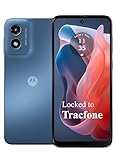
- Carrier: This phone is locked to Tracfone, which means this device can only be used on the Tracfone wireless network. Activating is easy, just 3 steps.
- ACTIVATION Promotion: Includes 1500 min, 1500 texts & 1500 MB Data + add more as you need it
- CAMERA SYSTEM: 50MP Quad Pixel camera. Capture sharper, more vibrant photos day or night with 4x the light sensitivity.
- PERFORMANCE: Blazing-fast Qualcomm performance. Get the speed you need for great entertainment with a Snapdragon 680 processor and 4GB of RAM.
- 64GB built-in storage. Get plenty of room for photos, movies, songs, and apps. Made for US
This tension limited the value of either path. A dominant Motorola could unsettle partners whose sales helped Android grow; a deliberately constrained Motorola would be a poor return on a large hardware investment. The patent portfolio could strengthen Android without requiring Google to permanently privilege Motorola, but running the phone business still put Google on both sides of the platform relationship.
Motorola was a turnaround bet, not a healthy business waiting to scale
Google bought Motorola Mobility after its competitive position had weakened. It faced Apple and Samsung, inconsistent product differentiation, carrier dependence, and manufacturing and organizational complexity. Google was not simply adding a thriving market leader to its portfolio; it was taking on a turnaround while integrating a business with different economics and operating rhythms.
Google’s software business could experiment and distribute products globally at low marginal cost. Motorola had to commit to physical production, manage component prices and inventory, and sell through carriers and retailers. Software iteration and hardware development also run on different schedules: a phone design and production plan must be set well before a product reaches a shelf. A promising concept could not instantly repair brand momentum, distribution, or manufacturing economics.
Moto X: a distinctive product, not a market turnaround
The first Moto X, introduced in 2013, was the clearest test of Google’s hardware strategy. Rather than compete only on specifications, it emphasized contextual software, voice interaction, customization of colors and materials, and close hardware-software integration. It aimed to make everyday use feel more personal instead of winning a specification comparison.
Those ideas earned positive attention, but critical interest was not the same as mass-market demand or profitability. Motorola had to persuade customers to choose a less familiar option against established premium rivals. Its pricing, specifications, distribution, and marketing all mattered. In the United States, carrier promotion and shelf placement could shape a phone’s prospects as much as its design. Customization could distinguish the product, but it was not guaranteed to become a broad reason to buy.
Contemporary criticism described the Moto X as innovative but unable to become a major commercial success at the scale implied by Google’s investment (WIRED; TIME). The more useful conclusion is not that the phone was bad; it is that a well-regarded product did not solve Motorola’s market-share, distribution, and financial problems.
Moto G and Moto E: a more plausible value strategy, with thinner margins
The Moto G, launched in late 2013, offered a more practical proposition: capable basic performance, clean Android software, and a lower price. It pointed toward a potentially stronger role for Motorola in price-sensitive markets than a direct assault on premium leaders. Google’s later sale announcement cited momentum for both the Moto X and Moto G, but those products had limited time to establish a durable business before Google announced its exit (Google’s announcement).
The Tool Desk
Outbyte PC Repair FREEClear out junk files and repair common Windows errorsFree Scan →Outbyte Driver Updater FREEFix the driver behind crashes, sound loss and screen glitchesFind Drivers →The Moto E extended the low-cost approach in 2014, targeting first-time smartphone buyers and emerging markets. Lower prices broadened the potential customer base, but also made scale, component costs, and distribution more important: margins on affordable devices can be thin, so a company needs efficient operations and substantial volume to make the model work (Le Monde).
Rank #3

- 50MP ULTRA-PIXEL CAMERA WITH OIS; Optical Image Stabilisation lets you capture sharper photos and perfect videos even in low light – without shaking
- Cinematic 6.5 inch POLED display; bring your entertainment to life with infinite contrast and over a billion lifelike colours
- Multi-dimensional sound; with Dolby Atmos, Motorola room sound, high-resolution audio and stereo speakers, you can hear and feel the sound from any direction
- Ultra-modern, water-repellent design; the compact and lightweight design of the smartphone gives it a smart look and accidentally spilled drinks or a few water splashes do not affect it
- High-end 5G performance; get everything out of 5G thanks to the powerful Snapdragon 695 processor with up to 2.2 GHz
These phones showed a product strategy taking shape, not proof that the business had turned around. The Moto X aimed to differentiate; the Moto G and Moto E aimed to compete on value. Neither approach could overcome weak scale on its own.
Independent reader supportYour contribution helps us test, update, and keep practical guides available for everyone.Why good phones did not make a successful phone company
- Limited scale: Motorola had to compete with companies that had greater purchasing power, marketing budgets, retail reach, and influence with carriers. A few well-reviewed products could not substitute for sustained volume.
- Late reset: The Moto X arrived in 2013, after customers and channels had already coalesced around major brands. The value strategy followed later, leaving little time to build momentum before Google chose to sell.
- Carrier and retail dependence: In important markets, promotion, financing, subsidies, shelf space, and carrier support affected which phones customers noticed and bought. Product quality alone did not guarantee strong placement.
- Unclear positioning: Motorola moved between premium innovation, affordable phones, reference hardware, and carrier-specific products. Individual devices could be appealing while the overall portfolio remained difficult to explain.
- Brand recovery takes time: Rebuilding trust after a weakened competitive period requires consistent products, marketing, retail execution, and customer support, not just a single launch.
- Hardware economics: Inventory risk, manufacturing costs, component forecasts, warranty costs, logistics, and returns made even unit growth no guarantee of attractive returns.
- Intense competition: Apple owned a powerful premium ecosystem, Samsung competed across price bands, and lower-cost manufacturers were becoming more aggressive. Motorola occupied a difficult middle ground.
The Nexus 6, developed by Motorola and released during the transition to Lenovo, showed that Motorola could execute on Google-led reference hardware. It was not evidence that Google had solved Motorola’s independent commercial challenge. Motorola’s Moto devices, Google’s Nexus program, and Google’s later Pixel hardware are distinct efforts; Motorola’s experience may offer context for later hardware choices, but it should not be treated as a proven direct cause of Pixel.
The exit: what Lenovo received and what Google kept
On January 29, 2014, Google announced that Lenovo would acquire Motorola Mobility’s smartphone business for approximately $2.9 billion. The transaction closed on October 30, 2014. The announced consideration included about $660 million in cash at closing, approximately $750 million in Lenovo ordinary shares, and a $1.5 billion three-year interest-free promissory note. Lenovo acquired the Motorola brand, smartphone products, and mobile operations. Google retained most of the patent portfolio and granted Lenovo a license; Lenovo also received a smaller number of patent assets (transaction filing; Lenovo closing announcement).
Recommended Free Tools
That was an asset separation, not a complete transfer of Motorola intellectual property. The structure indicates that Google valued continued access to the patents and selected strategic technology more than continued ownership of the manufacturing, carrier, and inventory-heavy smartphone operation. Google’s stated rationale emphasized Android and ecosystem focus, while Lenovo offered a hardware business with global ambitions.
Was it a $10 billion loss?
The headline comparison—approximately $12.5 billion paid and approximately $2.9 billion received—makes the deal look like a roughly $10 billion loss. It is a useful shorthand for how disappointing the hardware investment was, but not a complete accounting of the transaction. Google kept most of Motorola’s patents and other assets, and Motorola had divested non-smartphone assets before the Lenovo sale. Sale proceeds also included stock and a promissory note, not just cash.
The overall financial return was poor or at least highly questionable, especially as an operating acquisition. But subtracting the sale price from the purchase price and calling the result the full loss ignores retained assets and strategic value. Nor does retaining patents guarantee a profitable outcome: Google later recorded a $378 million impairment related to a retained Motorola patent-licensing royalty asset (Google 2014 Form 10-K; Google filing on the impairment).
There was also an opportunity cost in management attention and effort spent on hardware integration, manufacturing, carrier negotiations, product development, and restructuring. That cost is real as an analytical consideration but is not a separate booked loss that can be precisely added to the headline price gap.
Three scorecards, three different verdicts
- Hardware operating performance: failure. Google did not turn Motorola into a major, profitable smartphone business or restore its position at the scale the acquisition demanded.
- Financial return: poor and difficult to measure completely. The sale price was far below the acquisition price, and the retained assets had value but also financial risks. The available figures do not support treating the simple price gap as the exact total loss.
- Android strategy: partial success. Google acquired and retained a significant patent portfolio, strengthened its position in the smartphone patent environment, and gained direct exposure to hardware operations. The value of that learning is plausible, but difficult to isolate from later Google hardware work.
So did Google and Motorola fail? They failed as a long-term smartphone partnership: Google could not reconcile Android’s need for trusted independent manufacturers with the demands of operating its own phone maker, and Motorola’s products did not scale into a strong business quickly enough. But the deal was not pointless. Google gained strategic defenses for Android and the ability to exit the costly operating business while retaining most of the patents. It was a failed hardware turnaround and a partially successful ecosystem-defense transaction.
Quick Recap
Product prices and availability are accurate as of the date/time indicated and are subject to change. Any price and availability information displayed on Amazon at the time of purchase will apply.



