Some links on this page are affiliate links: if you buy through them we may earn a commission, at no extra cost to you.
Seagate has a credible technical path toward 100TB-class mechanical hard drives, but it has not guaranteed that a 100TB retail drive will launch in 2030. The company’s roadmap depends on reaching roughly 10TB per platter, then combining multiple platters in a single drive. The first products are more likely to serve hyperscale cloud providers and enterprise data centers than ordinary consumers.
What Seagate actually announced
Seagate’s March 2026 announcement about its Mozaic 4+ platform describes a path from roughly 4TB-plus per platter toward approximately 10TB per platter. In a 10-platter design, that density could enable a drive with about 100TB of capacity.
That is a technology and capacity roadmap—not a firm promise that a generally available retail 100TB hard drive will ship specifically in 2030. Several steps separate a roadmap target from a product consumers can buy:
Free tools Windows power users keep installed
One-click scans. No signup required.
- Technology demonstration: The recording system works in a laboratory or prototype.
- Qualification: Seagate and prospective customers test reliability, firmware, performance, thermals, and failure recovery.
- Volume production: The drive can be manufactured at commercially meaningful scale.
- Channel availability: Products reach distributors, OEMs, or retailers.
- Consumer availability: Individuals can purchase them through ordinary retail channels.
Seagate’s latest public material establishes meaningful progress through the first stages, but it does not establish a guaranteed consumer launch date.
#1 Best Overall

- High-capacity add-on storage.Compatibility : Windows 10 plus, Reformatting required for use with MacOS.
- Fast data transfers
- Plug-and-play ready for Windows PCs
- WD quality inside and out
Seagate’s announcement says Mozaic 4+ drives of up to 44TB were qualified and shipping in volume to two hyperscale cloud providers as of March 2026. It also describes the platform as capable of eventually enabling drives up to 100TB.
Seagate’s capacity roadmap
| Approximate date | Milestone | What it means |
|---|---|---|
| January 2025 | Exos M samples up to 36TB; 32TB ramping with a cloud customer | Company-announced HAMR product development and customer ramp |
| June 2025 | 4TB-per-platter qualification; up to 44TB planned | Near-term platform development |
| Early 2028 | Target for 5TB-per-platter products | Higher-capacity products may begin entering the market |
| Late 2027 | Mozaic 5 qualification shipments targeting more than 5TB per disk | Customer validation, not broad retail availability |
| Around 2028 | 10TB-per-platter laboratory demonstration target | A technical milestone, not necessarily a production drive |
| Around 2030–2032 | Possible 100TB-class drive | Roadmap horizon subject to execution, qualification, yield, and demand |
Seagate previously discussed qualifying 100TB-plus drives around 2032, while other public roadmaps have used 2030 as a target. That variation matters: “by 2030,” “around 2030,” “qualification in 2030,” and “available at retail in 2030” are four different claims.
For now, the 44TB Mozaic 4+ milestone is the strongest evidence that Seagate’s approach has progressed beyond a distant laboratory concept. It remains primarily a hyperscaler product milestone, not proof that a similar drive is available to home users.
Quick wins for a faster PC:
Clear out junk files and repair common Windows errorsFree Scan →Fix the driver behind crashes, sound loss and screen glitchesFind Drivers →How a mechanical drive could reach 100TB
The basic capacity arithmetic is straightforward:
10TB per platter × 10 platters ≈ 100TB per drive.
That does not mean Seagate is developing a single platter that stores 100TB. The target is mainly an areal-density achievement: storing more data in each square inch of magnetic media.
Seagate announced 36TB drives using a 10-platter design and described a progression from approximately 3.6TB per platter toward 10TB per platter. Increasing the amount of data stored on each platter is generally more useful than simply adding more platters, because a larger platter stack affects mechanical complexity, power, heat, and enclosure design.
What HAMR changes
Seagate’s Mozaic platforms are based on heat-assisted magnetic recording, or HAMR. In a HAMR drive, a tiny laser or plasmonic near-field optical device briefly heats a microscopic region of the recording medium. While heated, the magnetic material becomes easier for the write head to change. It then cools and retains the recorded bit.
Recommended Free Tools
This technique allows the drive to use smaller, more tightly packed magnetic grains than conventional recording methods can reliably write. Seagate also links future density gains to granular iron-platinum media, improved heads, photonics, controllers, and higher-density platter architectures.
HAMR improves how much data fits on a drive. It does not turn an HDD into an SSD. The drive still has spinning platters, moving heads, mechanical seek time, rotational latency, noise, vibration, and mechanical failure modes.
Rank #2

- Plug-and-play expandability
- SuperSpeed USB 3.2 Gen 1 (5Gbps)
Why Seagate and cloud providers want larger HDDs
The financial case for very large hard drives is primarily about cost per terabyte and infrastructure efficiency, not speed.
Cloud providers and data centers must store growing volumes of video, backups, AI training data, model outputs, telemetry, and other datasets. If each drive stores more data, an operator may need fewer drive bays, servers, cables, controllers, racks, and cooling resources for the same raw capacity.
Seagate claims that, in a one-exabyte deployment compared with standard 30TB drives, Mozaic technology could improve infrastructure efficiency by approximately 47%, reduce data-center footprint by about 100 square feet, and lower annual energy consumption by roughly 0.8 million kilowatt-hours. These are Seagate’s internal calculations, not independent benchmarks, so they should be treated as company estimates rather than guaranteed savings.
For data-center operators, the relevant calculation is total cost of ownership: drive price, power, cooling, rack space, networking, maintenance, rebuilds, and the cost of downtime. A higher-capacity drive can reduce some of those costs, but it can also increase the amount of data exposed when one drive fails.
Will consumers be able to buy a 100TB HDD?
Probably not at first. Seagate’s current 44TB Mozaic 4+ products were shipping in volume to two hyperscale cloud providers as of March 2026, with broader availability planned as production expands. That is materially different from a normal retail launch.
The likely order of availability is:
- Hyperscalers and enterprise data centers: First, because they can commit to large orders and perform lengthy qualification programs.
- Professional and prosumer storage: Possible later, if firmware, thermals, reliability, and workload compatibility are suitable.
- NAS products: Dependent on vendor validation, recording format, rebuild behavior, and enclosure support.
- Desktop and USB consumer products: Least likely to receive maximum-capacity models early.
Initial 100TB-class drives could also be sold through long-term supply agreements rather than through retail shelves. Even if a drive technically fits a standard 3.5-inch bay, that does not guarantee compatibility with a consumer NAS or desktop enclosure.
Do these 3 things before closing this tab:
1Repair Windows errors before they cause bigger problems2Fix the driver behind crashes, sound loss and screen glitches3Clear out junk files and repair common Windows errorsWhy HDDs remain relevant despite SSDs
SSDs are substantially better for operating systems, databases, virtual machines, active applications, and latency-sensitive AI workloads. They offer much lower latency and far stronger random-I/O performance, with no spinning mechanism.
HDDs remain attractive when the objective is storing very large quantities of data at a generally lower cost per terabyte. They work well for sequential access, backups, media libraries, surveillance archives, nearline data, and information that is valuable but not constantly accessed.
A typical storage architecture therefore uses tiers:
Rank #3
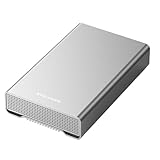
- [ 14TB ] Capacity USB 3.2 Gen 2 USB-C (10Gbps) External Hard Drive (estimate 13TB Capacity available after formatted) (Build-in 14TB 7200RPM Enterprise Internal Hard Drive)
- Works for any Windows OS Desktop PC, Laptop with USB 3.2 interface (backward compatible with USB 3.0)
- Expand computer hard drive storage instantly! Add extra storage to your Desktop PC / Laptop Without opening up the case
- Perfect for hard drive expansion and backup storage for your entire Windows OS system and important files! (Don't wait for a crash – regular daily backups are essential for data security! )
- Support MacOS system, Required to re-format as APFS (Apple File System)
- SSDs: Hot data, metadata, databases, and active workloads.
- HDDs: Large active or nearline datasets, backups, and media.
- Tape, object storage, or cloud archive: Data that is rarely accessed and can tolerate slower retrieval.
A 100TB HDD would increase capacity density within the HDD tier. It would not eliminate the need for SSDs.
Windows Errors? Fix Them Before They Spread
Repair common Windows errors and clear accumulated junk for a smoother, more stable PC - no reinstall needed.Free scan · no reinstallOutdated Drivers Are Slowing You Down
One free scan finds every outdated or missing driver and matches the right update for your exact hardware.Free scan · exact hardware matchThe operational trade-offs of a 100TB drive
Longer rebuilds
If a 100TB drive fails in a RAID or erasure-coded system, replacing and rebuilding it could take many hours or even days, depending on throughput, workload, array design, and the amount of concurrent activity. During that period, the system may be operating with reduced protection.
Large disks make RAID planning more important. RAID-5-style single-parity protection is increasingly difficult to justify for very large drives. Dual parity, erasure coding, replication, distributed rebuilds, and tested backups can reduce the consequences of another failure during recovery.
A larger failure domain
One failed 100TB disk represents more data than one failed 10TB disk. Consolidating capacity into fewer drives can reduce hardware count, but it also concentrates more information in each device. A single drive—regardless of capacity—is not a backup strategy.
Sequential performance, not proportionally higher IOPS
More capacity does not automatically mean more input/output operations per second. Mechanical latency remains largely a mechanical limitation. A 100TB HDD may be excellent for sequential transfers while remaining unsuitable for a database or virtual-machine workload that generates frequent random reads and writes.
SMR and CMR differences
The largest-capacity versions may use shingled magnetic recording, or SMR. SMR overlaps tracks to increase density, but some rewrite patterns can be slower or more restrictive than on conventional magnetic recording (CMR) drives.
Before buying a high-capacity disk for a NAS or RAID system, verify:
- Whether the model uses CMR or SMR.
- Whether it is drive-managed or host-managed SMR.
- NAS and RAID compatibility.
- Sustained-write behavior.
- Firmware support from the enclosure or storage-system vendor.
- Expected rebuild and resilver behavior.
The highest advertised capacity is not automatically the best choice for a multi-drive array.
Power, heat, and vibration
A drive with more platters and tighter recording tolerances can place greater demands on enclosure airflow, vibration control, power delivery, and firmware. Even if it lowers power consumption per stored terabyte, its absolute power draw may not fall in proportion to its capacity.
The Tool Desk
Outbyte Driver Updater FREEScan for outdated or missing drivers - takes under a minuteDriver Scan →Outbyte PC Repair FREEClear out junk files and repair common Windows errorsFree Scan →Rank #4

- 40 TB TB3 RAID Desktop HDD
How certain is the roadmap?
The 100TB target is technically plausible, but it should be treated as a roadmap possibility rather than a guaranteed product date.
Reasons for confidence include Seagate’s move from HAMR demonstrations into volume shipments, its 36TB Mozaic 3+ products, and its qualified 44TB Mozaic 4+ drives shipping to hyperscalers. The company has also published intermediate milestones rather than relying only on a distant 100TB headline.
Reasons for caution include the history of storage roadmaps slipping, the difference between a laboratory demonstration and economical mass production, and the engineering work still required in media, heads, photonics, controllers, manufacturing yield, firmware, and long-term reliability.
Western Digital is pursuing its own combination of ePMR and HAMR technologies, with a roadmap toward approximately 100TB-class products in the 2029–2030 range. Toshiba is pursuing separate energy-assisted recording and platter-stack strategies. These competing efforts suggest that 100TB-class HDDs could eventually become an industry category, but the vendors do not necessarily use “target,” “qualification,” and “availability” in the same way.
What’s actually slowing this PC down?
Pick the symptom - the matching free tool is one click away.
What should you buy or use today?
Do not delay a real storage need for a speculative 2030 product. Choose the storage medium according to workload:
- Large NAS, media library, surveillance, or backup: Consider a high-capacity CMR NAS drive such as Seagate IronWolf Pro, subject to your NAS manufacturer’s compatibility list.
- Enterprise or data-center nearline storage: Consider Exos-class products validated by your system vendor or storage integrator.
- Databases, virtual machines, AI indexes, and active applications: Use SSDs where latency and random I/O matter.
- Cold archive: Compare HDD arrays, tape, object storage, and cloud-archive pricing based on access frequency and recovery requirements.
For readers evaluating currently announced Seagate products, the company announced 30TB Exos M and IronWolf Pro drives through its store, authorized resellers, and channel partners in 2025. The announced launch price was $599.99, but that is a dated price signal, not a guaranteed current street price. Check Seagate’s live store or its Where to Buy page for current regional availability and pricing.
The 30TB Exos M is aimed at enterprise deployments, while the 30TB IronWolf Pro is designed for NAS and prosumer arrays. Neither is a direct substitute for a future 100TB drive; the practical benefit today is available capacity, not the endpoint of Seagate’s roadmap.
Bottom line
Seagate’s path to 100TB mechanical hard drives is real and supported by intermediate products, including 44TB Mozaic 4+ drives shipping to hyperscalers. But “100TB by 2030” should be read as a target or roadmap horizon, not a guaranteed retail-launch promise.
If the products arrive, the first buyers will likely be cloud providers and enterprise data centers seeking more capacity per rack and lower cost per stored terabyte. Consumers should expect slower adoption, higher initial prices, compatibility questions, and the need for stronger redundancy and backup planning. For current purchases, buy for today’s workload rather than waiting for a capacity milestone that remains subject to qualification and manufacturing scale.
Quick Recap
Product prices and availability are accurate as of the date/time indicated and are subject to change. Any price and availability information displayed on Amazon at the time of purchase will apply.



