Some links on this page are affiliate links: if you buy through them we may earn a commission, at no extra cost to you.
Ready, Fire, Aim means preparing enough to act safely, running a small test, then correcting course with evidence. It can help a business learn faster than a plan built around certainty—but it is not a license to skip analysis, controls or financial discipline. The useful version is bounded experimentation: limit the downside, decide in advance what you will measure, and scale only when results justify it.
What “Ready, Fire, Aim” means
The phrase is strongly associated with entrepreneur Michael Masterson’s 2008 book Ready, Fire, Aim: Zero to $100 Million in No Time Flat. In that book, it sits within a broader business-growth model that considers how a company’s challenges change as it expands. The phrase is also used more broadly as a leadership principle: act before every uncertainty is resolved, then use what happens to improve the next decision.

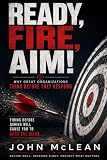


That broader use is related to lean experimentation and agile product development, but it is not itself a formal standard or a synonym for Scrum, Kanban, Lean Startup or the Agile Manifesto. Think of it as a memorable operating principle, not a complete management system.
Recommended Free Tools
- Ready: Clarify the problem, intended outcome, assumptions, constraints and acceptable risk.
- Fire: Take the smallest meaningful action that can generate useful evidence.
- Aim: Compare results with the hypothesis, learn from customers or operations, and adjust.
“Ready, Aim, Fire” can be sensible when a decision is consequential or hard to reverse. The weakness comes when planning becomes an attempt to obtain certainty that is not available. In a changing market, the target can move while a team is still perfecting its plan. A government-published leadership paper uses a similar contrast: a projectile follows a fixed trajectory, while a guided missile repeatedly realigns toward a moving target as new information arrives. The important feature is the feedback and correction, not simply launching sooner. (U.S. government paper)
#1 Best Overall
Why acting sooner can improve agility
Planning can identify risks and organize work, but it cannot reliably substitute for evidence from real customers, employees or operating conditions. A small test can reveal whether customers understand an offer, whether they will pay for it, where a process breaks down, or what a new feature does to support volume. That information can prevent a company from investing heavily in the wrong product or workflow.
Lean-startup practice makes a related case for building a minimum viable product, collecting customer feedback, iterating and pivoting when evidence challenges the original idea. These are related practices, not proof that every idea should be rushed into a live launch. (Canon Business Insights)
For a finance-minded owner or manager, the practical benefit is about the cost of uncertainty: a small, capped experiment may be cheaper than committing a full budget to an untested assumption. But the experiment still needs a spending limit, a named owner and a way to know whether it worked. Moving quickly without those controls can turn a learning opportunity into an avoidable loss.
What’s actually slowing this PC down?
Pick the symptom - the matching free tool is one click away.
A practical operating model
- Define the decision. State the problem in concrete terms. “We need more growth” is too broad; “we need to know whether a lower-cost onboarding offer improves paid conversion among small-business customers” is testable.
- Write the hypothesis. Identify what you believe, who it concerns and why. Example: “If we offer a guided setup to new customers, more of them will complete setup within seven days.”
- Set the minimum readiness threshold. Name the audience, owner, time window, cost ceiling, required approvals, success measure and stop condition before starting.
- Choose the smallest useful test. Use a prototype, customer interview, limited launch, manual trial or internal pilot before committing to a broad rollout.
- Protect people and the business. Define exposure limits, customer disclosures where appropriate, a rollback plan, support coverage and escalation triggers.
- Collect evidence. Track relevant numbers and observations, not just activity. Compare the outcome with the original hypothesis.
- Decide what happens next. Continue, improve the test, change the offer or audience, scale, pause or stop. Record the reason so the learning is reusable.
A one-page experiment brief can make the “Ready” stage concrete:
- Problem and decision: What do we need to learn or choose?
- Hypothesis: What do we expect, and why?
- Audience and scope: Who is included, and who is not?
- Test and duration: What will happen, and when will it end?
- Budget and risk limits: What is the maximum acceptable cost or exposure?
- Measures: Which customer, financial or operational results matter?
- Stop, revise and scale rules: What evidence triggers each decision?
- Owner and review date: Who is accountable, and when will the team assess results?
“Ready” means prepared enough to learn safely, not prepared enough to guarantee success. Starting with technology rather than the business problem, expected benefit, scope and feedback plan is a known way to produce a “Ready, Fire, Aim” failure. (BPM Institute)
What can the first test look like?
The right “fire” depends on the uncertainty. A test should generally be small, reversible, observable, time-boxed and limited to a defined audience. Examples include:
- Product: Offer a feature to a small customer cohort behind a feature flag, with a rollback plan.
- Marketing: Test two messages or offers with a limited audience and compare qualified conversions—not just clicks.
- Operations: Trial a revised process in one team or location before changing the whole company.
- Customer service: Test a new routing or response workflow with a limited queue and track resolution quality as well as speed.
- Pricing: Run a carefully scoped pricing experiment, with legal review and clear rules for who receives which offer.
- Leadership: Delegate a defined class of low-risk decisions to a team, with an escalation threshold for exceptions.
- Major transformation: Simulate a change, run a pilot in one business unit, or stage deployment before extending it across the organization.
An experiment need not be a public product launch. Interviews, prototypes, concierge services, landing-page tests, simulations and tabletop exercises can generate evidence with less exposure. Choose the method that answers the question without putting more money, trust or operational stability at risk than necessary.
“Aim” is a repeated feedback loop
After the test, review both quantitative and qualitative evidence. Depending on the decision, useful measures may include conversion, retention, revenue, cost, cycle time, defects, complaints, adoption or support volume. Customer interviews and frontline observations can explain why a number moved—or why it did not.
Before interpreting results, check whether the test actually reached the intended audience and whether its measures reflect the outcome that matters. A rise in sign-ups, for example, may not be useful if retention falls or support costs rise. Separate a meaningful pattern from a small or noisy sample; a pilot may suggest what to test next without proving that the idea will work at scale.
Then make an explicit choice:
- Continue: The result supports the hypothesis and the risk remains acceptable.
- Improve: The idea may work, but the test exposed a fixable problem.
- Change direction: The evidence suggests another customer, offer or process is more promising.
- Scale: Results justify broader use, subject to stage gates and operational readiness.
- Pause or stop: The evidence is weak, the downside is too high, or the test did not answer the question.
Stopping an experiment that disproves an assumption can be a good business decision; failure is not automatically valuable. It becomes useful learning only when the test was bounded, the results are observable and the organization changes its next decision. The loop is not a one-off correction: act, observe, learn, adjust and act again.
How established companies can use the approach
Ready, Fire, Aim is not limited to startups. Large organizations can pilot programs before enterprise-wide rollouts, give small cross-functional teams clear decision rights, shorten approval paths for low-risk tests and build stage gates before scaling. Product and customer feedback also need a route to the people who can act on it; otherwise a pilot produces reports rather than adaptation.
Do these 3 things before closing this tab:
1Clear out junk files and repair common Windows errors2Scan for outdated or missing drivers - takes under a minute3Repair Windows errors before they cause bigger problemsGrowth changes what a company can safely do. Masterson’s book describes four stages of development, and its contents address changing management problems such as bottlenecks, bureaucracy and organizational change. A summary of the book gives approximate revenue ranges—infancy at $0–$1 million, fast growth at $1–$10 million, adolescence at $10–$50 million and maturity at $50 million or more. These are figures from Masterson’s framework, not universal benchmarks for what a company should earn or how it should be managed. (O’Reilly’s book contents; book summary)
At greater scale, experimentation needs more coordination, not less discipline. Separate reversible decisions from irreversible ones; protect critical operations while designating appropriate areas for trials; involve legal, finance, security, operations and customer-facing teams when their risks are implicated. Give teams room to test within agreed boundaries, and use evidence-based gates before spending or deploying at larger scale.
Ready, Fire, Aim is not “move fast and break things”
| Ready, Fire, Aim | “Move fast and break things” |
|---|---|
| Acts quickly within defined boundaries. | Can suggest speed without regard to consequences. |
| Uses evidence and correction as part of the method. | Can celebrate disruption while leaving recovery and repair unclear. |
| Favors small, reversible tests where possible. | Can lead to large or difficult-to-reverse bets. |
| Requires feedback, review and a decision about what to change. | Can treat feedback as secondary to launch speed. |
| Protects safety, compliance, customer trust and financial limits. | Can push costs onto customers, employees or other stakeholders. |
Agility is not simply making decisions quickly. It includes noticing change, considering the situation and using pilots or experiments instead of assuming that a fast, large-scale shift is correct. (Worth) Speed has value when it increases learning without imposing unacceptable costs.
Independent reader supportYour contribution helps us test, update, and keep practical guides available for everyone.When not to experiment live
Do not use “Ready, Fire, Aim” to bypass controls where an error could cause disproportionate or irreversible harm. This includes physical safety and public health; clinical decisions; aviation, nuclear, chemical and other industrial hazards; financial reporting and fiduciary duties; regulated transactions; security and privacy changes; legal and employment decisions; and infrastructure investments that cannot readily be reversed.
The Tool Desk
Outbyte Driver Updater FREEScan for outdated or missing drivers - takes under a minuteDriver Scan →Outbyte PC Repair FREERepair Windows errors before they cause bigger problemsFix Now →Use planning, review and required approvals first. Where appropriate, preserve the learning objective through simulation, staged deployment, redundancy or a controlled pilot with proper safeguards. Be especially cautious when affected people are vulnerable, cannot meaningfully opt out, or would bear the cost of an experiment they did not choose.
Prefer a conventional, more thoroughly planned approach when the decision is hard to reverse, the worst-case outcome is severe, compliance requirements are strict, the system offers little opportunity for correction, or the organization cannot measure the result. If a low-risk test can provide information without exposing people or the business to that harm, the test may still be useful—but the guardrails determine whether it is appropriate.
What an organization needs to make the loop work
A launch alone does not create agility. The organization also needs:
- Clear decision ownership: A named person can act and is accountable for the review.
- Fast access to evidence: Teams can see useful customer and operational data rather than wait months for a report.
- Defined risk thresholds: Employees know what they may test independently and what must be escalated.
- Reversibility: The company can contain or undo changes where feasible.
- Psychological safety: People can report negative results instead of hiding them.
- Learning-oriented incentives: A well-run experiment is not treated as misconduct simply because its hypothesis was wrong.
- Review time: Teams reserve time to interpret results and make adjustments.
- Cross-functional input: The right legal, finance, security, operations and customer teams participate before their concerns become incidents.
Leaders should distinguish an intelligent, bounded experiment that produces an unexpected result from negligence, such as ignoring a known hazard, skipping required approvals or failing to monitor an agreed limit. Without that distinction, people may conceal bad news and the feedback loop breaks.
How to tell whether agility is improving
Measure both learning speed and the quality of outcomes. Depending on the work, a useful scorecard might include:
- Time from decision to first test.
- Time from test completion to evidence review.
- Time from feedback to a consequential adjustment.
- Share of initiatives with a written hypothesis, owner, metric and stop rule.
- Customer adoption, retention or satisfaction alongside revenue and cost.
- Defects, incidents, complaints, rework or other signs of harm.
- Cost per validated learning and time required to reverse a failed change.
- Share of scaled initiatives that meet their stated success criteria.
Experiment count alone is a poor measure: a team can run many tests without learning anything important. Pair speed measures with customer, financial, quality and risk outcomes. If the first test arrives sooner but failures are harder to contain, or customers receive a worse experience, agility has not improved.
Bottom line: plan for the risk, then learn quickly
Ready, Fire, Aim works best as disciplined action under uncertainty. Decide what you need to learn, set the minimum preparation and safeguards that match the stakes, run a small observable test, and let the evidence change your next move. It should help an organization avoid both costly delay and costly overreach—not replace strategy, sound financial judgment or necessary controls.
Quick Recap
Product prices and availability are accurate as of the date/time indicated and are subject to change. Any price and availability information displayed on Amazon at the time of purchase will apply.



