Some links on this page are affiliate links: if you buy through them we may earn a commission, at no extra cost to you.
NXP opened its 150 mm (six-inch) radio-frequency gallium-nitride (RF GaN) fab in Chandler, Arizona, on September 29, 2020. The in-house facility was designed for high-volume production of RF power-amplifier technology used in 5G base stations, not complete telecom systems. NXP’s 2025 Form 10-K, filed February 19, 2026, still lists Chandler RF as a six-inch GaN facility, though that filing does not establish its current production level.
What NXP opened in Chandler
The Chandler facility makes RF GaN semiconductor devices, with 5G infrastructure as its primary target. NXP also identified industrial communications, aerospace, defense and radar as potential markets. The company placed the manufacturing operation alongside its Chandler R&D team, aiming to connect process development, device engineering and product validation more closely. NXP’s opening announcement said the fab was qualified, initial products were ramping, and full capacity was expected by the end of 2020; that was a 2020 target, not a current production figure.
“New” did not mean a wholly new site built from scratch. NXP said it converted a legacy Chandler facility, previously used as an automotive electroplating line, for six-inch RF GaN manufacturing. The company described the fab as applying its quality processes and adhering to automotive quality standards. Its description of the facility as the most advanced of its kind was NXP’s own positioning, not an independently established industry ranking. NXP’s account of the conversion and technology provides that context.
Why GaN is useful in 5G radio power amplifiers
Gallium nitride is a semiconductor material valued in RF power applications for its ability to support high-frequency operation and high power density. For a base-station power amplifier, the practical appeal can include a useful combination of output power, gain, bandwidth and efficiency. NXP described its GaN work in terms of power density, gain and linearized efficiency, and said its technology was intended for RF operation at and above approximately 2 GHz. Those characteristics can help radio designers address the demanding power-amplifier role in 5G infrastructure.
#1 Best Overall

- 1pc SBB5089+SE5004 One-Way Microwave Power Amplifier RF Power Amplifier Module 40DB WYDZ-PA-5G-6GHz-2W
They do not guarantee that every GaN radio is more efficient or smaller than every alternative. Amplifiers must handle complex modulated signals with sufficient linearity; results depend on the device and circuit design, frequency band, waveform, biasing, digital predistortion, operating back-off, packaging and thermal path. Higher power density can help reduce the size of an RF solution, but it also raises thermal-design demands. Nor does better transistor-level efficiency translate automatically into an equal reduction in a network’s total electricity use.
GaN is one of several semiconductor technologies used across radio systems. It does not replace silicon, silicon-germanium or gallium arsenide in every function or frequency range, and NXP’s Chandler operation was an RF GaN fab rather than a general-purpose logic fab or a GaN power-electronics plant for chargers and electric vehicles.
Rank #2
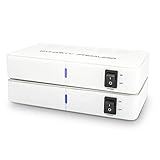
- ✅ 【MAKE YOUR REAR SPEAKERS WIRELESS IN MINUTES】 No more long speaker wires across your living room. Instantly convert passive surround speakers into a clean wireless setup for 5.1 or 7.1 home theater systems.
- ✅ 【BUILT-IN 2x50W AMPLIFIER -NO EXTRA AMP NEEDED】 Unlike basic wireless adapters, this kit powers passive speakers directly. Save money, reduce equipment, simplify installation.
- ✅ 【STABLE DUAL-BAND 5.2 / 5.8GHz TRANSMISSION】 Selectable frequencies + 106 RF channels help avoid WiFi interference and signal dropouts for smooth movie and TV audio.
- ✅ 【LOW LATENCY FOR TV & MOVIES】 Designed for real-time surround sound with minimal audio delay to maintain proper lip-sync performance.
- ✅ 【UP TO 100FT WIRELESS RANGE】 Reliable long-range transmission (line of sight). Perfect for large living rooms, basements, and media rooms.
What 150 mm means—and what it does not
150 mm describes the wafer’s diameter, not the size of an individual chip or the area of the fab. Six-inch wafers are smaller than the 200 mm and 300 mm wafers common in many silicon fabs. Wafer size affects how many dies can fit on a wafer, equipment economics and process compatibility, but it is not a stand-alone measure of device quality or manufacturing competitiveness.
Free tools Windows power users keep installed
One-click scans. No signup required.
The meaningful comparisons are usable-die yield, performance, reliability, cost and fit for the intended RF market. NXP’s 2025 Form 10-K lists Chandler RF as a six-inch GaN front-end facility and reports a 0.25–0.40 µm process range. The filing separately identifies an eight-inch Chandler silicon fab; the two facilities and process platforms should not be conflated. NXP’s 2025 Form 10-K is the source for those facility details.
Rank #3
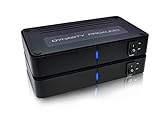
- ✅ 【MAKE YOUR REAR SPEAKERS WIRELESS IN MINUTES】 No more long speaker wires across your living room. Instantly convert passive surround speakers into a clean wireless setup for 5.1 or 7.1 home theater systems.
- ✅ 【BUILT-IN 2x50W AMPLIFIER -NO EXTRA AMP NEEDED】 Unlike basic wireless adapters, this kit powers passive speakers directly. Save money, reduce equipment, simplify installation.
- ✅ 【STABLE DUAL-BAND 5.2 / 5.8GHz TRANSMISSION】 Selectable frequencies + 106 RF channels help avoid WiFi interference and signal dropouts for smooth movie and TV audio.
- ✅ 【LOW LATENCY FOR TV & MOVIES】 Designed for real-time surround sound with minimal audio delay to maintain proper lip-sync performance.
- ✅ 【UP TO 100FT WIRELESS RANGE】 Reliable long-range transmission (line of sight). Perfect for large living rooms, basements, and media rooms.
Why NXP brought production in-house
An internal fab gives a chipmaker more direct control over manufacturing capacity and process learning. In its October 2, 2020 interview with EE Times, NXP framed in-house capacity as a way to strengthen supply security and evolve GaN technology more quickly. Colocation with R&D could also shorten the feedback loop between process changes, device development and customer qualification, while keeping manufacturing know-how within the company.
That control comes with trade-offs: the owner carries the fixed costs, staffing and equipment burden, and the risk that capacity may not be fully utilized. The opening announcement established NXP’s plans and initial ramp, not subsequent fab utilization, product adoption or financial returns. NXP also presented the investment as part of a U.S. 5G supply-chain and technology-autonomy effort, and described the process as scalable toward 6G. The latter was a forward-looking corporate claim in 2020, not evidence of a deployed 6G product.
Rank #4

- Wide measure frequency:This amplifier has a wide frequency range of 5-3500MHz, and large dynamic range +20dBm@1dBP
- Great performance:It has stable gain 20dB typical, and small noise figure 1.3dB typical
- Main purpose:It is especially suitable for all kinds of radio frequency receiving front-end circuit to extend communication distance
- Add shielding shell:The broadband low noise RF amplifier is designed with shielding shell
Products and markets linked to the GaN platform
Later NXP product materials show the technology applied to RF devices for macro base stations, massive-MIMO radios, multichip RF modules and discrete mMIMO solutions. The documented product coverage includes sub-1 GHz bands, around 1.8 GHz, and the 2.5–2.7 GHz range. These components supply the radio-frequency amplification function; they are not finished base stations. NXP’s macro-cell GaN fact sheet and discrete mMIMO fact sheet describe product-level applications and specifications. Output-power, gain and efficiency figures in product materials should be read as typical values under the stated reference-board conditions, not as guaranteed results for every deployed radio.
In a later announcement, NXP reported an eight-percentage-point efficiency increase for a cited 5G GaN multichip-module solution. That is a company-reported result for the specified solution, not a universal efficiency gain for all GaN amplifiers or 5G networks. NXP’s module announcement describes that product claim.
Best Value
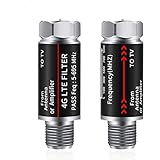
- UPGRADED LTE FILTER TECHNOLOGY - Newest filters 4G /5G signal for a clear channels;Solve the problem of TV signal interference.Giveing you hdtv digital signals.
- Filters all LTE Signal Noise - Our LTE filter removes all noise caused by 5G cellular signals, letting through only TV signal frequencies,which allows you to experience quality, crisp TV with no cellular interference.
- EASY INSTALLATION - It fits any TV antenna or antenna amplifier , fits any type of TV(2 packs suitable for family use).
- Made of Premium Materials - The shell is made of all metal, nickel-plated; Built-in filter chip ;Long-term use will not be damaged.
- Service Guarantee - If you have any questions, please consult our customer service, and the warranty will be returned for 3 years.
The 2020 opening and its wider context
NXP announced the opening on September 29, 2020, as 5G deployments were increasing demand for high-performance RF power amplifiers. Massive-MIMO radios put a premium on compact, efficient, high-power RF designs, while telecom operators and equipment makers were seeking ways to limit radio-access-network energy use. NXP’s opening ceremony was virtual and included company executives and government representatives, among them Arizona Governor Doug Ducey, Senators Kyrsten Sinema and Martha McSally, Representative Greg Stanton, Chandler Mayor Kevin Hartke and a U.S. Department of Commerce official. Those were the offices and participants associated with the 2020 event, not current titles. The Arizona Commerce Authority’s event account records the ceremony.
What is known about the fab’s status in 2026
NXP’s 2025 Form 10-K, filed February 19, 2026, still lists a Chandler RF front-end facility using six-inch wafers and GaN technology. That is evidence that the facility remained on the company’s official facility list at filing time; it does not prove the fab was operating at full production on August 18, 2026. Unofficial industry and social-media posts have alleged a closure or an exit from 5G RF power, but no definitive closure announcement appears in the cited NXP filing or product documents. The claims therefore remain unverified rather than established facts.
Quick Recap
Product prices and availability are accurate as of the date/time indicated and are subject to change. Any price and availability information displayed on Amazon at the time of purchase will apply.
Quick wins for a faster PC:
Clear out junk files and repair common Windows errorsFree Scan →Scan for outdated or missing drivers - takes under a minuteDriver Scan →



