Some links on this page are affiliate links: if you buy through them we may earn a commission, at no extra cost to you.
NVIDIA did not commit $2 billion as a construction budget for a completed 5-gigawatt data-center project. On January 26, 2026, it announced a $2 billion purchase of CoreWeave Class A shares, alongside a separate collaboration intended to help CoreWeave build more than 5 GW of AI-factory capacity by 2030. The distinction matters: one is a completed equity transaction; the other is a long-term, execution-dependent infrastructure goal.
What NVIDIA actually bought
CoreWeave’s January 26 announcement described a $2 billion investment by NVIDIA. CoreWeave’s Form 8-K supplies the transaction detail: under an agreement dated and completed January 23, NVIDIA bought 22,935,780 newly issued shares of CoreWeave Class A common stock for $87.20 per share. The private placement was made under Section 4(a)(2) of the Securities Act.
That money went to CoreWeave in exchange for equity. The filing does not identify it as a construction grant, a dedicated data-center budget, or a $2 billion order for NVIDIA equipment. The companies announced the stock purchase and their expanded infrastructure collaboration together, but they are distinct parts of the announcement. CoreWeave’s Form 8-K and NVIDIA’s announcement provide the transaction and partnership terms.
The $87.20 figure is the price paid in that private placement, not a current share-price quote or, by itself, a measure of CoreWeave’s current valuation. The announced share count also does not establish NVIDIA’s ownership percentage without a dated, fully diluted share count.
#1 Best Overall

- Professional AI & Creator Workstation: AMD Radeon AI PRO R9700 GPU with 32GB GDDR6 is engineered for AI development, professional content creation, and compute-intensive workloads.
- Massive 32GB Memory Capacity: 32GB of GDDR6 memory on a 256-bit bus provides ample bandwidth for large AI models, 8K video editing, and complex 3D rendering.
- Advanced RDNA 4 with AI Accelerators: 64 Compute Units with 3rd Gen Ray Tracing and dedicated 2nd Gen AI Accelerators for groundbreaking AI performance and visual computing.
- Professional Blower Cooling: Efficient single blower design exhausts heat directly out of the chassis, ideal for multi-GPU workstation and server configurations.
- Enterprise-Grade Thermal Solution: Vapor chamber heatsink with industrial Honeywell PTM7950 thermal interface material ensures reliable cooling under sustained professional loads.
What the 5-GW target means—and what it leaves open
A gigawatt measures power capacity. It is not a count of GPUs, servers, buildings, or dollars. The companies’ stated goal is for CoreWeave to build more than 5 GW of AI factories by 2030. That is a future target, not a report that 5 GW is already operating or fully utilized.
The public announcement and filing do not specify whether the target refers to utility power, total facility capacity, or usable IT load—the electricity available to computing equipment after facility needs such as cooling. Nor do they disclose the sites, the amount already operating, owned-versus-leased capacity, GPU quantities, workload allocation, or a campus-by-campus schedule. Without those details, converting 5 GW into a GPU count would require assumptions the companies have not supplied.
These distinctions matter because planned capacity, secured power, a constructed building, installed equipment, and revenue-producing computing capacity are different milestones. “AI factory” is the companies’ infrastructure terminology, not a standardized measure that makes those milestones interchangeable. CoreWeave’s filing calls the target forward-looking and makes it subject to future agreements, conditions, and execution; it is not a guarantee. The filing sets out that qualification.
The Tool Desk
Outbyte Driver Updater FREEFix the driver behind crashes, sound loss and screen glitchesFind Drivers →Outbyte PC Repair FREEClear out junk files and repair common Windows errorsFree Scan →Rank #2

- NVIDIA Volta GV100 Architecture — 4,608 CUDA Cores, 640 1st-Gen Tensor Cores delivering 14 TFLOPS FP32 and 112 TFLOPS deep learning performance for AI training, inference, HPC, and scientific computing workloads
- 32GB HBM2 ECC Memory — 900 GB/s Bandwidth — High-bandwidth memory on a 4096-bit bus with ECC error correction provides the memory capacity and throughput required for the largest AI models, simulations, and datasets
- PCIe 3.0 x16 Interface — 250W TDP — Standard PCIe Gen3 connectivity with passive cooling designed for enterprise rack server deployment in HPE ProLiant, Dell PowerEdge, and Supermicro platforms with adequate chassis airflow
- NVLink — Scale to 96GB Unified Memory — Connect two V100 GPUs via NVLink at 300 GB/s bi-directional bandwidth to scale GPU memory from 32GB to 96GB for larger AI training and HPC workloads
- Multi-Precision Computing — Supports FP64 (7 TFLOPS), FP32 (14 TFLOPS), FP16 (112 TFLOPS) and INT8 precision modes for flexible deployment across training, inference, and scientific simulation workloads
How the expanded collaboration is supposed to work
NVIDIA and CoreWeave describe this as an expansion of a longstanding relationship, not a first partnership. CoreWeave is expected to develop and operate the AI factories using NVIDIA accelerated-computing technology. NVIDIA says its financial strength is intended to help CoreWeave accelerate procurement of land, electrical power, and data-center shells—the basic site and building infrastructure needed before computing systems can be deployed.
The companies also describe work beyond buying hardware:
- Deploy multiple generations of NVIDIA infrastructure, with Rubin, Vera CPUs, and BlueField storage systems named in the announcement. It does not provide quantities or a deployment timetable.
- Test and validate CoreWeave’s AI-native software and reference architecture.
- Work toward incorporating CoreWeave offerings, including SUNK and CoreWeave Mission Control, into NVIDIA reference architectures for cloud partners and enterprise customers.
These are stated plans, not evidence that every named platform is already installed at scale or that software integration has become a completed commercial offering. The filing also says contemplated future agreements and order forms may be needed and may not be completed or may have different terms. The companies’ announcement describes the intended collaboration.
Rank #3

- [Local AI Inference & 70B Model Ready] Equipped with the AMD Ryzen 7 PRO 8845HS processor, NEXUS is engineered for heavy local AI workloads. With a full-size GPU bay, it runs 70B LLMs natively without an internet connection. Ideal for AI developers and tech enthusiasts who need private environment for coding and model testing.
- [132TB Mass Storage with ZFS Integrity] Features a hybrid storage architecture (3×NVMe + 4×3.5" HDD) supporting up to 132TB. Utilizing the enterprise-grade ZFS file system and ECC memory, it prevents data corruption and bit rot—a must-have for professional photographers and video editors safeguarding 4K/8K RAW footage.
- [OpenClaw-Driven Automation Workflow] The built-in OpenClaw execution layer allows complex automated tasks to be processed locally. Even when offline, your backup schedules and AI file organization continue seamlessly. Say goodbye to monthly cloud subscriptions and high latency.
- [Dual 10GbE & USB4 Ultra-Connectivity] Experience server-class speeds with dual 10GbE ports and a 40Gbps USB4 interface. It enables multi-user real-time collaboration on large project files directly from the NAS, ensuring zero-lag editing for creative studios and production teams.
- [Open-Source ZimaOS for Total Privacy] Running on the fully open-source ZimaOS, NEXUS ensures your data stays physically on-premise with no backdoors. It acts as a "Digital Fortress" for privacy-conscious families and small businesses who demand absolute data sovereignty.
Why NVIDIA would invest in a customer
CoreWeave is a specialist AI cloud provider whose platform combines compute, storage, networking, software, and managed services. NVIDIA supplies key accelerated-computing technology for that platform. A better-capitalized CoreWeave could potentially secure sites and power, deploy more NVIDIA-based systems, and make capacity available to AI developers and enterprises. NVIDIA also gains a closer role in how a cloud platform is designed and deployed, rather than participating only as a hardware supplier.
Outdated Drivers Are Slowing You Down
One free scan finds every outdated or missing driver and matches the right update for your exact hardware.Free scan · exact hardware matchWindows Errors? Fix Them Before They Spread
Repair common Windows errors and clear accumulated junk for a smoother, more stable PC - no reinstall needed.Free scan · no reinstallThe software and reference-architecture work could give CoreWeave technology a route into partner and enterprise deployments beyond CoreWeave-operated facilities, if the companies complete and commercialize that integration. Taken together, the arrangement could reinforce NVIDIA’s ecosystem: it invests in an infrastructure customer while supporting expansion of systems built around NVIDIA technology. That is strategic logic, not a disclosed guarantee of sales, profit, customer demand, or investment return.
For CoreWeave, the potential upside is access to capital and closer alignment with NVIDIA’s infrastructure roadmap. The trade-off is deeper dependence on NVIDIA hardware and product timing. For customers, more capacity could broaden access to accelerated computing, but the announcement does not promise them a particular allocation, price, or service level.
Rank #4
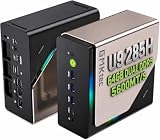
- EVOLUTION CORE ULTRA 9 285H MINI PC - GMKtec EVO-T1 is the next evolution in AI mini PC Ultra 9 series. The Core Ultra 9 285H offers 16 cores (six P-cores + eight E-cores + two LPE-cores) and 16 threads with a turbo clock of 5.4 GHz. It is currently one of the best value for performance AI mini PC computers.
- AI NPU - The 285H features an Intel AI Boost NPU, capable of up to 13 TOPS (Tera Operations per Second) for INT8 calculations, which is designed to accelerate AI tasks.
- INTEL ARC 140T GAMING PC - The Arc 140T GPU includes 8 Xe cores and supports features like DirectX 12, OpenGL 4.5, and OpenCL 3, making it capable of handling modern games and creative applications. It also supports Quick Sync Video for efficient video encoding and decoding, as well as AV1 encoding and decoding.
- 64GB DDR5 RAM + 1TB SSD - The EVO-T1 is equipped with Dual 32GB (Total 64GB) SO-DIMM DDR5 5600MHz memory sticks. 2TB PCIE 4.0 SSD Drive with 3x M.2 2280 Expansion slots. Each slot capable of reading up to 4TB. (12TB MAX)
- QUAD SCREEN 8K DISPLAY SUPPORT - EVO-T1 AI Mini PC support 4-screen 4K/8K output via HDMI 2.1 (8K@60Hz), DisplayPort 1.4 (4K@60Hz), and USB Type-C Transfer speed (supporting PD3.0/DP1.4/DATA). Ideal for gaming, video editing, and multitasking, it provides expansive and crisp multi-display support.
What could prevent the target from being reached
A 5-GW buildout would require more than chips and a financing announcement. The companies identify land and power procurement as part of the effort; actual capacity also depends on securing connections, construction, equipment availability, financing, customer commitments, and successful deployment. CoreWeave’s filing points to future agreements and conditions as well as execution and other risks described in its SEC filings.
CoreWeave’s expansion model also makes financing and utilization important questions. TechCrunch, citing PitchBook data, reported $18.81 billion in CoreWeave debt obligations as of September 2025 and reported third-quarter 2025 revenue of $1.36 billion. Those are attributed figures with different meanings and measurement periods—not a statement that the $2 billion NVIDIA investment repays that debt or finances the full buildout. TechCrunch’s report provides that context.
- Power and construction: Can CoreWeave obtain grid connections, permits, cooling systems, and facilities on a schedule compatible with the 2030 goal?
- Capital and returns: The announcement does not disclose the total cost, financing mix, expected return, or how much additional borrowing would be needed. Heavy fixed investment is riskier if utilization or pricing falls short.
- Customer commitments: The companies cite demand for AI infrastructure, including management commentary, but this announcement does not establish guaranteed customer contracts or future utilization for the proposed capacity.
- Technology cycles: New GPU generations may improve performance, but equipment still has to be financed, installed, and kept economically productive as architectures change.
- Concentration and circularity: NVIDIA’s stake could support a customer that may buy NVIDIA systems, raising a reasonable question about vendor-supported demand and dependence on one technology ecosystem. That is a risk to examine, not evidence that the arrangement is improper.
What investors and cloud buyers should take from the announcement
For investors, the event signals a closer strategic relationship and an equity investment at a specified transaction price. It does not, alone, establish CoreWeave’s future profitability, the value of NVIDIA’s stake today, or the financial returns from the collaboration. The 5-GW figure is an ambitious capacity target, not a delivered asset or a substitute for examining financing, contracts, construction progress, and utilization.
Best Value

- [ Maximum AI Compute Power ] Dominate complex workloads with the ASUS ESC8000A-E13. This 4U rack server is a powerhouse engineered for mass-scale AI, machine learning, and deep training. Featuring support for dual AMD EPYC 9005/9004 processors and up to eight dual-slot GPUs, it delivers the raw computational muscle required to train LLMs and run complex simulations effortlessly. Accelerate your data science pipeline and transform raw data into actionable intelligence faster than ever.
- [ Advanced Thermal Efficiency ] High performance demands elite cooling. The ESC8000A-E13 features a cutting-edge aerodynamic design with independent CPU and GPU airflow tunnels. Equipped with redundant hot-swap fans and optimized for liquid cooling integrations, this 4U server ensures maximum uptime under heavy, sustained workloads. Keep your data center running cool, quiet, and highly efficient while preventing thermal throttling during mission-critical enterprise operations.
- [ Scale with Flexible Storage ] Future-proof your infrastructure with unmatched storage and expansion flexibility. This offers comprehensive front-panel drive bays supporting Gen5 NVMe, SAS, or SATA drives alongside multiple PCIe 5.0 slots. Designed as a high-density 4U server capable of housing eight dual-slot GPUs: NVD H200, RTX PRO 6000 Blackwell, RTX PRO 4500 Blackwell or AMD Instinct MI350P PCIe Card, each supporting up to 600 watts.
- [ Enterprise-Grade Reliability ] Minimize downtime and secure your ecosystem with server-grade redundancy. The ESC8000A-E13 is built for 24/7 continuous operation, boasting 2+2 redundant (3200W total) 80 PLUS Titanium power supplies and integrated ASUS ASMB11-iKVM for comprehensive out-of-band management. Ideal for cloud service providers, rendering farms, and large enterprise infrastructure, it combines robust physical hardware with smart remote monitoring to safeguard your digital assets.
- [Reliability Guaranteed] Shop with total peace of mind knowing that every new computer component we sell is backed by our EPC 3-year warranty. Whether you are investing in high-speed DDR5 RAM or a powerhouse GPU, we protect your build against defects and performance failures. We stand firmly behind the quality of our hardware, ensuring that your setup remains fast, stable, and secure for years to come.
For organizations buying AI infrastructure, the announcement is evidence of planned investment and platform cooperation, not a purchasable share of the 5-GW expansion. It gives no site list, customer allocation, pricing, or service commitment. Buyers evaluating capacity still need provider-specific terms, location and power availability, hardware configuration, software compatibility, and delivery schedules.
CoreWeave’s product information and pricing page are starting points for evaluating its offerings; neither establishes the price or availability of capacity under this announced collaboration. The deal-specific announcement provides no public price schedule.
What remains undisclosed
- The total cost and financing mix for the greater-than-5-GW buildout.
- Specific locations, power-connection timelines, and capacity milestones.
- The GPU quantities and the meaning of the capacity measure in facility-versus-IT-load terms.
- How much capacity is covered by customer commitments or how it will be allocated.
- NVIDIA’s resulting ownership percentage and the investment’s expected financial return.
- Whether the planned software integration will become a formal, generally available commercial product.
The companies’ January 2026 announcement describes the intended buildout and cooperation; CoreWeave’s SEC filing establishes the equity transaction and warns that the long-term target depends on future conditions. The practical reading is therefore a major financing and ecosystem signal, not proof that the 5-GW outcome is funded, contracted, or assured.
Quick Recap
Product prices and availability are accurate as of the date/time indicated and are subject to change. Any price and availability information displayed on Amazon at the time of purchase will apply.



