Some links on this page are affiliate links: if you buy through them we may earn a commission, at no extra cost to you.
Plan on about $20–$150 for laptop memory itself, or roughly $60–$190 when you pay for installation. The exact total depends on whether your laptop uses removable DDR4 or DDR5 SODIMMs, how much capacity you need, whether one slot is free, and local labor. Many newer laptops have soldered memory, making a conventional RAM upgrade impossible.
The ranges below are approximate U.S. planning figures based on prices reviewed in August 2026. Check live listings and your laptop’s exact service manual before ordering.
Typical total cost of a laptop RAM upgrade
Budget for the memory, not just the sticker price of a module. Your total can include labor, a precision screwdriver, shipping, tax, diagnostic fees and, in the worst case, the cost of undoing an incompatible installation.
| Upgrade scenario | Memory planning range | Professional labor | Typical total |
|---|---|---|---|
| 4GB → 8GB or 16GB | $20–$60 | About $40 | $60–$100 |
| 8GB → 16GB | $20–$70 | About $40 | $60–$110 |
| 8GB → 32GB | $40–$120 | About $40 | $80–$160 |
| 16GB → 32GB | $50–$150 or more | About $40 | $90–$190 or more |
| 32GB → 64GB | Highly model- and market-dependent | About $40 or a quoted repair price | Often $100–$300+, potentially much more |
Best Buy lists in-store hardware installation at $39.99, but parts and additional labor may be extra. Independent shops may charge differently; uBreakiFix advertises memory upgrades, diagnostics and a one-year limited warranty for most repairs, with the final quote depending on location and model.
#1 Best Overall

- A-Tech 16GB RAM Module, DDR4 SO-DIMM 260-Pin, 3200MHz PC4-25600 (PC4-3200AA)
- Non-ECC Unbuffered, JEDEC DDR4 Standard 1.2V Operating Voltage
- Compatible with select Laptop, Notebook, Mini PC, and All-in-One (AIO) systems. Please verify your system's memory type, form factor, and maximum supported capacity before purchasing
- Not compatible with desktop DIMM, non DDR4 memory, or ECC memory types such as RDIMM, LRDIMM, and ECC UDIMM
- Increases available memory capacity to enhance system responsiveness, application performance, and multitasking capabilities.
High-capacity DDR5 is an outlier. Corsair’s U.S. page displayed a 96GB DDR5 SODIMM kit at $999.99 during one crawl—evidence that capacity and supply can radically change the price, not a normal 16GB or 32GB upgrade benchmark.
What determines the price?
- DDR generation: DDR4 modules are often less expensive than newer DDR5, but laptop-specific demand can reverse that.
- Capacity: 8GB and 16GB modules cost less than 32GB or 64GB modules.
- One module or a kit: If both slots are occupied, you may need two new modules rather than one.
- Removable or soldered memory: Soldered RAM cannot be replaced like a SODIMM.
- Brand, warranty and availability: A reputable module with an easy return policy can be worth more than the cheapest listing.
- Installation complexity: A laptop requiring extensive bottom-cover or motherboard disassembly may cost more than a simple two-slot design.
First check whether your exact laptop is upgradeable
Do not rely on a family name such as “HP Pavilion,” “Dell Inspiron” or “Lenovo IdeaPad.” Different configurations under the same name can have two slots, one slot plus soldered memory, or no removable memory at all.
Find the complete model number from the label, BIOS/UEFI screen, Windows System Information, or the manufacturer’s support app. Then download that model’s Maintenance and Service Guide or Hardware Reference Guide. HP specifically directs owners to those model-specific manuals. The guide should state the number of slots, supported memory generation, maximum module size and maximum total capacity.
Quick wins for a faster PC:
Clear out junk files and repair common Windows errorsFree Scan →Fix the driver behind crashes, sound loss and screen glitchesFind Drivers →Repair Windows errors before they cause bigger problemsFix Now →Classify your laptop before spending money:
- Fully upgradeable: Two removable SODIMM slots.
- Partially upgradeable: One soldered module plus one removable slot.
- Replaceable but limited: Removable memory exists, but the manufacturer lists a low maximum.
- Not upgradeable: All memory is soldered.
- Technically serviceable but impractical: Replacement requires board-level work or a motherboard swap.
Corsair notes that some laptops have soldered memory. If yours does, the relevant choice is usually software cleanup, an SSD where appropriate, or a replacement computer—not a RAM purchase.
How to check your current RAM in Windows
- Press Ctrl + Shift + Esc to open Task Manager.
- Choose Performance, then Memory.
- Record total installed memory, speed, form factor and slots used if shown.
You can also open Settings → System → About or run msinfo32 for System Information. Task Manager is an initial check, not the final compatibility authority: it may omit slot details and cannot reliably tell you whether memory is soldered. Confirm everything against the exact service manual. Crucial’s Upgrade Selector and System Scanner and Corsair’s compatibility finder can provide a second check.
Rank #2

- Boosts System Performance: 32GB DDR5 RAM laptop memory kit (2x16GB) that operates at 5600MHz, 5200MHz, or 4800MHz to improve multitasking and system responsiveness for smoother performance
- Accelerated gaming performance: Every millisecond gained in fast-paced gameplay counts—power through heavy workloads and benefit from versatile downclocking and higher frame rates
- Optimized DDR5 compatibility: Best for 12th Gen Intel Core and AMD Ryzen 7000 Series processors — Intel XMP 3.0 and AMD EXPO also supported on the same RAM module
- Trusted Micron Quality: Backed by 42 years of memory expertise, this DDR5 RAM is rigorously tested at both component and module levels, ensuring top performance and reliability
- ECC Type = Non-ECC, Form Factor = SODIMM, Pin Count = 262-Pin, PC Speed = PC5-44800, Voltage = 1.1V, Rank And Configuration = 1Rx8
How to choose compatible laptop RAM
Match all of these specifications:
- Generation: DDR3, DDR3L, DDR4 or DDR5. Generations are not interchangeable.
- Form factor: Laptop memory is normally SODIMM, not desktop UDIMM.
- Speed: For example, DDR4-3200 or DDR5-5600. The laptop may run a faster-rated module at its own supported speed.
- Voltage and electrical specification.
- Module size and total maximum: Follow the manufacturer’s limits.
- ECC: Consumer laptops normally require non-ECC memory.
- Firmware and operating-system limits.
As one physical reminder, HP identifies DDR4 SODIMM as 260-pin and DDR5 SODIMM as 262-pin. A cheap desktop module will not fit. Do not install DDR5 in a DDR4 laptop simply because both are called “RAM.”
Add a module or replace the existing ones?
If one slot is free, adding a compatible module is often the least expensive route. Match the documented capacity and specification as closely as possible. If both slots are occupied, replace one or both modules; a matched kit is the simplest choice.
Recommended Free Tools
Mixed capacities or brands can work, but they are not guaranteed. Mixed speeds generally operate at the slower supported speed. Two matched modules can enable dual-channel operation, which may matter more on systems with integrated graphics because the graphics processor shares system memory. Do not treat a specific performance percentage as guaranteed.
How much RAM do you actually need?
- 8GB: Adequate for basic browsing and office work, but restrictive with many browser tabs and modern applications.
- 16GB: The sensible baseline for general Windows use, school, office work and moderate creative tasks.
- 32GB: A better target for gaming, programming environments, large browser workloads, photo/video work, virtual machines and longer useful life.
- 64GB or more: Mainly for multiple virtual machines, large datasets, demanding video projects or specialized professional software.
More RAM does not automatically make every laptop faster. If Windows is not running out of memory, the visible gain may be small. Crucial notes that results depend on the original system and selected upgrade.
RAM or SSD: which upgrade is better?
| Likely bottleneck | Upgrade to consider |
|---|---|
| Memory usage stays near 100%; apps reload when switching; virtual machines or large projects run out of headroom | RAM |
| Hard-disk drive, very slow boot and app launches, or nearly full storage | SSD |
| Weak CPU/GPU, overheating, failing battery, damaged motherboard or malware | Neither RAM nor SSD alone solves it |
Compare the proposed upgrade with the laptop’s condition. RAM is worthwhile when slots exist, the processor and storage are adequate, and memory pressure is the actual problem. Replacement is usually better when the battery, hinge, display or motherboard is failing, compatible memory is scarce, or the required modules cost a large fraction of a newer laptop.
Rank #3
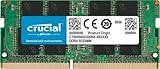
- Boosts System Performance:16GB DDR4 laptop memory that operates at 3200MHz to improve multitasking and system responsiveness for smoother performance
- Easy Installation: Upgrade your laptop RAM with ease—no computer skills required Follow step-by-step how-to guides available at Crucial for a smooth, worry-free installation
- Compatibility Guaranteed: Ensure seamless compatibility with your laptop by using the Crucial System Scanner or Crucial Upgrade Selector—get accurate recommendations for your specific device
- Trusted Micron Quality: Backed by 42 years of memory expertise, this DDR4 RAM is rigorously tested at both component and module levels, ensuring top performance and reliability for your Mac system
- ECC Type = Non-ECC, Form Factor = SODIMM, Pin Count = 260-pin, PC Speed = PC4-25600, Voltage = 1.2V, Rank and Configuration = 1Rx8 or 2Rx8
DIY installation versus paying a shop
DIY
DIY normally gives the lowest total cost and lets you restore the original configuration if the new part is incompatible. The risks are stripped screws, broken clips, electrostatic damage, an incorrect module, and possible warranty or service-policy complications.
PC Slower Than It Used to Be?
A free scan shows the junk files, broken settings and background clutter dragging Windows down - then fixes them in one click.Free scan · Windows 10 & 11Crashes, No Sound, or Screen Glitches?
Random freezes, missing sound and display glitches usually trace back to one bad driver. Find and replace yours safely.Free scan · under a minuteProfessional installation
A shop can verify compatibility, perform diagnostics and reduce physical risk. Labor can nevertheless approach the price of inexpensive memory, and some stores may require approved parts or charge additional labor. Soldered-memory systems may need a motherboard replacement rather than installation.
General DIY installation sequence
- Back up important files.
- Shut down fully; do not merely close the lid.
- Disconnect the charger and peripherals.
- Read the exact service manual for cover removal and battery-disconnect instructions.
- Remove the bottom cover with the correct precision screwdriver.
- Disconnect the internal battery if the manufacturer requires it.
- Release the SODIMM retaining clips and lift the old module by its edges.
- Align the notch, insert the new module at the specified angle and press it down until the clips lock.
- Reassemble, boot and verify memory in firmware or Windows.
- Run a memory test if the laptop crashes, fails to boot or reports less memory.
There is no universal screw layout, and not every laptop requires battery disconnection. The model-specific procedure controls.
Independent reader supportYour contribution helps us test, update, and keep practical guides available for everyone.If the laptop will not boot afterward
- Power off and disconnect the charger.
- Reseat the module.
- Test one module at a time and, on two-slot systems, test each slot.
- Confirm DDR generation, SODIMM form factor and supported capacity.
- Allow time for memory training on some newer systems.
- Reset BIOS/UEFI settings only as the manufacturer instructs.
- Reinstall the original RAM to determine whether the laptop still works.
- Update firmware only when the manufacturer specifically recommends it.
- Return a defective or incompatible module.
If less RAM is recognized, check seating, slot health, firmware limits, system-reserved memory (including integrated graphics), maximum capacity and—on very old systems—32-bit operating-system limits. Community reports document model-specific incompatibilities, so apparent DDR and speed matches are not proof of compatibility.
MacBooks and other soldered-memory laptops
Many newer Mac laptops integrate memory into the system and cannot be upgraded after purchase. Older Intel Macs have model-specific exceptions. Crucial’s Mac compatibility chart notes that many systems made after mid-2012 and Retina models are not upgradeable, while listing exceptions. Verify the exact model before buying anything.
Rank #4

- A-Tech 8GB RAM Module, DDR4 SO-DIMM 260-Pin, 2666MHz / 2667MHz PC4-21300 (PC4-2666V)
- Non-ECC Unbuffered, JEDEC DDR4 Standard 1.2V Operating Voltage
- Compatible with select DDR4 SODIMM capable Laptop, Notebook, Mini PC, and All-in-One (AIO) computer systems. Please verify your system's memory type, form factor, and maximum supported capacity before purchasing
- Not compatible with desktop (DIMM), DDR2, DDR3, DDR5, ECC Registered (RDIMM), ECC Load Reduced (LRDIMM), or ECC Unbuffered (ECC UDIMM) memory types
- Increases available memory capacity to enhance system responsiveness, application performance, and multitasking capabilities.
Final decision checklist
- Confirm removable slots and maximum capacity in the exact service manual.
- Match DDR generation, SODIMM form factor, speed and capacity.
- Price the memory, labor, tools, tax and return risk together.
- Choose 16GB for a practical baseline and 32GB for heavier or longer-term use, when supported.
- Prefer a matched kit when replacing both occupied modules.
- Check whether an SSD or replacement laptop addresses the real bottleneck.
Frequently Asked Questions
Is a laptop RAM upgrade worth paying $40 for installation?
It can be, especially when the laptop is otherwise healthy and the memory upgrade solves a real memory bottleneck. Compare the labor with the module price and the laptop’s remaining value.
Can I use desktop RAM in a laptop?
Normally no. Laptops use SODIMM modules, while desktops generally use longer UDIMMs. Confirm the exact form factor in the service manual.
Why does Windows show less usable RAM than installed?
A reserved portion may be used by integrated graphics, firmware or hardware. Also check seating, slot health, maximum-capacity limits and whether the operating system is 32-bit.
The Bottom Line
A removable-memory laptop can often be upgraded for about $20–$150 in parts, or roughly $60–$190 with professional installation. Check the exact model before buying, and spend the money only when insufficient RAM—not storage, thermals, the processor or the laptop’s age—is the reason it feels slow.
Do these 3 things before closing this tab:
1Repair Windows errors before they cause bigger problems2Scan for outdated or missing drivers - takes under a minute3Clear out junk files and repair common Windows errorsQuick Recap
Product prices and availability are accurate as of the date/time indicated and are subject to change. Any price and availability information displayed on Amazon at the time of purchase will apply.



