Free tools Windows power users keep installed
One-click scans. No signup required.
Some links on this page are affiliate links: if you buy through them we may earn a commission, at no extra cost to you.
No. A fair, useful way to set expectations, discuss performance, and support improvement matters across sectors, but every employer does not need dedicated performance-evaluation software. Smaller teams with simple roles and reliable manager routines may do well with templates or an existing HR system. Software becomes more valuable when reviews are inconsistent, records are scattered, or a distributed workforce makes coordination and oversight difficult.
What employee performance evaluation software does
Employee performance evaluation software organizes some or all of the work involved in assessing and developing employees. Depending on the product, it may provide goal tracking, employee self-assessments, manager reviews, competency assessments, peer or 360-degree feedback, check-ins, one-to-one meeting notes, development plans, review-cycle reminders, rating calibration, recognition, reporting, and links to compensation, succession, or learning workflows.
Not every employee-feedback or survey product is a performance-review system. Microsoft, for example, describes its Viva Glint 360 program as a way to gather feedback from multiple perspectives for development and improvement, not as a performance evaluation. Microsoft’s description of Viva Glint 360 is a useful distinction when comparing products.
Performance evaluation is not the same as performance management
A performance evaluation is a formal assessment at a particular time, often involving written feedback and ratings. Performance management is the wider, ongoing process: setting expectations, coaching, giving feedback, developing employees, recognizing contributions, addressing underperformance, and connecting individual work to organizational objectives. CIPD describes it as an umbrella that can include objectives, feedback, development, reward and recognition, career progression, and underperformance management. CIPD’s performance-management guidance emphasizes that the approach should fit an organization’s context and objectives.
#1 Best Overall
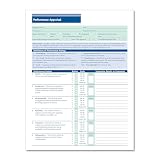
- HR & EMPLOYEE MANAGEMENT: Make employee performance evaluations easier, more efficient, and less stressful by using the Performance Appraisal Form by ComplyRight. Such a documentation process also helps employers validate employee promotions as well as protect the employer against potential termination disputes during a lawsuit.
- EMPLOYEE PERFORMANCE: Make the performance review process a more consistent, time-saving procedure. This employee evaluation form allows the employer to communicate their expectations easily and effectively, while providing the employees a tangible way to access their progress.
- APPRAISAL FORM: The performance evaluation form features an easy-to-understand 100-point rating scale that ranges from outstanding to unsatisfactory for 11 key performance factors, such as productivity, job knowledge, and creativity. It has a large comments section to provide a detailed explanation to employees to support their performance ratings.
- PACKAGING/DIMENSIONS: Rated as "Excellent" by HR professionals, this employee performance appraisal form measures 8-1/2” wide and 11” long and is sold in a pack of 50 sheets. It also includes a ComplyRight tips sheet for optimal, compliant use.
- COMPLYRIGHT: At ComplyRight, our mission is to free employers from the burden of tracking and complying with the complex web of federal, state, and local employment laws. ComplyRight is the market leader in government-compliant products such as tax forms, tax software, HR products and services, labor law solutions, and health insurance claim forms.
Software can structure forms, route tasks, send reminders, preserve records, and summarize information. It cannot supply clear expectations, sound measures, skilled managers, adequate staffing, or trust. If the underlying process is vague or unfair, putting it online can make the same problems easier to repeat.
Why organizations adopt software
A dedicated tool may help when annual reviews are missed, managers apply different standards to similar jobs, goals drift away from business priorities, or documentation is scattered across email and spreadsheets. It can also help HR see completion status and rating patterns, give employees clearer access to expectations and development plans, and coordinate review activity across teams, locations, or countries.
Enterprise systems can combine several workflows. SAP SuccessFactors documentation describes goal management, continuous performance management, reviews, self-evaluation, manager evaluation, competencies, and 360-degree reviews. Those capabilities illustrate the scope a larger organization may need; they are not a reason for every employer to buy an enterprise suite. SAP’s Performance and Goals documentation details its product’s workflows.
Rank #2
![Express Schedule Free Employee Scheduling Software [PC/Mac Download]](https://m.media-amazon.com/images/I/41yvuCFIVfS._SL160_.jpg)
- Simple shift planning via an easy drag & drop interface
- Add time-off, sick leave, break entries and holidays
- Email schedules directly to your employees
How needs differ by sector
Performance software should reflect the work, not impose one office-centered model everywhere. The following are practical fit considerations, not claims that every employer in a sector has the same needs.
| Sector or setting | Capabilities that may matter | Risk to manage |
|---|---|---|
| Technology and professional services | Goals, project or client objectives, peer input, skills frameworks, career development, and distributed-team check-ins. | Counting visible activity, utilization, billable hours, or tickets instead of considering quality, complexity, collaboration, and outcomes. |
| Retail, hospitality, and frontline operations | Mobile or kiosk access, short forms, shift- and location-specific goals, training records, recognition, and language support. | Excluding workers with limited device access or treating customer scores as a complete measure without considering staffing, scheduling, workload, and equipment. |
| Manufacturing, logistics, and field services | Safety and quality measures, certifications, supervisor checklists, team-based goals, incident documentation, and mobile or offline workflows. | Rewarding speed over safety or quality, or penalizing employees for equipment breakdowns, supply shortages, or different assignments. |
| Healthcare and social care | Role-based competencies, training and certification tracking, teamwork, handoffs, professional standards, and tightly controlled access. | Putting sensitive details in broadly visible notes or reducing care quality to throughput while ignoring acuity, staffing, and resources. |
| Education | Role-specific objectives, development plans, observation records, and recognition of collaboration and service responsibilities. | Using student outcomes as a simplistic proxy for an individual’s work, without accounting for class composition, resources, or different roles. |
| Financial services and other regulated work | Audit trails, role-based permissions, documented workflows, policy and training records, and risk or conduct indicators. | Confusing completion of compliance tasks with overall performance, or retaining sensitive records unnecessarily. |
| Public sector and nonprofit organizations | Transparent criteria, mission-related and team goals, accessible workflows, and budget-conscious administration. | Importing private-sector productivity measures that do not fit public-service work, or overlooking collective bargaining and civil-service rules. |
When a dedicated platform is worth considering
Software is more likely to solve a real problem when several of these conditions apply:
- Multiple review cycles or employee populations need to be coordinated.
- Teams work across locations, countries, shifts, or remote settings.
- HR needs common templates while managers need goals tailored to different roles.
- Reviews inform pay, promotion, succession, or formal development decisions.
- The organization needs reliable records, completion tracking, calibration, or aggregate reporting.
- Managers need guided forms, prompts, reminders, or a practical way to maintain regular check-ins.
- Employees need mobile access, or performance workflows must connect with the HR system, payroll, identity, collaboration, or learning tools.
- The organization is growing faster than its informal processes can handle.
These are buying signals, not proof that a standalone product is required. An existing HRIS may already meet the need; a policy change or manager training may be the more important intervention.
Rank #3

- Free Cloud Service: The TC1 Cloud-Connect time clock, powered by NGTeco Office software and app, allows you to access real-time punch data from anywhere. Benefit from accurate hour calculations and automatic report generation through any web browser.
- Customizable Shifts for Any Workflow: Fully flexible shift configurations (fixed, rotating, split‑shift, open) suit all team structures. Perfect for part‑time staff, multi‑department operations, and 24/7 workplaces, this feature eliminates manual scheduling errors. It also supports custom weekly overtime rules and dual OT1/OT2 pay grades, enabling precise, adaptive overtime payroll calculations that align with diverse company compensation policies.
- Bank-Grade Data Security & Compliance: Powered by AWS US servers with end-to-end encryption, your attendance data is stored securely and fully compliant with global data protection standards, keeping sensitive workforce records protected.
- Multi-Language Support for Global Teams: NGTeco Office software supports 7+ languages (English, Spanish, French, German, Italian, Japanese, Latin American Spanish) for diverse, international workforces.
- Large Storage & Offline Functionality: Supports up to 200 users and 30,000 logs, connects via 2.4GHz WiFi or LAN. Offline punch capture syncs automatically to the cloud once network is restored, no data loss.
When simpler tools may be enough
A small organization with few job types, straightforward goals, and managers who hold regular documented conversations may not need a separate platform. The same may be true when reviews are infrequent and consistently completed, or when the current HRIS already offers usable review workflows. Structured templates and shared documents can be a reasonable starting point when the process is simple and access is controlled.
The Tool Desk
Outbyte PC Repair FREERepair Windows errors before they cause bigger problemsFix Now →Outbyte Driver Updater FREEScan for outdated or missing drivers - takes under a minuteDriver Scan →Be cautious about buying software before deciding what good performance means. If expectations, rating definitions, review frequency, and the purpose of the process are unsettled, a new system may turn unclear judgments into expensive form-filling. It is also a poor fit if employees cannot readily access it or if leaders expect automation to repair weak management practices.
Choose the right type of tool
The basic trade-offs are about depth, integration, flexibility, and administration rather than a universally best category.
Rank #4
![DeskFX Free Audio Effects & Audio Enhancer Software [PC Download]](https://m.media-amazon.com/images/I/41fXbDohyuS._SL160_.jpg)
- Transform audio playing via your speakers and headphones
- Improve sound quality by adjusting it with effects
- Take control over the sound playing through audio hardware
| Approach | Often suits | Advantages | Trade-offs |
|---|---|---|---|
| Standalone performance platform | Organizations that need deeper goals, feedback, development, or review workflows than their HRIS provides. | Specialized functionality and a focused employee experience; may be adopted without replacing the broader HR system. | Another system to administer, integrate, and keep in sync; may duplicate employee data or add cost. |
| Performance module in an HRIS or HCM suite | Organizations that want reviews connected to employee records, compensation, payroll, and organizational structure. | Shared data and potentially simpler integration and governance. | Functionality or user experience may be less flexible; needed capabilities may be in a higher-priced package. |
| Spreadsheets and documents | Small teams with simple processes, or organizations piloting a defined approach. | Familiar, flexible, and low in direct software cost. | Limited reminders, auditability, aggregation, and access control; version problems and accidental disclosure become harder to manage at scale. |
Annual reviews can be easier to administer and may be needed for formal records or compensation decisions. Ongoing check-ins can make feedback more timely, but they depend on manager follow-through and can create notification fatigue. CIPD’s performance factsheet treats performance management as broader than an annual appraisal. The practical choice is a cadence people can use well, not simply the most frequent one.
Ratings can help structure comparisons, compensation decisions, and workforce planning, but can also encourage gaming or make a developmental conversation feel punitive. Whether to rate employees depends on the process’s purpose, the quality of criteria, and the safeguards around decisions. Likewise, 360-degree feedback provides a wider set of perspectives, not automatic objectivity; select raters, explain confidentiality, and decide how the information will be used.
Quick wins for a faster PC:
Repair Windows errors before they cause bigger problemsFix Now →Scan for outdated or missing drivers - takes under a minuteDriver Scan →Clear out junk files and repair common Windows errorsFree Scan →Features to compare
Core capabilities
- Configurable review templates and support for more than one review frequency.
- Goal tracking, self-reviews, manager reviews, and role-based permissions.
- Review scheduling, useful reminders, comment history, and an audit trail.
- Exportable reports and integration with the organization’s HR system.
- Accessible desktop and mobile experiences, plus data-retention and deletion controls.
Advanced capabilities
Depending on the process, useful additions may include continuous feedback, one-to-one workflows, competency libraries, 360-degree input, calibration, development plans, career frameworks, succession planning, compensation-cycle or learning-system integration, analytics, multilingual support, single sign-on, and API access. Do not pay for modules that do not support a defined use case.
Best Value
![Dragon Professional 16.0 Speech Dictation and Voice Recognition Software [PC Download]](https://m.media-amazon.com/images/I/41mYWIw3-dL._SL160_.jpg)
- Dictate documents 3 times faster than typing with 99% recognition accurancy, right from the first use
- Developed by Nuance – a Microsoft company – ensuring the best experience on Windows 11 and Office 2021 and fully compatible with Windows 10 to support future migration plans of individual professionals and large organizations to Windows 11
- Achieve faster documentation turnaround- in the office and on the go
- Eliminate or reduce transcription time and costs
- Sync with separate Dragon Anywhere Mobile Solution that allows you to create and edit documents of any length by voice directly on your iOS and Android Device
Features that merit extra scrutiny
Assess AI-generated ratings, potential or flight-risk scores, sentiment analysis, forced ranking, and productivity scores based on activity rather than outcomes with particular care. Keystroke, screen, webcam, voice, facial-expression, or location monitoring can be especially intrusive. The EEOC and Department of Justice warn that software and AI used to monitor performance or influence training, pay, promotion, or termination can create disability-discrimination risks. Employers may need accommodation processes and must avoid tools that screen out qualified people with disabilities. The agencies’ guidance discusses these concerns.
Fairness, privacy, and legal safeguards
Performance evaluations can affect pay, promotion, discipline, and termination, so treat the process as part of employment decision-making, not just as an HR form. In the United States, EEOC guidance advises employers to communicate standards, apply them consistently, use factual details, and avoid ratings affected by protected characteristics. The EEOC’s evaluation guidance provides practical advice. Its materials also describe investigating complaints about discriminatory evaluations, comparing records for similar employees, and correcting unsupported evaluations. The EEOC’s guidance on evaluation complaints addresses those steps. These are U.S. sources; employers elsewhere should check the laws and employment arrangements that apply in their jurisdiction.
Before selection, decide who can see each type of information, whether peer feedback is anonymous or attributed, whether employees can respond, how long records are retained, and whether reviews will inform development, compensation, discipline, or several of those decisions. Use role-based access and an accommodation process. Review rating patterns across comparable roles and groups, and provide a way to correct inaccurate information.
Do these 3 things before closing this tab:
1Fix the driver behind crashes, sound loss and screen glitches2Clear out junk files and repair common Windows errors3Scan for outdated or missing drivers - takes under a minuteAI-generated summaries may omit context or reproduce biased language. If using them, disclose the assistance, preserve the underlying evidence, require a human to review outputs, and do not treat an algorithmic recommendation as conclusive. No software can guarantee legal compliance or remove bias simply by standardizing a form.
A practical selection and implementation process
- Diagnose the problem. Map the current review process, completion issues, manager and employee concerns, existing systems, decisions informed by reviews, and privacy, accessibility, legal, frontline, or international constraints.
- Define the operating model. Choose the review cadence; decide whether to use ratings; set individual and team-goal expectations; specify whether reviews affect pay; and define how underperformance, employee responses, access, and calibration will work.
- Build a requirements matrix. Compare review and goal workflows, feedback, development, reporting, integrations, mobile access, accessibility, security, AI controls, administration, cost, and implementation effort. Separate essential requirements from features that are merely attractive.
- Test with varied employee groups. Pilot with an office or department, a frontline or field group, and teams with different managerial or job needs. Check time to complete, usability, evidence quality, employee understanding, rating consistency, support requests, accessibility, and trust.
- Govern after launch. Review rating patterns and permissions, train new managers, update goals when priorities change, remove unused fields, and reassess AI features before enabling them. Ask whether the system is improving conversations, not just increasing documentation.
Bottom line
Every sector needs a fair and usable way to define, discuss, document, and improve performance. Dedicated employee performance evaluation software is a strategic choice, not a universal requirement. Buy it when it addresses a specific coordination, consistency, documentation, or workforce-access problem that simpler tools or the existing HRIS cannot handle; establish the process and safeguards before configuring the technology.
Quick Recap
Product prices and availability are accurate as of the date/time indicated and are subject to change. Any price and availability information displayed on Amazon at the time of purchase will apply.



