Some links on this page are affiliate links: if you buy through them we may earn a commission, at no extra cost to you.
Amazon added RFID-enabled checkout to Just Walk Out in September 2023, extending the system to clothing, jerseys, shoes, hats and other merchandise that can be difficult to track with cameras alone. A shopper takes or tries on items, then an RFID-equipped exit identifies the tagged goods and charges a payment method. It is an additional approach—not a replacement for computer vision across all Just Walk Out stores—and it is aimed particularly at busy venues and temporary retail.
What Amazon announced
Amazon’s RFID capability gives Just Walk Out another way to identify merchandise. In the original rollout, each item carried a unique RFID tag; readers at the exit detected the items and matched them to product information such as size and price. The shopper paid with a credit or debit card, mobile wallet, or an available Amazon One option. Amazon named Avery Dennison as its initial RFID technology partner.
The first announced pilot was at Seattle’s Climate Pledge Arena. Amazon also described an early deployment at the Seahawks Pro Shop Outlet at Lumen Field during the 2023–24 NFL season. Those venues illustrate the use case: shoppers want to buy team apparel or event merchandise quickly, often during short, crowded sales windows. Amazon’s announcement framed RFID as an expansion of the system, not a claim that every Just Walk Out store uses it.
The Tool Desk
Outbyte Driver Updater FREEFix the driver behind crashes, sound loss and screen glitchesFind Drivers →Outbyte PC Repair FREEClear out junk files and repair common Windows errorsFree Scan →Why apparel changes the checkout problem
Packaged goods such as cans, bottles and boxed snacks have relatively stable shapes and are often easy for cameras and shelf sensors to observe as shoppers pick them up or put them back. Clothing behaves differently. It hangs, folds, overlaps other garments, moves between racks and may be taken into a fitting room. A shopper can leave wearing a purchase rather than carrying it visibly.
#1 Best Overall
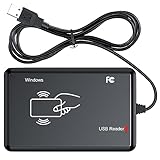
- RFID Reader Scanner read both 125KHz/13.56Mhz 1326 family ISO Prox whole family cards & EM ID EM4100 cards together, MF S50 S70 bank card and other 14443A protocol labels that support ISO14443-A/B protocol, ID card and other 14443B protocol labelsHID USB device no driver request.
- 125KHz/13.56Mhz Dual-frequency RFID reader supports EM4100 ID cards and also 1326 1346 1386 ISO Prox card, H10301 H10304 format etc.
- RFID Reader with 40 output formats for EM4100 ID card UID, max. 40 bits card number in 10H or 13 digital decimal format, configurable with config card by user.
- Proximity card reader sends 125KHz/13.56Mhz Dual-frequency proximity card 1326 family card number in 40 type formats or in raw wiegand bit data format, from 24 bit to 80 bits data, easy for understanding 1326 family card type.
- USB Inteface,Card reader only, Open the software or document that needs to be read,simulate keyboard input, works in Linux Andriod Windows Mac IOS.
With RFID, the system can read an identifier attached to the item at the exit instead of relying only on a camera to infer what happened to an object. That can make apparel and other “softlines” more suitable for automated checkout. But RFID does not make the whole transaction automatic by itself: the tag must stay with the item, product and price records must be correct, and the store still needs payment, inventory, returns and loss-prevention processes.
How an RFID Just Walk Out visit works
- Enter: The shopper uses the store’s available entry or payment-authentication method. Requirements can vary by deployment.
- Select merchandise: Items carry RFID tags linked to product records. Shoppers can carry or try on items as they shop.
- Pass through the exit lane: RFID readers detect the tagged merchandise and assemble the purchase.
- Pay and leave: The shopper taps an accepted card or mobile wallet, or uses another payment method offered at that location. Where the lane uses gates, they open after the transaction is completed.
- Get a receipt: Amazon’s RFID information says customers can retrieve receipts online, including by scanning a QR code on an item tag or using its receipt portal.
RFID is not GPS and does not, by itself, identify the shopper. It identifies tagged merchandise. The store still needs a way to associate the transaction with a payment method or other authentication. Amazon describes Just Walk Out more broadly as a combination of AI, computer vision, sensor fusion and RFID; the mix depends on the store and its setup. A customer does not necessarily need an Amazon account, though the specific payment and entry options vary by location. See the RFID product explanation and Just Walk Out overview for Amazon’s current description.
Rank #2
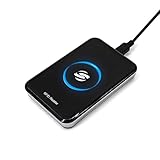
- New Metal Case RFID Reader Durable, Beautiful and More Accurate Reading.Note: 1. Not compatible with Mac, need to use with USB converter. 2. Windows system if you can not use, you need to install a patch in Windows: VCRedist 2008 SP1 (x64). 3. H10301, 8310 card does not support reading, setup tools, please go to the last link to download, thanks!
- RFID Reader Scanner read both 125KHz/13.56Mhz 1326 family ISO Prox whole family cards & EM ID EM4100 cards together, MF S50 S70 bank card and other 14443A protocol labels that support ISO14443-A/B protocol, ID card and other 14443B protocol labelsHID USB device no driver request.
- RFID Reader with 40 output formats for EM4100 ID card UID, max. 40 bits card number in 10H or 13 digital decimal format, configurable with config card by user.
- Proximity card reader sends 125KHz/13.56Mhz Dual-frequency proximity card 1326 family card number in 40 type formats or in raw wiegand bit data format, from 24 bit to 80 bits data, easy for understanding 1326 family card type.
- USB Inteface,Card reader only, Open the software or document that needs to be read,simulate keyboard input, works in Linux Andriod Windows Mac IOS.
From fixed venue stores to portable event lanes
In a 2026 update, Amazon described newer portable RFID lanes for pop-ups and events. The company says these lanes can be deployed in hours and include multiple antennas, updated detection algorithms, in-lane screens showing items and totals, motorized gates and dynamic preauthorization so shoppers can see totals before finishing payment. Amazon also says the gates can close when merchandise has not been paid for.
Do these 3 things before closing this tab:
1Fix the driver behind crashes, sound loss and screen glitches2Clear out junk files and repair common Windows errors3Scan for outdated or missing drivers - takes under a minuteAmazon reported that the portable lanes had been piloted at 17 locations during 2025. It says a lane can handle up to six transactions per minute and operate five to ten times faster than traditional checkout. Those are company-reported capacity and speed claims, not independent measurements of typical performance; actual throughput will depend on traffic, layout, merchandise and exceptions. In its 2026 account, Amazon also reported Just Walk Out at more than 360 third-party locations across five countries. That is a location count, not a count of retailers. Its consumer-facing site separately cites more than 175 third-party retailers, a different measure that should not be treated as directly comparable.
Rank #3

- RFID Reader read both 125KHz 1326 family ISO Prox whole family cards & ID 4100 RF/64 RF/32 cards together, USB device no driver request.
- 125KHz RFID reader supports 4100 ID cards and also 1326 1346 1386 ISO Prox card, 10301 10304 format etc.
- RFID Reader with 40 output formats for ID card UID, max. 40 bits card number in 10H or 13 digital decimal format, configurable with config card by user.
- Proximity card reader sends 125KHz proximity card 1326 family card number in 40 type formats or in raw wiegand bit data format, from 24 bit to 80 bits data, easy for understanding 1326 family card type
- Advanced config process allow user to choice 20 clients format output and set prefix/suffix, ingore leading zero. This is read only. If you want to write card with ID/FC number, you may go ASIN:B0BCYRSLSF
Amazon markets the technology to outside operators, including sports and entertainment, travel, healthcare, higher education, hospitality, business and convenience locations. The likely fit is a venue with short shopping trips, sharp traffic surges, constrained space or long lines—not automatically every clothing store. Amazon’s public product pages do not provide a standard self-serve price; operators are directed to contact Amazon.
What retailers need to solve before adopting it
The checkout lane is only one part of an RFID operation. A retailer considering it should work through at least these questions:
Rank #4

- 【Instant Plug & Play Setup】: No external power supply or battery needed. Simply connect the contactless card reader to your computer’s USB port, and it’s ready to use instantly—no complicated setup, and no additional software or drivers required, saving your time on installation.
- 【Lightning-Fast Performance】:Boost your efficiency with a high-speed response time of less than 0.2s. This 125kHz reader offers a stable reading distance of up to 8cm (depending on the tag type used), ensuring quick and reliable data capture without the frustration of repeated swipes.
- 【Universal OS Compatibility】:Designed for seamless integration across all your devices. This contactless reader fully supports Windows, Mac OS, Linux, Chrome OS, and Android 7.0+. Whether you're using a PC, laptop, or tablet, it provides consistent performance across multiple platforms.
- 【Standardized Data Output】:Specifically engineered for EM4100, EM4200, and TK4100 cards/tags. It automatically outputs the first 10 digits in a standardized format, making it perfect for office attendance, library management, and inventory tracking without manual entry errors.
- 【Standardized & Customizable Output】:Specifically engineered for EM4100, EM4200, and TK4100 cards/tags. By default, it automatically outputs the first 10 digits, making it perfect for office attendance and inventory tracking. Need a different format? Use our exclusive configuration tool to customize data output (such as 8-digit HEX, reversed formats, or adding a suffix like "Enter"), Setting tool is compatible with Windows system Only.
- Tagging and item data: Are all saleable items tagged consistently, with accurate SKU, size, price and inventory data? Can tags withstand try-ons, folding, returns and repackaging?
- Exit and accessibility: Is there room for readers, payment terminals, screens and gates, with a usable route for customers with strollers or mobility needs? Can the design handle groups without mixing up who pays for what?
- POS and pricing: Can the system apply tax, discounts, bundles, loyalty offers and gift cards? What happens if a price changes after an item is tagged?
- Exceptions and loss prevention: How are missing, damaged, detached or shielded tags handled? What happens when a shopper changes their mind at the exit or payment authorization fails?
- Returns and exchanges: Can customers recover an itemized receipt, return an item after removing its tag and exchange merchandise smoothly? Who handles merchandise returned to the wrong rack?
- Economics and staffing: Add up tags, hardware, installation, software, payment processing, integration, maintenance and shrink. Staff may still be needed for replenishment, tagging, customer help, returns and exceptions; “cashierless” does not mean labor-free.
Other awkward cases include a shopper carrying items from another store, two overlapping identical products, an item bought elsewhere passing through the lane, and a customer leaving with a garment they are wearing. A sound deployment needs clear procedures for these situations rather than assuming the reader and gate will resolve every ambiguity.
What’s actually slowing this PC down?
Pick the symptom - the matching free tool is one click away.
Why Amazon’s grocery retreat matters—but does not settle the question
Amazon removed Just Walk Out from many U.S. Amazon Fresh grocery stores in 2024, favoring Dash Carts in those locations, while continuing to offer the technology to third parties. The decision is a reminder that checkout-free systems are not automatically the best fit for every basket or store format. Large grocery trips involve many items, discounts and customer needs that can make another checkout approach more practical. The Associated Press reported on the Fresh change.
Best Value

- . IC card USB reader, Send data to cursor location, HID USB no driver is requested
- . usb reader supports iso14443A protocol cards
- .Support 4 byte UID and 7 byte UID 13.56M card
- .Emualte USB keyboard output, so easy interfaced into RFID system without changing the original software or program, selectable 28 formats are suitable for most common system
- .Default setting is 8H 10D format, Send card data in 10 digital datas to focused window as an external input device
That move does not by itself prove that Just Walk Out fails in all settings, just as adding RFID does not prove the model works everywhere. Apparel at a stadium, a small airport shop and a full-basket supermarket have different merchandise, traffic patterns and operating costs. RFID is a use-case expansion: computer vision can track visible interactions, while RFID can identify the item itself at a controlled exit. The commercial case still depends on whether the faster flow and potential sales gains outweigh the system’s cost and operational burden.
Privacy and human review
RFID tags should not be confused with personal tracking devices: they identify merchandise, not a shopper’s location like GPS. Just Walk Out still needs a payment or authentication step to associate a purchase with a person. Amazon says it does not use biometric information unless a customer chooses an authentication method such as Amazon One. That distinction does not eliminate broader questions shoppers may have about cameras, payment data or how a particular store handles information.
The Associated Press reported that Amazon acknowledged limited human review of video snippets when its system could not determine what happened, while Amazon disputed the idea that people watched every shopper live. That reporting concerns the broader Just Walk Out operation and should not be simplified into either “every shopper is monitored live” or “no human review ever occurs.” See AP’s account of the issue.
Who is most likely to benefit?
RFID checkout is most compelling where merchandise can be tagged reliably and customer demand arrives in bursts: stadium team stores, concert merchandise booths, festivals, airports, university shops, hospitals and other compact retail settings. A retailer should compare it with smart carts, scan-and-go apps, express staffed lanes and traditional POS—not just compare the headline transaction rate. Those alternatives can be simpler when traffic is modest, returns and consultation dominate, products are difficult to tag, or the exit cannot be controlled.
For a retailer, the key question is not whether a store can technically remove a cashier lane. It is whether its tagging discipline, inventory and payment integrations, exit design, exception handling and customer demand make the investment worthwhile. Amazon has not published a universal price, so an operator would need a deployment-specific quote and a careful total-cost comparison.
Quick Recap
Product prices and availability are accurate as of the date/time indicated and are subject to change. Any price and availability information displayed on Amazon at the time of purchase will apply.



