Recommended Free Tools
Some links on this page are affiliate links: if you buy through them we may earn a commission, at no extra cost to you.
SpaceX reported delivering more than 80% of the world’s payload mass to orbit in 2025. The crucial qualification: this is a share of mass, not a count of shipments or a claim that SpaceX carried 80% of other companies’ spacecraft. Most of the mass was internal payload, primarily Starlink hardware. That makes SpaceX an extraordinary force in orbital transportation—but also a launch provider competing for capacity with its own satellite business.
What the “80%” figure measures
In a filing with the U.S. Securities and Exchange Commission, SpaceX said it delivered 2,213 metric tons of payload to orbit in 2025, more than 80% of global mass to orbit. The company’s measure includes Starlink satellites, customer payloads and development cargo delivered on successful orbital launches and flight tests; it excludes failed or scrubbed attempts. It is a company-reported figure, not an independently audited global census. SpaceX’s SEC filing sets out its figures and definitions.
“Shipments” is therefore an imprecise way to describe the claim. A rideshare rocket can carry dozens or more individual spacecraft on one launch, while a single large satellite can weigh far more than many small ones combined. Payload mass, number of launches, number of spacecraft, outside-customer launches, revenue and available rocket capacity are different measures. None can be substituted for another without changing the question.
SpaceX’s reported figures
The following figures come from SpaceX’s filing. “Internal” means payload SpaceX launched for itself; “customer” means payload for outside customers. Launch counts refer to Falcon launches as categorized by the company.
#1 Best Overall

- Extremely exquisite Falcon 9 STRONGBACK rocket model (For collection or display, not a toy! Children should not buy it)
- First-stage super heavy-duty booster is made of precise aluminum alloy tubes. Other parts constructed with High-quality imported laser-formed photosensitive resin-it rocket material
- The proportional model:1:233
- Actual height: 32cm (the core diameter is 24mm, the real rocket is 9 meters in diameter) This ratio is the best choice for desktop placement
- Note: This model is not a toy model, it is not recommended to buy for children, please buy with caution to avoid unnecessary trouble for your shopping
| Measure | 2023 | 2024 | 2025 | Q1 2026 |
|---|---|---|---|---|
| Mass delivered to orbit | 1,210 metric tons | 1,699 metric tons | 2,213 metric tons | 556 metric tons |
| Internal payload | 1,005 metric tons | 1,418 metric tons | 1,901 metric tons | Not separately stated in cited passage |
| Customer payload | 205 metric tons | 282 metric tons | 312 metric tons | Not separately stated in cited passage |
| Falcon launches | 96 | 134 | 165 | 40 |
| Internal Falcon launches | 63 | 89 | 122 | 33 |
| Customer Falcon launches | 33 | 45 | 43 | 7 |
In 2025, internal payload was about 86% of SpaceX’s reported total mass: 1,901 of 2,213 metric tons. The 312 metric tons of customer payload are substantial, but far smaller than the company’s own payload mass. Likewise, 43 of 165 Falcon launches were customer launches under SpaceX’s classification. Neither fraction tells us SpaceX’s share of all third-party commercial launches or launch revenue.
An independent University of Cambridge analysis put SpaceX at approximately 75% of everything humanity sent into space in 2025. That estimate and SpaceX’s “more than 80%” are not necessarily contradictory: researchers can count different objects, development cargo, launches or payload mass, and may build different global denominators. The comparison is useful precisely because any headline percentage needs a stated method. Cambridge’s analysis describes its estimate.
Why Starlink changes the market picture
SpaceX occupies two roles: it sells launch services to outside customers, and it owns Starlink, a large satellite constellation that needs frequent replenishment and expansion. That vertical integration creates a major source of demand for its rockets. When SpaceX launches Starlink satellites, those satellites count as payload mass delivered to orbit even though they are not customer shipments.
This explains how SpaceX can dominate global payload throughput without carrying a comparable share of other companies’ spacecraft. It also makes the company both carrier and customer. The SEC filing says SpaceX expects to allocate significant future launch capacity to its AI segment as well, potentially adding another internal source of demand. That is a company expectation, not evidence of completed AI payload launches.
Rank #2

- Name:Falcon 9 + Dragon Material::Alloy+resin
- Size:Approximately 30x2cm (11.8*1 inch) Function: Static desktop display
- For collection or display, Not suitable for children to play with Handmade, there may be minor flaws
- Model is a highly Simulated SpaceX Falcon9 Dragon+F9 Starship Heavy Falcon Falcon 9 Biock 5 rocket model. The main body of the first-stage rocket is precision aluminum alloy tube, and the rest of the rocket materials are made of high-quality imported resin-with excellent laser forming ability and long-lasting preservation
Is SpaceX monopolizing space launches?
That depends on the market being discussed. SpaceX’s reported share of global payload mass is above 80%; its 165 Falcon launches in 2025 also made it a leading force in global launch cadence. But “monopoly” is too broad as a literal description of the entire launch industry. China’s state launch sector, Europe’s Ariane program, Russia, India, Japan, United Launch Alliance, Rocket Lab, Firefly, Blue Origin and other providers remain active. They serve different customers, launch sites, orbits and mission types.
More precisely, SpaceX has a highly concentrated position in payload mass delivered to orbit and an unusually high launch cadence. Its position in customer launch services is narrower than the mass figure suggests, because much of the throughput serves its own constellation. The relevant market also changes if the question is about U.S. national-security launches, dedicated small-satellite launches, heavy government missions, a particular orbit, or commercial revenue.
For a strict comparison, analysts would need to use consistent rules: which orbits count; whether mass means satellite alone or includes dispensers, development cargo and spacecraft; whether crew and cargo vehicles count; how orbital-transfer vehicles are treated; and whether classified, military, Chinese and failed launches are included. SpaceX excludes failed and scrubbed attempts from its reported mass measure, so its figure should not be casually compared with a launch-count total based on different inclusion rules.
Why Falcon 9 reached this scale
Reusability is important, but the advantage is broader than a lower quoted price. Falcon 9 combines flight-proven first-stage boosters, a large hardware fleet, frequent operations, standardized rideshare missions and vertical integration across rockets, satellites, launch operations and ground systems. Starlink supplies regular internal demand; commercial, civil, NASA, international and U.S. government missions add external demand.
Rank #3
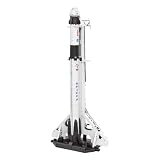
- HOBBY MODEL KIT – Unassembled model packed in an envelope with easy to follow instructions. Ideal for ages 14 and up.
- NO GLUE OR SOLDER NEEDED – Parts can be easily clipped from the metal sheets. Tweezers are the recommended tool for bending and twisting the connection tabs.
- SPACEX FALCON 9 - 3 Sheet Model with a Moderate difficulty level. Assembled Size: 3.00 L x 1.50 W x 7.00 H inches. 84 Pieces.
- FROM STEEL SHEETS TO 3D – Pop out the pieces and connect using tabs and holes. Includes illustrated instructions.
- HIGHLY DETAILED ETCHED MODEL – Display your 3D model once completed - collect and build them all.
SpaceX said 157 of its 165 Falcon 9 launches in 2025 used flight-proven boosters. By March 31, 2026, the company reported approximately 620 Falcon 9 orbital launches and a mission-success rate above 99%. Those are company-reported operating figures. Reuse and experience can support high cadence, but reliability, orbit, mission requirements and customer integration still matter to a buyer.
What dominance means for launch customers
High launch volume can benefit satellite operators. SpaceX’s rideshare program gives smaller spacecraft a route to orbit alongside other payloads, and a frequent manifest can create more opportunities than a low-cadence provider. The company’s Transporter-16 mission, launched March 30, 2026, carried 119 payloads. SpaceX’s mission page lists the flight and payload count.
But a low advertised price per kilogram is not the full cost of a mission. The right comparison includes target orbit, integration, licensing, insurance, spacecraft preparation, deployment requirements and the financial cost of waiting. A shared launch can be economical, but customers may have less control over exact timing, orbit and deployment geometry than on a dedicated mission. SpaceX’s rideshare terms make requests subject to approvals, manifest availability and hardware availability. The program terms explain those conditions.
The Tool Desk
Outbyte Driver Updater FREEScan for outdated or missing drivers - takes under a minuteDriver Scan →Outbyte PC Repair FREERepair Windows errors before they cause bigger problemsFix Now →There is also a capacity question. In the first quarters of 2025 and 2026, total Falcon launches rose from 36 to 40, while customer launches fell from 12 to 7 and internal launches rose from 24 to 33, according to SpaceX. That does not by itself prove customer missions were displaced: schedules, mission mix and demand can change for many reasons. It does show why operators should ask how much capacity is available to outside customers as SpaceX expands its internal programs.
Rank #4

- Extremely exquisite SpaceX Falcon 9 rocket model (For collection or display, not a toy! Children should not buy it)
- First-stage super heavy-duty booster is made of precise aluminum alloy tubes. The rest of the rocket is made of high-quality imported resin.Extremely good laser shapeability& long-lasting shelf life
- The proportional model:1:233
- Actual height: 32cm (the core diameter is 24mm, the real rocket is 9 meters in diameter) This ratio is the best choice for desktop placement
- Note: This model is not a toy model, it is not recommended to buy for children, please buy with caution to avoid unnecessary trouble for your shopping
Dependence on one provider is a resilience risk. A grounding, technical problem, policy change or manifest disruption at a dominant provider could affect many operators at once. Alternative providers may offer redundancy, national or security advantages, dedicated timing or a more suitable orbit, even if they are not the lowest-cost choice for a standard rideshare.
Launch price is not the same as launch cost
More launches do not automatically mean that every customer receives all the savings from improved production and operations. A July 2026 academic paper models the possibility that vertical integration allows SpaceX to retain some gains from learning and scale as “capacity rent.” It estimates that Falcon 9’s underlying real launch cost may have fallen more than advertised prices did in real terms. Those are model-based estimates, not cost figures disclosed by SpaceX and not proof of a particular pricing decision. The paper is available on arXiv.
Buyers should distinguish an advertised launch price from a provider’s internal cost, and compare like with like. Price per kilogram is sensitive to payload mass and orbit; a slot to one orbit is not interchangeable with a slot to another. Integration, insurance, licensing, deployment and schedule certainty can make a seemingly cheaper option more expensive for a specific mission.
Quick wins for a faster PC:
Clear out junk files and repair common Windows errorsFree Scan →Fix the driver behind crashes, sound loss and screen glitchesFind Drivers →Alternatives depend on the mission
There is no universal substitute for Falcon 9. For large or government missions, providers such as ULA’s Vulcan, Blue Origin’s New Glenn, Arianespace’s Ariane 6, and national systems in China, India and Japan offer alternatives, subject to their operational status, available missions and customer requirements. National-security policy, launch geography, licensing and mission assurance can matter as much as raw cost per kilogram.
Best Value

- Name:1:233 Falcon 9+Dragon Launch Station Set Material::Alloy+resin
- Size:Approximately 30x4cm (11.8*1.5inch) Function: Static desktop display
- For collection or display, Not suitable for children to play with Handmade, there may be minor flaws
- Model is a highly Simulated SpaceX Falcon9 Dragon+F9 Starship Heavy Falcon Falcon 9 Biock 5 rocket model. The main body of the first-stage rocket is precision aluminum alloy tube, and the rest of the rocket materials are made of high-quality imported resin-with excellent laser forming ability and long-lasting preservation
For smaller spacecraft, dedicated small launch can offer more control over orbit or timing than rideshare, though usually with different cost and payload trade-offs. Rocket Lab’s Electron payload guide describes a vehicle for satellites up to approximately 300 kilograms, with dedicated and rideshare options. Rocket Lab’s guide provides its published capability information.
Firefly lists Alpha capacity of 1,030 kilograms to a 300-kilometer low Earth orbit and 630 kilograms to a 500-kilometer sun-synchronous orbit. Its 2024 payload guide listed a $15 million dedicated commercial launch price; that is a published guide figure, not a guaranteed current quote. Firefly’s Alpha page and 2024 payload guide give the relevant details.
Another option is to separate getting to space from reaching the final orbit. An operator might use a rideshare launch and then an orbital-transfer vehicle for further maneuvering. Firefly describes its Elytra service as an in-space transfer and maneuverability option. It is relevant only when a mission benefits from post-launch movement; it adds another service and integration decision rather than replacing launch.
What Starship could change—and what it has not changed yet
SpaceX says Starship is intended to increase payload capacity, reusability and launch cadence. Its filing reported 12 Starship flight tests through March 31, 2026, and said the company expected payload delivery to begin in the second half of 2026. That was a forward-looking company expectation, not a completed operational milestone. Falcon 9’s historical throughput is measurable; Starship’s eventual cadence, cost and reliable payload performance should not be treated as established on that basis.
If Starship becomes operational at high cadence, it could increase SpaceX’s absolute payload throughput substantially. Its share of the global total would still depend on whether and how quickly other providers expand. As of August 18, 2026, the available evidence does not establish a complete independently verified global payload-share figure for 2026, so the first-quarter 556 metric tons should not be extrapolated into a full-year market share.
What the 80% claim tells investors and operators
The figure signals concentration in orbital infrastructure, not simply a consumer-facing market share. For satellite operators, the practical questions are whether a mission needs a dedicated launch, how much timing and orbit flexibility it requires, whether a shared manifest works, and what backup exists if the chosen provider cannot fly. For investors and policymakers, the key distinction is between a company’s total throughput—including its own satellites—and the competitive market for carrying third-party payloads.
The most accurate summary is that SpaceX reported delivering more than 80% of global payload mass to orbit in 2025, largely because it launched its own Starlink hardware at unprecedented scale. That is a remarkable concentration of throughput. It is not evidence that SpaceX carried 80% of individual shipments, 80% of third-party launches, or 80% of launch-industry revenue.
Do these 3 things before closing this tab:
1Clear out junk files and repair common Windows errors2Fix the driver behind crashes, sound loss and screen glitches3Repair Windows errors before they cause bigger problemsQuick Recap
Product prices and availability are accurate as of the date/time indicated and are subject to change. Any price and availability information displayed on Amazon at the time of purchase will apply.



