What’s actually slowing this PC down?
Pick the symptom - the matching free tool is one click away.
Economics is the social science that studies how individuals, businesses, and governments make choices under conditions of scarcity. Scarcity refers to the fundamental limitation that resources such as time, labor, capital, and natural inputs are finite, while human wants are effectively unlimited. Because not every desire can be satisfied simultaneously, economics focuses on how trade-offs are made and how resources are allocated across competing uses. These allocation decisions shape production, consumption, income distribution, and long-term economic growth.
At its core, economics analyzes incentives, which are factors that motivate behavior by altering costs and benefits. Prices, wages, taxes, interest rates, and regulations function as incentives that influence decision-making in markets and institutions. When incentives change, behavior tends to change in predictable ways, allowing economists to construct models that explain and forecast economic outcomes. These models are simplified representations of reality used to isolate key relationships, not exact descriptions of the real world.
| # | Preview | Product | Price | |
|---|---|---|---|---|
| 1 |
|
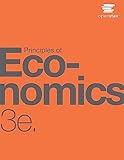
Principles of Economics 3e by OpenStax (Official paperback full-color print version) | $48.00 | Buy on Amazon |
| 2 |

|
Principles of Economics | $177.99 | Buy on Amazon |
| 3 |

|
Principles of Economics | $270.79 | Buy on Amazon |
| 4 |

|
Principles of Agricultural Economics (Routledge Textbooks in Environmental and Agricultural... | $56.48 | Buy on Amazon |
| 5 |

|
Principles of Microeconomics | $158.99 | Buy on Amazon |
The Scope of Economics as a Discipline
Economics spans both individual decision-making and economy-wide outcomes, traditionally divided into microeconomics and macroeconomics. Microeconomics examines how households and firms make choices regarding consumption, production, and pricing within specific markets. It addresses questions such as how prices are determined, why shortages or surpluses occur, and how competition affects efficiency and innovation.
Macroeconomics studies the economy as an integrated system, focusing on aggregate variables such as total output, employment, inflation, and economic growth. Aggregate variables measure the performance of the economy as a whole rather than individual components. Macroeconomic analysis explains business cycles, evaluates monetary and fiscal policy, and assesses how economies respond to shocks such as financial crises, technological change, or geopolitical events.
Free tools Windows power users keep installed
One-click scans. No signup required.
#1 Best Overall
Economics in Everyday Life
Economic reasoning applies to everyday decisions, even when individuals are not consciously applying formal theory. Choosing how to spend income, whether to save or borrow, and how to allocate time between work and leisure all involve opportunity cost, defined as the value of the next best alternative that is forgone. Opportunity cost is central to understanding why every choice has an implicit trade-off, even when no money changes hands.
At a societal level, economic principles influence public policy decisions that affect living standards and economic stability. Governments use economic analysis to design tax systems, allocate public spending, regulate markets, and manage inflation and unemployment. These decisions directly affect purchasing power, job availability, access to services, and long-term economic resilience.
Why Economics Matters for Markets and Policy
Economics provides a structured framework for interpreting data and evaluating competing policy options. Key economic indicators, such as gross domestic product, inflation rates, and unemployment figures, are statistical measures used to assess economic conditions and trends. Understanding what these indicators measure, and their limitations, allows individuals to interpret economic news with greater precision rather than relying on headlines or speculation.
By linking individual behavior, market outcomes, and institutional rules, economics explains how decentralized decisions produce broader economic patterns. This analytical perspective is essential for understanding how economic systems function, why outcomes differ across countries, and how policy choices can improve or worsen economic performance.
Recommended Free Tools
The Fundamental Economic Problem: Scarcity, Choice, and Opportunity Cost
At the core of all economic analysis lies a simple but unavoidable condition: scarcity. Scarcity refers to the fact that resources are limited, while human wants and needs are effectively unlimited. Because labor, capital, land, time, and natural resources cannot satisfy every possible use simultaneously, individuals and societies must make choices about how these resources are allocated.
This constraint is not limited to low-income economies or periods of crisis. Scarcity exists in all economic systems, regardless of wealth or technological advancement, because every allocation decision excludes alternative uses. Economics, as a discipline, begins by examining how these constraints shape behavior, incentives, and outcomes.
Scarcity and the Necessity of Choice
Scarcity makes choice unavoidable. When resources have competing uses, selecting one option inherently means rejecting others. This applies equally to consumers deciding how to spend income, firms determining production methods, and governments allocating public budgets.
Economic models formalize this process by analyzing trade-offs. A trade-off represents the relationship between alternatives that must be sacrificed to obtain a desired outcome. Understanding trade-offs allows economists to evaluate efficiency, defined as the use of resources in a way that maximizes total value or output given existing constraints.
Opportunity Cost as a Central Economic Concept
Opportunity cost provides a precise way to measure the true cost of a decision. It is defined as the value of the next best alternative that is forgone when a choice is made. Unlike explicit costs, such as prices or expenditures, opportunity cost includes benefits that are not realized because resources are committed elsewhere.
For example, allocating time to education carries an opportunity cost equal to the income or experience that could have been earned during that period. This concept applies to all levels of analysis, from individual decision-making to national policy choices, and explains why even seemingly “free” options involve real economic costs.
Opportunity Cost and Economic Decision-Making
Rational economic decision-making involves comparing marginal benefits and marginal costs. Marginal refers to the additional benefit or cost associated with a small increase in activity. A decision is economically justified when the marginal benefit equals or exceeds the marginal cost, including opportunity cost.
This framework underpins much of microeconomic and macroeconomic analysis. Firms use it to determine output levels, governments apply it when evaluating public projects, and policymakers rely on it to assess trade-offs between competing objectives such as economic growth, inflation control, and income redistribution.
Quick wins for a faster PC:
Repair Windows errors before they cause bigger problemsFix Now →Scan for outdated or missing drivers - takes under a minuteDriver Scan →Scarcity, Opportunity Cost, and Production Possibilities
Economists often illustrate scarcity and opportunity cost using a production possibilities frontier (PPF). The PPF is a graphical representation showing the maximum combinations of two goods or services that can be produced with available resources and technology. Points along the frontier represent efficient production, while points inside it indicate underutilized resources.
Moving along the PPF demonstrates opportunity cost directly. Producing more of one good requires sacrificing some quantity of another, highlighting the trade-offs inherent in resource allocation. This analytical tool is essential for understanding economic growth, technological progress, and the limits faced by any economy.
Main Branches of Economics Explained: Microeconomics, Macroeconomics, and Beyond
The analytical tools of scarcity, opportunity cost, and production possibilities provide the foundation for understanding how economics is organized as a discipline. To study complex economic behavior systematically, economists divide analysis into distinct but interconnected branches. Each branch focuses on a different level of decision-making while relying on shared principles and methods.
Microeconomics: Individual Choices and Market Outcomes
Microeconomics examines the behavior of individual economic agents, including households, firms, and consumers. An economic agent is any entity that makes decisions about allocating scarce resources. Microeconomic analysis focuses on how these agents respond to incentives, prices, and constraints.
Key topics in microeconomics include supply and demand, consumer choice, production costs, and market structures. Market structure refers to the organizational characteristics of a market, such as competition or monopoly, that influence pricing and output decisions. These models explain how prices emerge, how resources are allocated, and when markets may fail to achieve efficient outcomes.
Microeconomics also provides the basis for evaluating policy interventions such as taxes, subsidies, and price controls. By comparing marginal benefits and marginal costs at the individual level, economists assess how policies alter behavior and whether they improve overall economic welfare.
Rank #2
Macroeconomics: Economy-Wide Performance and Policy
Macroeconomics studies the economy as a whole, focusing on aggregate variables that summarize overall economic activity. Aggregate variables are economy-wide measures, such as total output, total employment, and the general price level. This branch addresses questions about economic growth, inflation, unemployment, and business cycles.
Central to macroeconomic analysis are key economic indicators. Gross Domestic Product (GDP) measures the total value of final goods and services produced within an economy, while inflation tracks changes in the average price level over time. Unemployment rates indicate the share of the labor force actively seeking work but unable to find employment.
Crashes, No Sound, or Screen Glitches?
Random freezes, missing sound and display glitches usually trace back to one bad driver. Find and replace yours safely.Free scan · under a minutePC Slower Than It Used to Be?
A free scan shows the junk files, broken settings and background clutter dragging Windows down - then fixes them in one click.Free scan · Windows 10 & 11Macroeconomics also analyzes the role of government policy. Fiscal policy refers to government decisions on taxation and spending, while monetary policy involves central bank actions that influence interest rates and money supply. These tools are evaluated using models that trace trade-offs, such as those between inflation control and economic growth.
Meso-Level and Institutional Economics
Between individual markets and the entire economy lies meso-level analysis, which focuses on industries, sectors, and institutions. Institutions are the formal and informal rules, laws, and organizations that shape economic behavior, including legal systems, financial markets, and labor unions. This level of analysis explains how structures influence incentives and performance.
Industrial organization, a meso-level field, studies firm behavior within specific industries. It examines competition, innovation, pricing strategies, and market power, which refers to a firm’s ability to influence prices. These insights are essential for understanding regulation, antitrust policy, and sectoral productivity differences.
Public Economics and the Role of Government
Public economics analyzes government activity and its impact on economic efficiency and equity. Efficiency concerns how well resources are allocated, while equity relates to the fairness of income and wealth distribution. This branch evaluates public goods, taxation systems, and social insurance programs.
Public goods are goods that are non-excludable and non-rival, meaning individuals cannot be prevented from using them and one person’s use does not reduce availability for others. National defense and public infrastructure are standard examples. Because markets undersupply such goods, public economics explains when and how government intervention may be justified.
International and Development Economics
International economics studies economic interactions between countries, including trade, capital flows, and exchange rates. Exchange rates are the prices at which one currency is exchanged for another and play a central role in global competitiveness. This field explains the gains from trade as well as the distributional consequences across industries and workers.
Development economics focuses on the long-term growth and structural transformation of low- and middle-income countries. Structural transformation refers to shifts in economic activity from agriculture to industry and services. This branch examines poverty, education, health, and institutional quality as drivers of sustainable development.
Behavioral, Environmental, and Empirical Economics
Behavioral economics integrates insights from psychology to study how real-world decision-making deviates from strictly rational models. It analyzes systematic biases, such as loss aversion, where losses are perceived as more significant than equivalent gains. These insights refine predictions about consumer behavior and policy effectiveness.
The Tool Desk
Outbyte Driver Updater FREEFix the driver behind crashes, sound loss and screen glitchesFind Drivers →Outbyte PC Repair FREERepair Windows errors before they cause bigger problemsFix Now →Environmental economics applies economic tools to environmental challenges, including pollution and climate change. It evaluates externalities, which are costs or benefits imposed on third parties not reflected in market prices. By assigning economic value to environmental impacts, this field informs regulation and resource management.
Econometrics underpins all branches of economics by providing statistical methods to test theories using data. It allows economists to distinguish correlation from causation and to measure the effects of policies and market changes. Empirical evidence generated through econometrics connects theoretical models to observable economic outcomes.
How Economic Decisions Are Made: Incentives, Trade-Offs, and Economic Models
Building on empirical evidence and theoretical frameworks, economics explains decision-making by examining how individuals, firms, and governments respond to incentives under constraints. An incentive is any factor that motivates a change in behavior, including prices, taxes, regulations, or social norms. Because resources are limited, every decision involves choosing one option over others.
Incentives and Human Behavior
Incentives shape behavior by altering the costs and benefits associated with different actions. Higher wages encourage labor supply, while higher prices tend to reduce consumer demand. Policies such as subsidies and taxes intentionally modify incentives to influence economic outcomes.
Economic analysis assumes that agents respond systematically to incentives, even when behavior departs from perfect rationality. Behavioral economics refines this view by accounting for psychological factors, but the central role of incentives remains intact. Understanding incentive structures is essential for predicting policy effectiveness and market responses.
Trade-Offs and Opportunity Cost
A trade-off arises when choosing one option requires giving up another. The value of the best alternative forgone is known as opportunity cost. This concept applies equally to personal choices, business investment decisions, and public spending priorities.
For example, government funds allocated to infrastructure cannot simultaneously be used for healthcare or education. Opportunity cost provides a consistent framework for comparing alternatives across different uses of scarce resources. Economic reasoning evaluates decisions based on these foregone alternatives rather than only on direct monetary costs.
Marginal Analysis and Decision-Making at the Margin
Many economic decisions are made through marginal analysis, which compares additional benefits to additional costs. Marginal benefit refers to the extra gain from a small increase in activity, while marginal cost is the extra expense incurred. Rational decision-making continues an activity up to the point where marginal benefit equals marginal cost.
Do these 3 things before closing this tab:
1Repair Windows errors before they cause bigger problems2Scan for outdated or missing drivers - takes under a minute3Clear out junk files and repair common Windows errorsRank #3
This framework explains behavior such as how much to produce, consume, or invest. Firms determine output levels by comparing the marginal revenue from selling one more unit to the marginal cost of producing it. Policymakers also rely on marginal analysis when assessing whether incremental regulation or spending yields net benefits.
Constraints, Institutions, and Choice
Economic decisions are made within constraints, including income limits, technology, laws, and institutional structures. Institutions are the formal and informal rules that govern economic interactions, such as property rights, contracts, and legal systems. These constraints shape the feasible set of choices available to decision-makers.
Well-designed institutions reduce uncertainty and transaction costs, which are the costs of making economic exchanges, including information and enforcement costs. By influencing incentives and constraints, institutions play a central role in determining economic performance across countries and over time.
Economic Models as Analytical Tools
Economic models are simplified representations of reality used to analyze complex economic relationships. They rely on assumptions to isolate key variables and clarify cause-and-effect mechanisms. While no model captures all aspects of the real world, each provides insight into specific economic questions.
Models may take the form of diagrams, equations, or simulations, depending on the problem being studied. Their usefulness lies in logical consistency and empirical relevance rather than descriptive completeness. Empirical testing through data determines whether a model’s predictions align with observed outcomes.
Positive and Normative Economic Analysis
Economic decision-making is analyzed using both positive and normative approaches. Positive economics describes and explains what is, focusing on testable statements about economic behavior and outcomes. Normative economics evaluates what ought to be, incorporating value judgments about efficiency, equity, or social welfare.
Distinguishing between these approaches clarifies debates over policy choices. Economic models and data inform positive analysis, while normative conclusions depend on societal goals and ethical considerations. This separation allows economics to remain analytically rigorous while addressing real-world policy questions.
Major Economic Systems Compared: Market, Command, Mixed, and Traditional Economies
Building on the role of institutions and models, economic systems describe how societies organize production, distribution, and consumption. Each system reflects a distinct set of rules governing who makes economic decisions, how resources are allocated, and how incentives are structured. These systems shape observable outcomes such as efficiency, equity, innovation, and economic stability.
The Tool Desk
Outbyte Driver Updater FREEFix the driver behind crashes, sound loss and screen glitchesFind Drivers →Outbyte PC Repair FREEClear out junk files and repair common Windows errorsFree Scan →Economic systems are analytical categories rather than perfectly bounded realities. Most real-world economies combine elements from multiple systems, but distinguishing their core features clarifies how institutional arrangements influence economic behavior and performance.
Market Economies
A market economy allocates resources primarily through decentralized decisions made by households and firms. Prices, determined by supply and demand, signal relative scarcity and guide production and consumption choices. Private property rights allow individuals and firms to own and control resources and capital.
In this system, competition incentivizes efficiency and innovation, as producers seek profits and consumers pursue value. Government involvement is limited but not absent, typically focusing on enforcing contracts, protecting property rights, and correcting market failures. Market failures occur when unregulated markets lead to inefficient outcomes, such as pollution or monopolistic pricing.
Command Economies
A command economy centralizes economic decision-making within the state. Government authorities determine what goods are produced, how they are produced, and how output is distributed. Prices may be administratively set rather than emerging from market interactions.
Do these 3 things before closing this tab:
1Repair Windows errors before they cause bigger problems2Fix the driver behind crashes, sound loss and screen glitches3Clear out junk files and repair common Windows errorsThis system aims to achieve specific social or political objectives, such as income equality or rapid industrialization. However, centralized planning often faces information problems, as planners lack detailed knowledge of consumer preferences and local conditions. These constraints can lead to inefficiencies, shortages, or misallocation of resources.
Mixed Economies
A mixed economy combines market-based allocation with active government intervention. Most contemporary economies fall into this category, blending private enterprise with public provision of goods and services. Governments regulate markets, redistribute income through taxation and transfers, and supply public goods such as infrastructure and national defense.
The mixed system seeks to balance efficiency with equity and stability. Market mechanisms drive innovation and responsiveness, while government policies address market failures and social objectives. The effectiveness of a mixed economy depends on institutional quality, policy design, and administrative capacity.
Traditional Economies
A traditional economy is organized around customs, norms, and long-established practices. Economic roles and production methods are often shaped by cultural or familial traditions rather than formal markets or centralized planning. Resource allocation tends to be stable but resistant to change.
Such systems are most commonly found in subsistence-based or rural societies. While traditional economies can provide social cohesion and predictability, they may limit productivity growth and adaptability to technological change. Their persistence highlights the role of informal institutions in shaping economic behavior.
Comparative Institutional Implications
Comparing economic systems underscores how institutional arrangements influence incentives and constraints. Market systems emphasize individual choice and price signals, while command systems prioritize coordination through authority. Mixed systems reflect trade-offs between decentralized efficiency and collective goals, and traditional systems demonstrate the enduring influence of culture on economic organization.
These distinctions provide a framework for analyzing real-world economies using models and data. By identifying which system features dominate, economists can better interpret economic indicators, policy outcomes, and long-term development patterns across countries.
Key Economic Indicators and What They Measure: Growth, Inflation, Employment, and Stability
Having established how different economic systems organize production and allocation, analysis turns to measurement. Economic indicators translate complex economic activity into standardized metrics that allow comparison over time and across countries. These indicators help economists, governments, and market participants assess performance, diagnose problems, and evaluate policy effectiveness.
Quick wins for a faster PC:
Fix the driver behind crashes, sound loss and screen glitchesFind Drivers →Repair Windows errors before they cause bigger problemsFix Now →Scan for outdated or missing drivers - takes under a minuteDriver Scan →Economic indicators are statistical measures derived from national accounts, surveys, and financial data. Each indicator captures a specific dimension of economic activity, but none is sufficient on its own. Interpreting them requires understanding both what they measure and their limitations.
Economic Growth: Measuring Output and Expansion
Economic growth refers to the increase in an economy’s total production of goods and services over time. It is most commonly measured by Gross Domestic Product (GDP), which represents the market value of all final goods and services produced within a country during a specific period. GDP growth rates indicate whether an economy is expanding or contracting.
GDP can be measured in nominal terms, using current prices, or in real terms, adjusted for inflation. Real GDP provides a clearer picture of changes in actual output by removing the effects of price changes. Economists also examine GDP per capita, which divides total output by population to approximate average living standards.
While GDP is a central indicator, it does not capture income distribution, environmental costs, or unpaid work. As a result, growth figures must be interpreted alongside social and structural indicators. This limitation is particularly relevant when comparing economies with different institutional and demographic characteristics.
Recommended Free Tools
Inflation: Tracking Changes in the Price Level
Inflation measures the rate at which the general level of prices for goods and services rises over time. It reflects changes in purchasing power, meaning how much consumption a given amount of money can buy. Moderate inflation is common in growing economies, while very high or negative inflation can signal instability.
The most widely used inflation measure is the Consumer Price Index (CPI), which tracks price changes in a representative basket of household goods and services. Another key measure is the Producer Price Index (PPI), which focuses on prices received by producers and can signal future consumer price trends.
Inflation affects households, firms, and governments differently. Rising prices can erode real incomes if wages do not keep pace, while unexpected inflation can distort investment and borrowing decisions. For this reason, price stability is a central objective of monetary policy in most mixed and market-based economies.
Employment: Assessing Labor Market Conditions
Employment indicators evaluate how effectively an economy uses its labor resources. The most prominent measure is the unemployment rate, defined as the percentage of the labor force that is actively seeking work but unable to find employment. The labor force includes individuals who are either employed or actively looking for work.
Unemployment data are often broken into categories such as cyclical, structural, and frictional unemployment. Cyclical unemployment is linked to economic downturns, structural unemployment arises from mismatches between skills and jobs, and frictional unemployment reflects normal job transitions. These distinctions help economists identify underlying labor market dynamics.
Additional indicators include labor force participation rates and employment-to-population ratios. These measures capture changes in work participation that unemployment rates alone may miss, such as discouraged workers exiting the labor market. Together, they provide a more complete view of labor market health.
Economic Stability: Evaluating Resilience and Balance
Economic stability refers to an economy’s ability to maintain steady growth, low inflation, and sustainable financial conditions over time. It is not measured by a single statistic but inferred from a combination of indicators. Volatility in output, prices, or financial markets can signal underlying vulnerabilities.
Key stability-related indicators include public debt levels, fiscal deficits, and external balances such as the current account. High debt relative to national income may constrain future policy options, while persistent external imbalances can expose economies to financial shocks. These measures are particularly important in open economies integrated into global markets.
What’s actually slowing this PC down?
Pick the symptom - the matching free tool is one click away.
Financial stability indicators, such as credit growth and asset price movements, also play a critical role. Rapid expansion of borrowing or sharp increases in asset prices may indicate systemic risk. Monitoring these trends allows policymakers to identify emerging imbalances before they disrupt broader economic activity.
Independent reader supportYour contribution helps us test, update, and keep practical guides available for everyone.How Governments and Central Banks Use Economics: Fiscal Policy, Monetary Policy, and Regulation
The indicators of growth, employment, inflation, and stability described earlier are not merely descriptive tools. They form the empirical foundation for economic policy, guiding how governments and central banks intervene in the economy. Economic theory and data together shape decisions intended to stabilize fluctuations, correct market failures, and promote long-term economic performance.
Fiscal Policy: Government Spending and Taxation
Fiscal policy refers to the use of government spending and taxation to influence overall economic activity. When economic growth slows or unemployment rises, governments may increase spending or reduce taxes to stimulate demand. During periods of high inflation or fiscal strain, the opposite approach may be used to cool economic activity or stabilize public finances.
Fiscal policy decisions are closely linked to indicators such as GDP growth, unemployment rates, and public debt levels. Budget deficits occur when government spending exceeds tax revenue, while surpluses arise when revenue exceeds spending. Economists analyze the size, timing, and composition of fiscal measures to assess their short-term impact and long-term sustainability.
Free tools Windows power users keep installed
One-click scans. No signup required.
Best Value
The effectiveness of fiscal policy depends on institutional capacity, political constraints, and economic conditions. In economies with high public debt, expansionary fiscal policy may be limited by borrowing costs or investor confidence. These trade-offs make fiscal policy a central area of applied economic analysis.
Monetary Policy: Managing Money and Credit
Monetary policy is conducted by central banks and focuses on controlling monetary conditions to achieve price stability and sustainable economic growth. The primary tool is the policy interest rate, which influences borrowing costs for households and businesses. Lower interest rates encourage spending and investment, while higher rates restrain inflationary pressures.
Central banks rely heavily on inflation data, employment indicators, and financial market conditions when setting policy. Inflation targeting, a framework where central banks aim for a specific inflation rate, is common in many economies. This approach uses economic models to balance the risks of inflation against the risks of economic slowdown.
In addition to interest rates, central banks may use balance sheet policies, such as purchasing government securities, to influence longer-term financial conditions. These tools are typically employed when conventional policy reaches its limits. Their use reflects evolving economic research on financial markets and monetary transmission mechanisms.
Regulation: Shaping Market Structure and Behavior
Economic regulation addresses areas where markets may fail to allocate resources efficiently or equitably. Market failure occurs when private incentives do not align with social outcomes, such as in cases of monopolies, externalities, or information asymmetry. Regulation aims to correct these issues through rules, standards, and oversight.
Financial regulation is a prominent example, designed to maintain financial stability and protect consumers. Capital requirements, lending standards, and supervision of financial institutions are informed by economic analysis of risk and systemic spillovers. These measures seek to reduce the likelihood that financial distress spreads across the economy.
Regulation also extends to labor markets, environmental policy, and competition policy. Minimum wage laws, emissions standards, and antitrust enforcement reflect economic assessments of efficiency, fairness, and long-term costs. Economic indicators help evaluate whether regulatory interventions are achieving their intended outcomes.
Policy Coordination and Economic Constraints
Fiscal policy, monetary policy, and regulation do not operate in isolation. Their interaction shapes overall economic outcomes, and lack of coordination can reduce effectiveness. For example, expansionary fiscal policy may be offset by tight monetary policy if inflation risks rise.
Economic constraints limit policy choices even when problems are well understood. High inflation restricts monetary easing, while large deficits constrain fiscal expansion. Economics provides the analytical framework to evaluate these constraints, but it does not eliminate trade-offs or uncertainty.
By grounding policy decisions in data, models, and historical evidence, economics functions as both a diagnostic and decision-making discipline. Governments and central banks use it to interpret economic signals, anticipate consequences, and manage complex systems under conditions of risk and imperfect information.
Connecting Theory to Reality: How Economics Shapes Markets, Businesses, and Personal Decisions
Economic theory becomes meaningful only when applied to real-world behavior. The concepts of incentives, trade-offs, and constraints explain how individuals, firms, and governments respond to changing conditions. By linking abstract models to observable outcomes, economics provides a structured way to interpret complex economic activity.
How Economic Forces Shape Markets
Markets reflect the interaction of supply and demand, which describe how producers and consumers respond to prices. Supply represents the quantity producers are willing to sell at different prices, while demand reflects the quantity consumers are willing to buy. Changes in costs, preferences, technology, or policy shift these relationships and alter market prices and quantities.
Windows Errors? Fix Them Before They Spread
Repair common Windows errors and clear accumulated junk for a smoother, more stable PC - no reinstall needed.Free scan · no reinstallOutdated Drivers Are Slowing You Down
One free scan finds every outdated or missing driver and matches the right update for your exact hardware.Free scan · exact hardware matchEconomic indicators translate these shifts into measurable signals. Inflation measures the rate at which overall prices rise, while unemployment captures unused labor resources. Movements in these indicators help explain why markets expand, contract, or reallocate resources across sectors.
Economic Decision-Making Within Businesses
Firms apply economic reasoning to decisions about production, pricing, and investment. Marginal analysis, the comparison of additional costs and additional benefits, guides choices such as whether to expand output or adopt new technology. These decisions are shaped by market structure, meaning the level of competition ranging from many sellers to a single dominant firm.
Expectations also play a central role. Businesses form forecasts about future demand, interest rates, and regulations based on available data. When expectations change, investment and hiring decisions adjust, transmitting economic signals across the broader economy.
Households and Personal Economic Choices
Individuals face economic decisions related to work, consumption, saving, and education. Opportunity cost, defined as the value of the next best alternative forgone, explains why choosing one option always involves giving up another. Income levels, prices, and access to credit shape these trade-offs.
Macroeconomic conditions influence personal outcomes even when individual behavior remains unchanged. Higher inflation reduces purchasing power, while interest rate changes affect borrowing and saving incentives. Economics clarifies how personal financial circumstances are connected to aggregate economic forces.
Feedback Loops Between Data, Models, and Outcomes
Economic systems are dynamic, meaning outcomes today influence decisions tomorrow. Data from indicators such as gross domestic product, employment, and productivity feed back into economic models. These models are simplified representations of reality used to test relationships and evaluate policy scenarios.
When outcomes diverge from predictions, models are revised and assumptions reassessed. This iterative process highlights that economics is not a fixed set of answers but a disciplined method for learning from evidence. Its strength lies in organizing information, identifying patterns, and clarifying the consequences of alternative choices.
By connecting theory to observed behavior, economics links individual decisions to market outcomes and policy constraints. It explains not only what happens in economies, but why it happens and under what conditions outcomes change. This integration of theory, data, and real-world application defines economics as a practical and analytical discipline essential to understanding modern economic life.
Recommended Free Tools
Quick Recap
Product prices and availability are accurate as of the date/time indicated and are subject to change. Any price and availability information displayed on Amazon at the time of purchase will apply.




