Some links on this page are affiliate links: if you buy through them we may earn a commission, at no extra cost to you.
SoftBank has completed its $6.5 billion all-cash acquisition of Ampere Computing. The agreement was announced on March 19, 2025, and the transaction closed on November 25, 2025. Ampere is now a wholly owned SoftBank subsidiary, giving SoftBank a direct operating business in server-CPU design alongside its controlling stake in Arm Holdings.
The deal strengthens SoftBank’s position in the fast-growing Arm-based data-center market, but it does not guarantee that Ampere will overtake Intel, AMD, or custom chips designed by major cloud providers. Its success will depend on product execution, software compatibility, cloud availability, pricing, and SoftBank’s ability to manage the potential tension between Arm’s licensing business and Ampere’s competing CPU products.



What SoftBank bought
SoftBank acquired all equity interests in Ampere Computing Holdings LLC for $6.5 billion in cash. SoftBank completed the purchase through its subsidiary Silver Bands 6 (US) Corp. The transaction was supported by the required regulatory approvals and made Ampere a wholly owned SoftBank subsidiary.
Ampere continues to operate under its existing name, with its headquarters in Santa Clara, California. Major sellers included Carlyle and Oracle. SoftBank already held approximately 8.08% of Ampere’s voting equity before agreeing to purchase the remaining interests.
#1 Best Overall
SoftBank’s fiscal 2025 financial report disclosed a bridge-loan commitment of up to $6.5 billion from financial institutions. That disclosure should not automatically be interpreted as proof that the entire final purchase price was funded with debt; it describes the reported bridge financing available for the transaction.
See SoftBank’s acquisition announcement, detailed transaction filing, and completion announcement for the transaction terms.
Deal timeline
- March 19, 2025: SoftBank and Ampere signed the acquisition agreement, in U.S. time.
- March 20, 2025: The companies publicly announced the proposed transaction.
- April 10, 2025: SoftBank entered into a bridge-loan commitment of up to $6.5 billion, according to its fiscal 2025 report.
- November 25, 2025: The acquisition closed, in U.S. time.
- November 26, 2025: SoftBank announced that Ampere had become wholly owned.
As of August 18, 2026, this is a completed acquisition—not a pending proposal to buy Ampere.
What Ampere makes
Ampere designs server processors based on the Arm computing platform. Its public product families include AmpereOne and AmpereOne M, which are intended for cloud computing, general-purpose data-center workloads, and AI infrastructure.
It helps to separate four terms that are often blurred in coverage:
- Arm architecture: The instruction-set foundation used by compatible processors.
- Arm CPU intellectual property: Processor designs and related technology that Arm licenses to customers.
- Ampere processors: Finished CPU designs created by Ampere for server and cloud workloads.
- Cloud instances: The virtual machines customers rent from cloud providers. Most customers consume Ampere CPUs through these services rather than buying a retail chip.
That distinction matters because SoftBank bought Ampere, not Arm. Arm Holdings remains a separate publicly traded semiconductor intellectual-property company. SoftBank is Arm’s controlling shareholder, while Ampere is now an operating chip-design company within the SoftBank group.
Rank #2
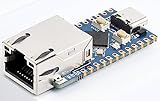
- 【RP2040-ETH Module】 Based On RP2040, Onboard Ethernet Port,Dual-core Arm Cortex M0+ processor, flexible clock running up to 133 MHz 264KB of SRAM, and 4MB of onboard Flash memory.
- Onboard CH9120 with integrated TCP/IP protocol stack. 14 × multi-function GPIO pins, compatible with some Pico HATs.
- Castellated module allows soldering direct to carrier boards. Drag-and-drop programming using mass storage over USB. 8 × Programmable I/O (PIO) state machines for custom peripheral support. Controllable via network.
- Support multiple communication modes: Supports TCP Server / TCP Client / UDP Server / UDP
- Support C/C++, MicroPython, Arduino: Comprehensive SDK, Dev Resources, Tutorials To Help You Easily Get Started
Ampere has announced cloud deployments involving its AmpereOne and AmpereOne M families. Oracle Cloud Infrastructure has announced A4 Standard instances powered by AmpereOne M. Ampere’s newsroom and press releases provide the company’s latest deployment and product announcements.
Why Ampere was strategically valuable to SoftBank
SoftBank already had exposure to Arm’s architecture and licensing ecosystem. Ampere gives it something different: an established team and product platform for designing complete server CPUs.
A direct position in server silicon
Owning Ampere gives SoftBank a direct position closer to the operating layer of computing infrastructure. Rather than relying only on Arm’s licensable designs, SoftBank now owns a company responsible for developing and commercializing server processors.
Exposure to cloud and AI infrastructure
AI systems are often associated with GPUs and other accelerators, but those systems still require host CPUs. Host processors handle orchestration, operating-system tasks, storage, networking, data movement, and general-purpose workloads surrounding AI models.
Ampere is primarily a CPU designer, not a replacement for every AI accelerator. Its relevance to AI infrastructure is that efficient host processors can be part of large AI and cloud systems.
Quick wins for a faster PC:
Scan for outdated or missing drivers - takes under a minuteDriver Scan →Clear out junk files and repair common Windows errorsFree Scan →Fix the driver behind crashes, sound loss and screen glitchesFind Drivers →Energy-efficient data centers
Ampere has positioned its processors around performance per watt and energy-efficient cloud computing. Lower power consumption can matter to data-center operators because electricity, cooling, and physical capacity are significant operating costs.
However, efficiency is workload-dependent. A claim that one processor is more efficient than another is meaningful only when the workload, software, comparison hardware, test conditions, and measurement method are specified.
A U.S. semiconductor asset
Ampere’s Santa Clara headquarters gives SoftBank an established U.S. semiconductor-design presence. SoftBank has described the acquisition as part of its broader AI-infrastructure strategy and connected it with initiatives involving AI ventures such as Cristal intelligence and Stargate. Those are SoftBank’s stated strategic objectives, not guaranteed outcomes of the acquisition.
How the deal changes Arm-server competition
The competition in Arm-based servers now involves more than independent chip companies. Major cloud providers are designing processors for their own infrastructure:
Do these 3 things before closing this tab:
1Scan for outdated or missing drivers - takes under a minute2Repair Windows errors before they cause bigger problems3Fix the driver behind crashes, sound loss and screen glitches| Platform | Business model | Strategic strength |
|---|---|---|
| AmpereOne | Merchant server-CPU platform | An independent Arm-based CPU option for cloud and server customers |
| AWS Graviton | Captive cloud silicon | Tight integration with AWS infrastructure and services |
| Google Axion | Captive cloud silicon | Integration with Google’s data centers and workloads |
| Microsoft Cobalt | Captive Azure silicon | Deployment and software control within Azure |
| Intel Xeon | Merchant x86 CPU | Broad compatibility and a mature server ecosystem |
| AMD EPYC | Merchant x86 CPU | High performance and broad server adoption |
| NVIDIA Arm CPUs | AI-system-oriented CPU | Close coupling with GPUs, networking, and AI infrastructure |
Arm’s fiscal 2026 materials describe Arm-based infrastructure across AWS, Google Cloud, Microsoft Azure, Oracle, and Alibaba Cloud. Arm also reported that AWS custom silicon—including Graviton, Trainium, and Nitro—was generating more than $20 billion annually at the time of its fiscal 2026 results announcement. That figure is an Arm-reported figure, not an independent market-size estimate.
The market effect is therefore two-sided. SoftBank gains a stronger Arm-based silicon asset, while Ampere joins a group that controls the architecture company whose technology is used throughout the ecosystem. But Arm-based processors are not interchangeable. Graviton, Axion, Cobalt, AmpereOne, and NVIDIA’s Arm CPUs can differ substantially in core design, memory bandwidth, interconnects, accelerators, software, pricing, and deployment options.
Arm’s cloud-computing overview and its fiscal 2026 results explain the company’s view of this expanding infrastructure market.
The governance question: does SoftBank now compete with Arm customers?
SoftBank’s ownership of both Arm and Ampere creates a legitimate governance question. Arm licenses technology to many companies—including hyperscalers and chip designers—that may compete with Ampere. Those companies could reasonably want Arm to remain a neutral platform provider.
Free tools Windows power users keep installed
One-click scans. No signup required.
The relevant corporate relationships are:
- SoftBank Group: The parent company and controlling shareholder of Arm.
- Arm Holdings: The publicly traded semiconductor IP and architecture company.
- Ampere: The SoftBank-owned server-CPU designer.
- Arm licensees: Independent companies that use Arm technology in their own products.
Arm’s fiscal 2026 Form 20-F discusses risks related to SoftBank’s controlling interest, potential conflicts with other Arm shareholders, competition, and the development of more integrated compute products.
The defensible conclusion is that the acquisition creates potential channel conflict and governance tension. It does not establish that SoftBank or Arm has violated licensing rules, favored Ampere improperly, or denied other customers access to Arm technology. Those would require specific evidence or a regulatory finding.
Why did Oracle sell its Ampere stake?
SoftBank said Ampere’s lead investors, including Oracle and Carlyle, were selling their respective positions as part of the acquisition. Oracle later reported a gain from selling its Ampere investment after the deal closed in its fiscal 2026 Form 10-K.
Selling an equity stake does not necessarily mean Oracle stopped using Ampere technology. Oracle can remain a commercial customer or operator of Ampere-based infrastructure even after no longer owning part of the company. The transaction changed Ampere’s ownership; it does not, by itself, prove that every commercial relationship changed.
What the acquisition could mean for cloud customers
Cloud customers may eventually see:
- More investment in Ampere’s CPU roadmap.
- Additional cloud providers offering Ampere-based instances.
- More choice for workloads that prioritize energy efficiency, price-performance, or scale-out economics.
- Greater competition among Arm-based cloud instances.
- Potential uncertainty about whether Ampere will remain a broadly neutral merchant supplier now that it is owned by SoftBank.
Customers should evaluate the actual cloud instance rather than relying on the processor brand alone. Important questions include:
- Is the instance available in the region and cloud environment the customer needs?
- How does the workload perform compared with x86 alternatives and other Arm instances?
- Are the required Linux distributions, containers, Kubernetes tools, databases, and libraries supported?
- What are the total costs, including migration, testing, licensing, support, and operational changes?
- Does the application benefit from Arm’s performance and power characteristics, or does it depend on software optimized for x86?
Arm-based does not automatically mean faster, cheaper, or more efficient for every application. The practical advantage depends on the workload and the quality of the surrounding software and cloud service.
What would make the deal successful?
The $6.5 billion acquisition will be strategically stronger if SoftBank can demonstrate progress in five areas:
- Roadmap execution: Successive AmpereOne generations with improvements in performance, power efficiency, memory bandwidth, and AI-host capabilities.
- Customer expansion: More cloud providers, server manufacturers, and system builders using Ampere processors beyond deployments closely associated with Oracle.
- Software compatibility: Reliable support for Linux, containers, Kubernetes, databases, Java, Python, web services, and AI-inference workloads.
- Economic competitiveness: Convincing price-performance and total-cost-of-ownership results against both x86 processors and competing Arm products.
- Ecosystem neutrality: Clear separation between Arm’s licensing function and Ampere’s product business, so other Arm customers continue to view the platform as dependable and fair.
Investors and industry observers should look for product launches, cloud availability, customer adoption, workload-specific benchmarks, pricing, and SoftBank disclosures about Ampere’s financial performance. Acquisition completion proves that ownership changed; it does not prove that new products, customers, or market-share gains have already appeared.
The Tool Desk
Outbyte PC Repair FREERepair Windows errors before they cause bigger problemsFix Now →Outbyte Driver Updater FREEScan for outdated or missing drivers - takes under a minuteDriver Scan →What this means for investors
For SoftBank, Ampere adds both an opportunity and a risk. The opportunity is greater exposure to the growth of cloud and AI infrastructure and a closer connection to commercial server silicon. The risk is that semiconductor design requires sustained research and development, manufacturing coordination, software investment, and customer support before revenue and market share can justify a large purchase price.
For Arm investors, the transaction may increase SoftBank’s strategic commitment to Arm-based computing. It also makes the relationship between Arm and its licensees more important to monitor. If hyperscalers and other chip companies believe Arm is no longer sufficiently neutral, that could affect licensing relationships and ecosystem confidence. Arm’s own filings identify competition, software availability, customer concentration, and increasingly integrated computing products as material risks.
For cloud customers, the immediate significance is increased choice—not a requirement to move workloads to Ampere or Arm. Migration decisions should be based on measured application performance, availability, software support, and total cost rather than acquisition headlines.
Bottom line
SoftBank completed its $6.5 billion purchase of Ampere on November 25, 2025. The acquisition gives SoftBank direct ownership of a server-CPU designer and adds weight to the Arm-based infrastructure race against x86 processors, hyperscaler-designed chips, and AI-focused silicon platforms.
Recommended Free Tools
It is strategically significant, but not automatically market-changing. Ampere must still execute its roadmap, win cloud and server customers, maintain software compatibility, and prove compelling economics. At the same time, SoftBank will need to manage the governance tension created by owning both Arm—the broadly licensed IP company—and Ampere, a company that sells competing server processors.
Quick Recap
Product prices and availability are accurate as of the date/time indicated and are subject to change. Any price and availability information displayed on Amazon at the time of purchase will apply.



